By Dorothy Dunnett
‘I lost three ships,’ Chancellor said. ‘And eighty- five souls.’ ‘I stopped counting,’ Lymond said, ‘after I had seen the first hundred or so of my soldiers dispatched to their earthly rest through me. You lead, therefore you kill.’
‘Your son will be John Dee’s next pupil. You cannot face marriage again?’ Richard Chancellor drew in a short breath, and let it carefully out, without stirring the candle. He said, ‘I have only met one girl to match Eleanor. And you are married to her.’
Lymond slid his hands off the table. On his shadowless face rested, openly, an astonishment so unexpected, so vivid that Chancellor himself was taken aback and said quickly, almost in anger, ‘I’m sorry. But she is a remarkable girl.’ ‘She is a remarkable girl,’ Lymond repeated. He looked startled still. ‘She must be Christopher’s age.’
I was trying to explain to a non-fiction reading loved one the other day why reading fiction was an enriching and important part of my life. Particularly when you find something so involved and complex and written so brilliantly and beautifully as the Lymond Chronicles. I tried to explain how it was like entering another world which doesn’t really fully go away even when you are not reading the words but going about your day to day business. Even when you are not actively contemplating the book, you go through your day knowing there is an alternate reality waiting for you when you choose to go back to it. You live safely through fear, tragedy, and grief. But also through triumph, wonder, joy, and love. People who don’t read stories don’t know about this, I guess. Not every reading experience does this for me. I’ve enjoyed and even loved other books without having this feeling of it being part of my life. For me, It’s mostly been series or at least connected books where there is world building involved. Like Harry Potter. And a sadly somewhat forgotten writer of historical and swashbuckling adventure and romance named Patricia Veryan.
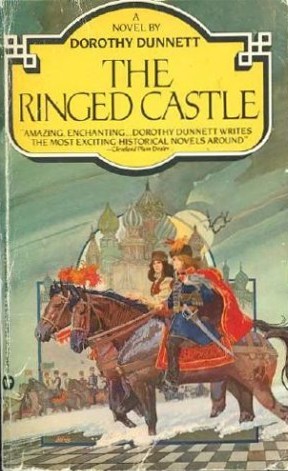
The Ringed Castle, I was thrilled to discover, begins not with Lymond on the way to Russia from The Levant, as the previous book ended, but with Philippa coming home to her mother, Kate.
Not to every young girl is it given to enter the harem of the Sultan of Turkey and return to her homeland a virgin….The most prosaic schoolgirl in England, Philippa Somerville arrived home from Stamboul in the summer….
Kate, nor Lady Culter, cannot reconcile the “The Queen of Sheba”-like stylish young woman with the formerly bedraggled Philippa,
“the undersized fifteen- year- old who had left her uncle’s home in London two winters ago, to plant herself willy nilly in the unsuitable company of Lady Culter’s younger son Francis… Francis Crawford of Lymond, the hard- living leader of mercenaries whose by- blow Kuzúm had been snatched and used in a game by his enemies.”
But it’s her all right. Not being sure what her reception would be, her face is “green with fright.” But after an exchange of quips with her Mom, she slides giggling into Kate’s waiting arms.
From there, Lady Dunnett alternates between Lymond’s adventures accumulating power while navigating the insanities of Russia and the terrifying court of Ivan the Terrible, and Philippa’s continuing maturation in the home of real historical figure Henry Sidney and his family and friends. Lymond is the hated and feared Voevoda Borshoia, The Supreme Commander of the Tsar’s army, and Philippa is a very popular lady-in-waiting in the court of another troubled ruler, Mary I.
As a highly qualified Turkish-trained concubine from the harem of Suleiman the Magnificent, Philippa Somerville settled into English court life as a kite among chickens, and as a kite among kites into the Spanish court of the new King-consort Philip.
She has lots of suitors, except she’s married and her divorce from the Voevoda of all Russia is being held up. As much as I hated sporadically leaving Philippa and the English Court (which includes Mary’s dearest confidant and Lymond’s worst enemy, now that Gabriel is dead, Margaret Lennox. Also an important historical figure), I was always quickly immersed in Lymond’s exploits in Russia. Dorothy Dunnett knows how to keep things interesting no matter what. The husband and wife (in name only) are re-united around a year later when Lymond is forced, through political machinations of his enemies, to leave Russia to accompany the English Muscovy Company back to England to promote trade between the two countries.
Now I, your Tsar, beg it of you. Sail to London, the home of this strange, married Queen, and speak to her in her own tongue, but with the heart of a Russian. Bring me what I want.’ There was no escape. No loophole; no answer, no argument; no excuse. ‘Then of course, Lord, I shall go,’ Lymond said.
With him goes Richard Chancellor another real historical figure much admired by DD. who has become Lymond’s true friend and match in intellect and spirit.
“The Ringed Castle” refers to Moscow and the Kremlin, but it is also a metaphor for Lymond. Since the horrific occurrences in Istanbul he has coped by shutting down all emotion and putting up a virtually impenetrable wall between himself, his comrades and his family. “He can make you want to knock him down, if he feels like it, by simply saying “good morning”. Those who still care for him fear for his humanity: He has become a machine. The alert reader sees that is not entirely true. Further isolating Francis is the knowledge that his parentage is not what he thought it was, and a prophecy that he thinks will doom his brother if he returns home. He wants nothing to do with his formerly beloved and formidable, now heartbroken and fragile, mother. And, as usual, someone is trying to kill him. It is in England, thanks largely to Philippa, that chinks start to appear in his armor. But he is determined to return to Russia where certain death surely awaits.
As always some of the plot elements border on the preposterous, despite the erudition of the writing. And Lymond is surely one of the most maddening heroes in popular fiction. If you don’t like flawed (really flawed), you might want to give this series a pass. But if you gird your loins and proceed, there is always Philippa, who starts to become a major player after the second book. And Archie. And Sybilla. And Richard. And Kate. And Adam. And Danny. Not to mention a growing number of late lamenteds, and not so lamented.
And despite the often grim happenings (don’t get attached to any domesticated animals), there is humor. One of my favorite “running jokes” is Philippa’s and Lymond’s perception of each others ages. Lymond still thinks of her as a schoolgirl, and Philippa believes (and she is not alone) that Lymond is her mother’s age. They are only 10 years apart, and usually only the reader seems to realize it. Also banter, sophisticated wit, and comedy.
On to the last book in the series, Checkmate. I expect to be awestruck, amused, frustrated and saddened, but from what I gather, not disappointed.
 Rebekah's Readings and Watchings