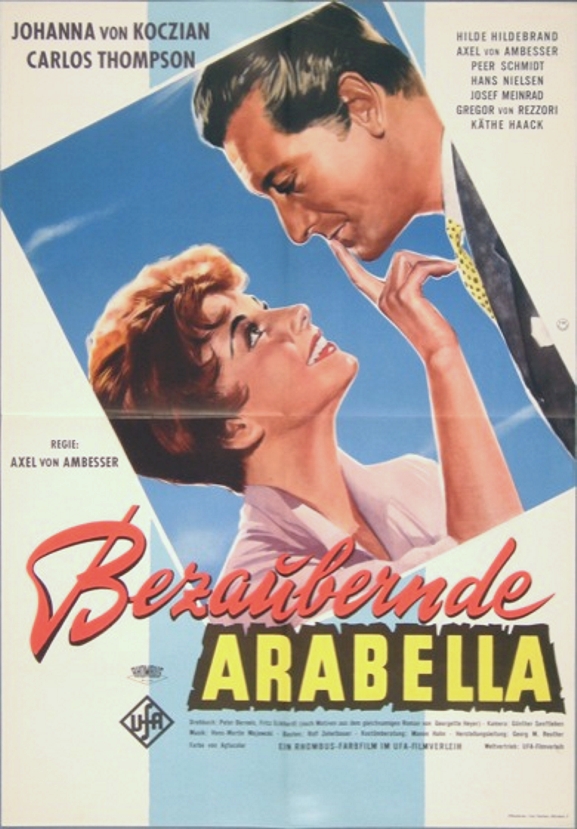
Not Quite Arabella
**Spoilers**
I have been aware for a long time that this German movie existed. It is based on the beloved author Georgette Heyer’s 1949 novel, Arabella. It is, in fact, my favorite book by this creator of the Regency Romance genre, or at least, Arabella is my favorite heroine. But I knew it was not accessible in English. Then I read on one of my Facebook groups that the International Heyer Society had put it up on YouTube with English captions. So, although I knew without doubt that it would not be very comparable to the original work, I had to see it. It turned out that the basic premise of the plot remained intact although it goes off the rails early and often. To wit, A sweet and spirited girl in search of a rich husband for her family’s sake is taken under the wing of her London-based godmother in order to accomplish just that. She is shepherded around London society by a sophisticated man about town who has no intention of falling in love with her, but does. The movie also borrows the names of the characters. Arabella’s godmother is Lady Bridlington. And Beaumaris (pronounced Beaumar-ee’ in the movie,) has a friend named Lord Fleetwood who is a gossip. Like in the book, Arabella is impulsive. Heyer’s Arabella tries to deceive Beaumaris as to her wealth and family back ground out of pride and temper. Movie Arabella encourages his assumption that she wants to marry for money out of love for luxury and greed, instead of necessity.
Thus end the similarities. If I would list the differences between the book and the movie, it would be a very long list indeed. But let me have a go at the main ones.
First, and very importantly, the 1959 movie is set in the early 1900s rather than during the Regency period of the early 1800s.
Movie Arabella’s late father lost all the family’s money in the stock market and no longer well off, her fiance dumps her, spurring her acceptance of Lady Bridlington’s invitation to London.
Lady Bridlington is an impoverished artist and Lord Fleetwood is not only a friend of Beaumaris, but her longtime beau. Unclutch your pearls, Heyerites.
In order to win a bet, Movie Beaumaris has agreed to set Arabella up with prospective husbands and tutors her in how to ingratiate herself with them and hopefully pry out a marriage proposal out of one of them. As we find out, and as Beaumaris well knows, they are very unsuitable prospects: A beer magnate who is a confirmed bachelor, a sociopathic Art Collector, and a totally nuts Big Game Hunter.* Meanwhile he has kept a young and very eligible possible suitor away from her. No prizes for guessing why. Absent are the scenes which show Arabella to be person of great moral character and physical courage as well as beauty and charm. These include her rescue of a chimney sweep from his cruel master and her routing a gang of boys torturing a dirty mongrel. Instead we have adventures with an automobile.
Despite the huge differences between Heyer’s book and this movie, taken on its own terms, the movie was a very serviceable period romantic comedy. There were several amusing scenes and some banter that some would even consider “witty banter.” The actress who played Arabella, Johanna von Koczian, was very pretty and engaging with great comic timing. She was very funny. Hilde Hildebrand’s portrayal of Lady Bridlington, was charming, and handsome Carlos Thompson made a credible Beaumaris. Thompson and the multitalented actress and writer, Lili Palmer, were married for 28 years until her death in 1986. In fact, all three of these actors have very impressive and interesting resumes.
Had this originated in Hollywood or in the U.K. it probably would now be shown regularly on Turner Classic Movies with a fair number of kind reviews.
* Fair Warning– Arabella’s jaw-dropping encounter with Sir Archibald Duncan unfortunately features him trying to seduce her with a bizarre African dance, then assaulting her (unsuccessfully) with his African servant playing jungle drums in the background. It was one of at least two flagrantly racist scenes.







 Rebekah's Readings and Watchings