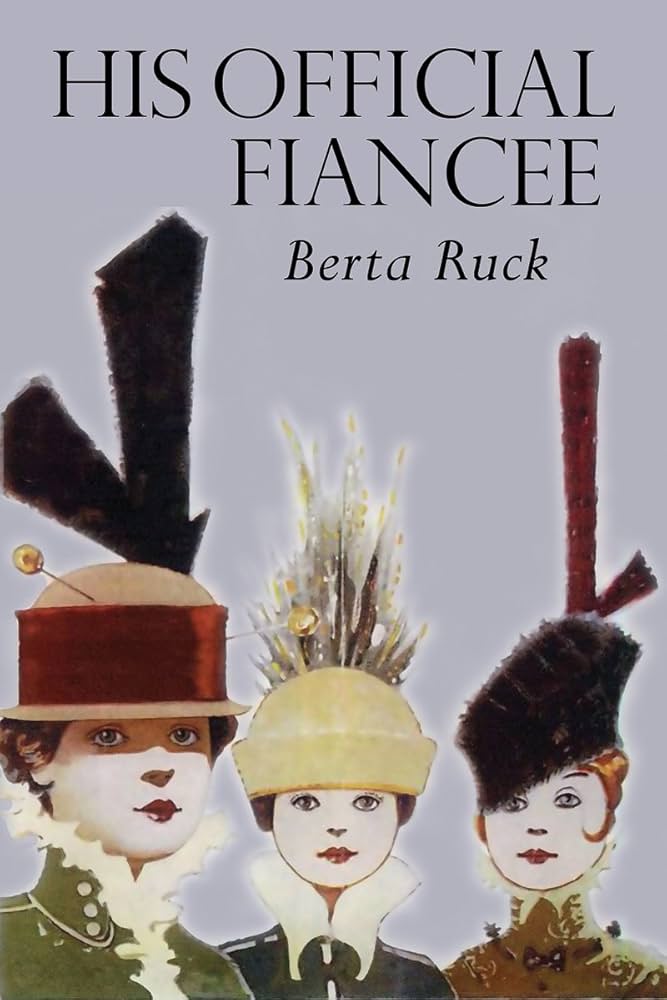
His Official Fiancée

By Berta Ruck

After listening to the dodderings and drivels and despairs of girls who aren’t cold, I’m rather thankful that I am. At least I can be fond enough of people in a sensible sort of way. I could be of Sydney. I suppose it will end in my getting him to marry me….But not yet. I haven’t even got his address!

If a girl were the least bit inclined to fall in love with Billy Waters—and I see now that some girls might be; though not, of course, any girl of my type, capable of this kind of frank friendship that puts anything else out of the question!—well, if she were, she’d find it much easier to complete the process here at Porth Cariad than anywhere else that I can imagine him. Some men—generally the nicest—are so much more themselves in the depths of the country. He is.

It is important to remember that this book was written and set in 1913, shortly before WWI. Otherwise the actions and feelings of our heroine make little sense. More than once, I wanted to box her ears. I didn’t get her passive aggressive resentment of her likable fake fiance. I didn’t understand her fits of umbrage that led her to sulk and goad him with constant microaggressions hidden behind a sweet and humble facade. Especially since she was otherwise such a likable and rather admirable girl. Monica is a formerly wealthy society girl, who due to her late father’s debts and her brother’s profligacy is now forced to work for a living. She calls her change of fortune “The Smash.” She is just one of a typing pool and known as a hard-worker but not all that good at her job, though popular enough. When the boss, William Waters, known by the girls as “Still Waters” due to his reserved and formal “fault-finding automaton” personality calls her in to his office, she (and everyone else) assumes she is going to be fired. Instead, he has quite the proposition to put in front of her. He needs a fiance for a year for an unspecified reason, and he offers Monica 500 pounds to put herself at his disposal and take on the purely business assignment. For a girl slaving away for 25 shillings a week this is quite the temptation. I looked it up and it is as someone scraping by on 125 pounds a week was offered almost 50,000 pounds. Even so, Monica plans to refuse because such a proposition is beneath her dignity and quite improper. But when her irresponsible brother calls her from South Africa and tells her he has gotten into hot water (again) and needs 100 pounds desperately, she agrees to Waters’ proposition.

The book is in first person and I found Monica’s tone to be quite modern: open, confiding, and humorous. She shares her more rebellious thoughts with the reader about her situation while outwardly putting on a demure and proper facade. She does not understand William Waters, and doesn’t particularly like him because he is so different from the rich and idle young men she grew up with. That all starts to change when she is invited to stay with his family in the country so they can get to know her. It turns out that his mother is warm, lovely, and welcoming and far from the steely aristocratic matron she had envisioned He also has two sisters who are bright and lively and who immediately take to Monica (or Nancy, as they know her-William told his mother he was engaged to a girl from his office but since he did not even know Monica’s name, he just said her name was Nancy, when he was asked.)

While there at Sevenoaks, his family home, she starts to realize that there is more to “Still Waters” than she originally thought. Although she won’t admit it to the reader or herself, he compares quite favorably with the man she was almost engaged to in her other life. When her father died and “The Smash” happened, Sydney Vandeleer “coincidentally” went off with his mother to Europe, never sealing the deal with the suddenly poor Monica. At the beginning of the novel, she still has hope that he may still come up to scratch. He does seem to still pine for her, but she soon realizes, as she spends more time with “Billy” and his family that he is nothing but a weak artsy-fartsy dilettante.
She is happy being back in the kind of comfortable household she was raised in, with all of the little luxuries, but it adds to her resentment of William because it is only a temporary respite from the hardscrabble life she will have to go back to once the year is up. Also his family is so nice that she is embarrassed to have to lie and deceive them. Finally, William gets tired of her games and they have a showdown with the result that they agree to be friends and work together. She is invited along on a family vacation to the Welsh seaside where she finally falls in love with “Her Official Fiance,” though she won’t admit it. That is, until she thinks she might lose him to a pretty flirty French girl.

I picked this up because I like vintage novels and this one was described as having a very modern feel, and rather unconventional for the times. I saw that right away and was rather enjoying it, but it was easy to put down. I took about a 2 month break in the middle to read other books and during that time, I happened to re-watch the movie, A Room with a View. That movie, a real favorite, was set during this exact time period with the same class of people, and the same type of environment.It helped me to picture the world and relate to the ways of the characters in this novel a little better. In the context of the movie, I returned to the book having a better understanding of and liking for Monica and I happily finished it in a couple of days. It must have been a very popular book in the day, because in 1919 they actually made a Hollywood movie out of it. It was Berta Ruck’s (Mrs. Oliver Onions) first novel and she was to go on to write 89 more. Born in 1878. she lived for a 100 years. In 1970, she was interviewed by the BBC and you can find the interview on YouTube. https://www.youtube.com/watch?v=pv6V1… I recommend it.

Rating: 2.5 out of 5.

Angels

by Marian Keyes

But the point I’m making is I wasn’t playing it safe when I married Garv, This is the way I really am!”
Plain yoghurt at room temperature?”
“Um…”
Plain yoghurt at room temperature and proud of it?” “…With Raspberry puree at the bottom?”
Yes! I might even get a T-shirt saying it”
Two. One for Garv as well.”

Had I read the Walsh Family Chronicles in order I would have probably looked upon Maggie’s story as a relief after Claire’s marriage drama and Rachel’s hard-fought and very entertaining journey out of denial and into sobriety. I don’t remember too much about how I felt about it on my first read, by which time I was well into Marian Keyes’ oeuvre, which included many of her standalone novels. When I came to my second Walsh novel, at first I didn’t even realize I had read about these characters before. I remember I liked Angels better than most people did. This time on Audible, I liked it pretty well. After reading all of the Walsh sisters’ stories including sequels, I was very familiar with how the rest of her family view Garv and Margaret. I was interested in how Keyes would find much fodder in the boring life of boring Maggie and her even more boring husband Garv. He is accepted only grudgingly in the first go-round with the Walshes. Except Anna, and that’s a whole other story. They love and respect Margaret but she is somewhat of an outsider, being sensible, responsible, and stable compared the rest of the family’s batshit-in-a-blender lives and times. As I got to know Maggie and learned about her life, I realized she was no different from the usual likable, funny, and good-hearted heroines of Women’s Fiction or Romantic Comedies. She was “every woman” and not boring at all.

After she finds out her husband has cheated on her and she is fired from her job, Maggie flees from Ireland to Los Angeles to visit her best friend Emily. As the white sheep of the family who never strays from the straight and narrow, this unexpected turn of events is quite the shocker. As Maggie experiences life in California and meets many of their strange peoples, we also learn a little more about her teen years, her first love, Shay Delaney, whom she has never quite gotten out of her system, her happy marriage to Garv, and what has caused their marriage to fracture and then break. Her life there with her friend Emily, a struggling scriptwriter, is one curveball after another. But nothing of lasting importance happens to her there in Los Angeles, and most of the book is about Maggie meeting and interacting with various Los Angeles stereotypes. It has even less of a plot than Watermelon. She also meets Shay there, but there is no fear that he will be any more important in her future than the rest of the other large cast of characters. By that time, we understand what a wonderful man Garv is, how happy they both were in their marriage, and how much Maggie still loves him. But he doesn’t show up in the book live and in person until the 95% mark. By this point, I was half in love with myself and I was very happy to see him, hear his side of the story, and have him get Maggie away from her well-meaning but overbearing family. Yes, Mammy Walsh, Mr. Walsh, Anna, and Helen show up in L.A. late in the book and bring their own special brand of crazy and hilarious to the unsuspecting Angelenos. Most of the book is an affectionate send-up of Hollywood culture seen through Maggie’s Irish eyes. The only real people of any depth were her old friend Emily and her new friend Laura. Some of the book is quite dated and exaggerated, though there is also a lot of truth in it, I imagine.

I didn’t love it but I liked it, and I also enjoyed Gerry Halligan’s reading even if the accents of the American characters seemed a little exaggerated and “off.” Weirdly, she pronounced Rodeo drive like it was a cowboy contest and “4-1-1” as 4-eleven. Even those little quirks had their charms.

Rating: 3.5 out of 5.

Wild Strawberries

by Angela Thirkell

From their earliest days the Leslie children had thought of their mother as doing or making something, handling brush, pencil, needle with equal enthusiasm, coming in late to lunch with clay in her hair, devastating the drawing-room with her far-flung painting materials, taking cumbersome pieces of embroidery on picnics, disgracing everyone by a determination to paint the village cricket pavilion with scenes from the life of St Francis for which she made the gardeners pose. What Mr Leslie thought no one actually knew, for Mr Leslie had his own ways of life and rarely interfered. Once only had he been known to make a protest. In the fever of an enamelling craze, Lady Emily had a furnace put up in the service-room, thus making it extremely difficult for Gudgeon and the footman to get past, and moreover pressing the footman as her assistant when he should have been laying lunch.”

I enjoyed this as much or more than many of Angela Thirkell’s books. It was fairly short and the world in which I found myself was fairly confined and not bursting with various characters which were hard to keep straight, nor was I roaming from one country house or family circle to another. I was most definitely helped by my trusty copy of Angela Thirkell’s World, which traces all of the characters in her Barsetshire Novels from the early 1930s, through WWII to the late 1950s.

So when Dodo Bingham and her twin daughters show up for Martin’s 17th birthday party,  learning that the carefree David actually married one of those twins in book 15 , Peace Breaks Out, it was a laugh. Wild Strawberries is book #2 in the Barsetshire universe.

We are introduced to the Leslie Family: Lady Emily, her curmudgeonly husband, and their grown children, John, Agnes, and David. Also, their grandson, Martin, whom they are raising since his father was killed in WWI. His mother is not in the picture. Apparently not in a bad way, necessarily, because according to ATW, the future children of Martin’s Uncle David stay with her in America. Visiting for the summer is Mary. A meek and mild second cousin (reminded me of Jane Austen’s Fanny Price), she is young, pretty, and very nice. The book centers around her crush on David, the Leslies’ entitled and irresponsible younger son. Her heart is destined to be broken but for David’s very responsible and very good older brother John. As the book opens, he is  a sad widower,  but when he falls for the shy and reticent Mary as she plays and sings at the piano when she thinks no one is paying attention,  the path to the happy ending becomes clear. All is straightened out, as well as some other unrelated developments,  on the night of Martin “Thanks Awfully” Leslie’s 17th birthday party.

But that bare bones of a plot, if you can call it that, is really just foundation to sketch, reveal, and affectionately skewer the personalities of the family and their friends. I grew fond of all of the Leslies but my favorite characters were Lady Emily (who reminded me of an older Laura Morland), Agnes, and Martin. I didn’t care for or approve of David much, but we aren’t meant to. He is the type who, instead of being gainfully employed like his older brother, fancies himself a novelist. Luckily for him he has an independent income “owing to the ill-judged partiality of an aunt.” He doesn’t doubt that his awful novel will be a bestseller, and although it isn’t even finished, is already confidently planning a play and a film script. Lady Emily, the benign and gentle matriarch, floats through her home, Rushwater, swathed in myriad shawls and scarves, frequently calling on her adoring family and protective servants to retrieve them and any other various accoutrements that she realizes she has mislaid. Usually they are within arm’s reach.  When she inevitably trails a scarf through her soup, she rinses it in her wine glass. Her daughter Agnes, married to the always absent Colonel Graham, is lovely and sweet-natured. She dotes on her 3 lively children, and nothing can shake her out of her calm and placid approach to life. When her children cause upset in the house, whether it is which cereal they will or will not eat or falling in the goldfish pond, her response is to laugh “Oh Wicked Ones!” with pride and affection and call for Nannie. In a bit of a side plot, she is totally oblivious to the wild passion she has inspired in the 19-year-old son of the Leslies’ new French neighbors. This is a common Thirkell trope. He’ll get over it.

Wild Strawberries is the type of book where several pages are devoted to a servant’s relationship to the dinner gong. If you’re up for that type of book, you will find yourself transported to another world of which you might certainly disapprove and even look upon with disdain. But while disapproving, you are in the hands of a very talented writer. So you might also find yourself chuckling and being charmed by the frivolity of it all. In 2024 it is a fantasy world, but it’s important to remember that less than 100 years ago it was an authentic slice of life.

Rating: 4 out of 5.

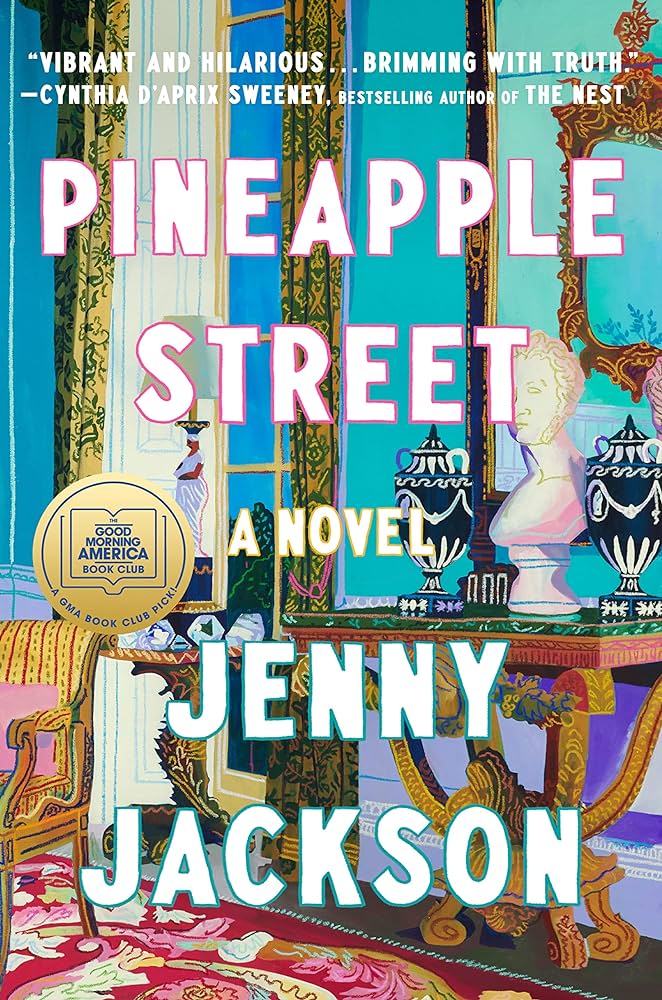
Pineapple Street

by Jenny Jackson

“Oh, no! I left my Cartier bracelet in Lena’s BMW and she’s leaving soon for her grandmother’s house in Southampton!”

Sasha felt wrong-footed 90 percent of the time but also simultaneously felt she was Molly Ringwald in an eighties movie and everyone else was the preppy villain.

This book seems to be in the “love it or hate it” category with many readers. I loved it. It was funny and insightful, and I was invested in our three main character’s admittedly first-world problems and daily lives. This book is about rich people. Specifically, A family that lives in the Fruit Street area in Brooklyn Heights, an exclusive old-money enclave where many celebrities now live. When we are first introduced to the family, we are given the impression that this family is of the worst kind of rich people: Arrogant, snobby, shallow, insular, you name it. They do not make a good impression. They are all of that indeed, but, they also have some good and endearing qualities. That seems to rub some readers the wrong way. Some readers are suspicious that the author is a major force in the publishing world. Some even seem to think that they were drawn in against their will by the gorgeous cover and the evocative title. The other main criticism of this book is that “nothing happens.” Well, I’m used to reading books where nothing much happens. Some of my favorite authors write books in which nothing much happens other than living their daily lives. Well, I guess things do happen because they grow and change, have realizations and insights, go down unexpected paths, and achieve happiness and success. But it’s not because they do things like triumphing over evil, escaping death by inches, solving a mystery, weathering a tragedy, or doing anything that most would consider particularly exciting or adventurous.

The three main characters are Darby, Georgiana, and Sasha. Darby and Georgiana are trust fund babies and the daughters of Chip and Tilda. Despite their pampered existence, both are actually quite likable aside from the way they treat Sasha. Sasha is a middle-class, borderline blue-collar, girl from a raucous loving family who marries Cord, the scion of the Stockton family. Sasha and her attempts to navigate the social and family mores of his insular family are the heart of the book. Although treated politely on the surface, she is kept firmly on the outside of the family circle. But rudeness on their part is unconscious and unintentional, for the most part. And her husband Cord, who also has very likable qualities and is a good guy, doesn’t see it or want to see it.

“I’m not sure what I did wrong, but I just feel like your sisters don’t like me.” “What are you talking about? That’s not true.” Cord patted her back and tried to leave the room. He was a WASP through and through, deeply uncomfortable with conflict.

Oooh not good. But then we have this private moment between Cord and Sasha:

“Did you ever feel that way as a kid?” she asked. “So intense and confused?” “Yeah, totally. I was in love with Little Debbie,” he confessed. “Who’s that?” Sasha asked, running a finger along his bare chest. “A neighbor?” “No, the little girl with a hat on the box of snack cakes.”

How can you not like that guy?

Cord and Sasha love each other, but Cord does not have Sasha’s back while she wrestles with death by a thousand cuts and Sasha prefers a partner that loves her but does not need or depend on her for his happiness. She had that kind of love before and it almost derailed her life.

 She had seen what all-consuming passion looked like, how it felt to ride the currents of intense adoration and fury, and she didn’t want it. She wanted someone stable, someone easy, someone who loved her but not enough to lose himself entirely.

When Darby and Georgiana experience some havoc in their lives, it turns each of their worlds on its axis. Darby’s beloved husband is fired from his important and high-paying job. He is made the scapegoat for a screw-up that was not his fault because he is Korean and without influential family connections. Georgiana falls in love and betrays her personal code by continuing the affair even after she finds out that he is married. Then something tragic happens and she spirals.

Thanks to a nasty confrontation at a family party, Sasha finally reaches the end of her rope and opens a can of you know what on their you know whats. Finally, it comes to a head. All of the secrets and secret feelings come out. But things don’t change until Sasha’s Dad gets sick and she leaves to be with her family. One thing leads to another which leads to a family who finally finds harmony and understanding of themselves and each other. At least the kids do, anyway. Tilda and Chip don’t really change, but they change toward Sasha. And Sasha gets to leave the creepy shrine to the Stocktons and their ancestors on Pineapple Street.

I got a real kick out of this book. The writing was witty with a keen sense of the ridiculous. I liked reading about these strange rich people who live in a whole other universe and seen through the eyes of a normal girl. I also appreciated that even though few would approve of their attitudes or the way they led their lives they were not painted with a wide brush as human beings. The author wanted us to understand them and I found that they were worth understanding. I do wish we had seen more inner workings of why things progressed the way they did. For example, how did Sasha and Cord get over the Pre-Nup crisis? One minute Cord tells her he chooses his family over her, they are on the verge of a break-up, Cord is wrecked, and the next they are happily married. Why do the Stocktons accept Malcolm, Darby’s husband, so easily but not Sasha who is also successful and well-educated? And what made Cord finally see the light and show up in Sasha’s family’s kitchen? After the party disaster at the end, one minute Cord thinks Sasha overreacted and the next he finally has her back.

Interestingly, the author, Jenny Jackson’s, “Acknowledgments” set my teeth on edge a bit. “I wrote half this novel in my apartment on Pineapple Street….” they begin and continue for a paragraph which I found rather smug. Maybe it’s just me. It was strange and ironic given the theme of the book. Or is it possible she was having a laugh? I almost took my rating down but I didn’t because who does that?

Rating: 5 out of 5.

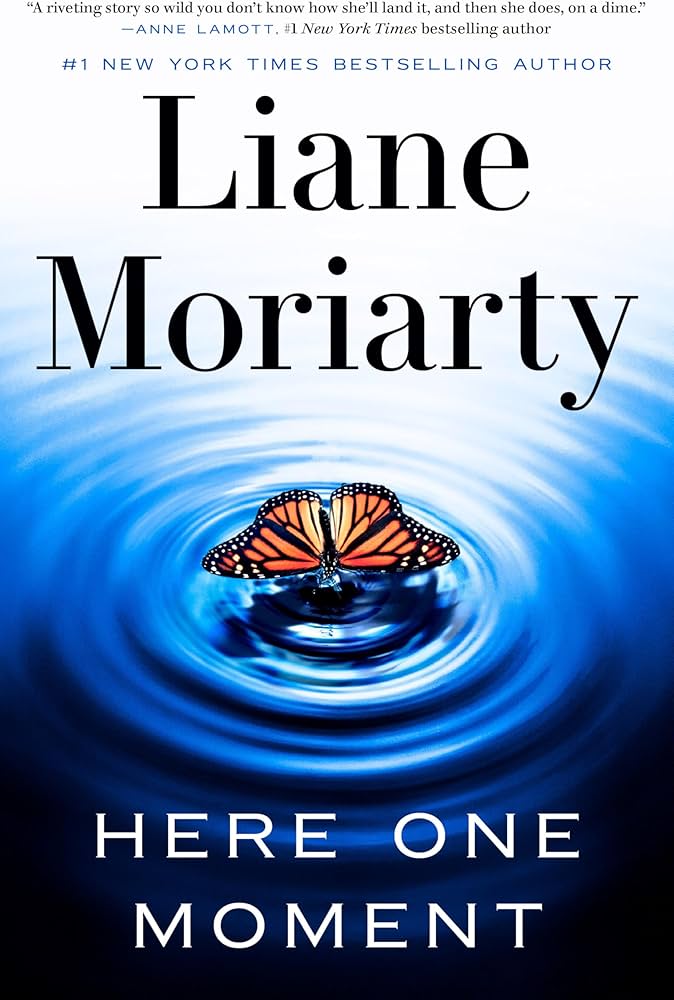
Here One Moment

by Liane Moriarty

It has just occurred to me that I haven’t yet introduced myself. I apologize. One should always introduce oneself quickly!

Investing in life insurance does not increase your risk of dying. Correction: Investing in life insurance may increase your risk of dying if you are married to a murderer. I’m not trying to be funny. Just accurate.

It’s interesting when you suddenly behave out of character. An example: I went tandem skydiving for my sixtieth birthday. It was exhilarating! Obviously, I will never go skydiving again. Not if you paid me. I still have nightmares about it.

I’ve read all of Liane Moriarty’s books. They have all kept me engaged although, of course, I have liked some more than others. But I know when I pick one up, though bad and sad things might happen it will all come together in the end to a satisfying conclusion full of hope. This one kept me on the edge of my seat. Things looked pretty dark for some of the characters this book centers on, but my faith in the author was rewarded in spades.

On a shortish flight from Hobart, Tasmania to Sydney, Australia, an older woman gets up from her seat almost in a trance-like state and goes from passenger to passenger implacably predicting their time and cause of death. This book centers on 6 of them and their families, as well as Cherry, who comes to be known as“The Death Lady”. In Liane Moriarty’s signature fashion, the tension mounts as we jump from one main character to another, learn their stories, and how the prediction clouds and complicates their lives. But we spend the most time getting to know Cherry. At first, I was impatient with that because I was so worried about the other characters, whose deaths, except for one, were predicted to be imminent and shocking. That exception was the prediction for the baby son of a young mother. Her boy will drown at age 7. We see the forces of their doom gathering even as we come to care about them and their loved ones. But it was not long before I was caught up in the life of the brilliant and funny Cherry, who, it turns out, was well worth knowing. Even more than learning the fates of our principal characters, we wonder throughout what in the world possessed her to stand up in that plane and do something so devastating and so out of character.

Are Cherry’s predictions to be taken seriously? As three people on the flight die exactly as predicted, it seems maybe so. But are the apparent fates of those that remain preventable? Will believing the predictions to be true become a self-fulfilling prophecy? What about free will? Or are our futures ruled by determinism? There is lots to think and wonder about in this novel besides the gripping plot and masterful character development. How does Chaos Theory come into it? It’s the cover of the book! Or The Many Worlds Interpretation? We learn about the Monte Carlo Fallacy(or the Gambler’s Fallacy), The Call of the Void (or The Vertigo of Possibility), and The Just World Fallacy. (There’s no such thing as Karma? Shoot!) Why does Cherry look so familiar to one of the passengers? What is the significance of her strange brooch? How odd that we don’t remember the 4th person who dies. And what about Cherry’s famous fortune-teller mother? Will her beautiful predictions for Cherry come true or was she a well-meaning charlatan? What are the notebooks she speaks of?

After coming to it’s moving and satisfying (even triumphant) conclusion, I thought back on all that occurred in the book. I was amazed at how Liane brought it all together like an intricate puzzle successfully solved. She really outdid herself. Many seemingly insignificant details are important clues but I didn’t grasp their meaning and how they all came together until the end. Liane Moriarty leaves none of her signature devices and tactics by the wayside and they certainly worked to keep me enthralled. Here One Moment was brilliantly crafted and hugely enjoyable.

Many thanks to NetGalley and Crown Publishing for a free Uncorrected Digital Galley of this book in return for an unbiased review. This book will be published September 10, 2024.

Rating: 5 out of 5.

Arabella

by Georgette Heyer

What a joy after recent reads to fall back on an old favorite that has one of the most lovable and admirable heroines in all of the great Georgette Heyer’s works. Not to mention one of my favorite heroes. I listened to this on Audible and the narration by Gemma Whelan was excellent. When I am asked what my favorite GH regency is, without thinking twice I usually point to this one. Sometimes another, but most likely this one. I believe it may be the first one I ever read back when I was probably 12 or 13. I am proud of my tween self, too used to the obvious romance and strict formula of contemporary and historical gothics, for pushing through the strange words and mannered sentence structure and so much else, to recognize the sheer brilliance and entertainment value of Georgette Heyer. I became a lifelong devotee and gobbled up the rest of her books like candy.

I won’t go into the plot too much because it’s really not all that important. Heyer’s genius is the world she builds, her wit, her comedy, and her characters. Particularly her secondary characters. The setting is my favorite of the several that Heyer usually employs  It’s not a road trip, at an Inn, or at a country estate. It is set in the glittery world of London at the height of the season where the elite of society engage in all manner of entertainments and activities with an eye to marrying off their daughters to eligible bachelors who, in turn, need heirs to carry on their line.

Our heroine, Arabella, a country vicar’s daughter, is sent to London to be brought out by her society matron Godmother. On her way to the big city, she meets Robert Beaumaris when she is forced to ask for shelter at his hunting box due to a carriage breakdown. Mr. Beaumaris is the richest, most admired, and feted Corinthian in the land and is constantly being pursued by hopeful young females. He assumes that Arabella is one of their ilk and she overhears him explaining this to his guest Lord Fleetwood. Being a girl of spirit, she is mightily offended and is goaded to portray herself as a fabulously wealthy heiress to disabuse him of his false assumption and to teach him a lesson.

She contrived, without precisely making so vulgar a boast, to convey the impression that she was escaping from courtships so persistent as to amount to persecution; and Mr Beaumaris, listening with intense pleasure, said that London was the very place for anyone desirous of escaping attention.

Of course, he sees right through her and it amuses him to make her the belle of the season which he can do by merely not looking bored in her presence.

Because of Mr. Beaumaris’s flattering attentions, Arabella’s season fast becomes a success beyond her wildest dreams. When she and her Godmother become aware that the whole of London believes her to be fabulously wealthy, it certainly explains why gazetted fortune hunters are hanging around a poor vicar’s daughter. Arabella, whose conscience is finely honed thanks to her upbringing, feels terribly guilty and to make matters more awkward, she is falling for the sophisticated Mr. Beaumaris. She can’t bear to tell him what a lying silly fool she was. Not to mention his power, with a glance, to squash all of her popularity and her mother’s hopes of her attracting an eligible suitor. As for Mr. Beaumaris, much to his bemusement, he unexpectedly finds himself wound around her little finger. He has grown to realize that not only is Arabella beautiful and unspoiled, but she is a person of great moral and physical courage. In short, the girl he has been looking for all of his life. Not that he was looking for such a girl of course, but someone of substance who would not bore him. The scenes where Arabella, in his presence, rescues a chimney sweep from his cruel master and routs a gang of boys torturing a dirty mongrel, are two of the most entertaining and heartwarming scenes in all of Heyer. The scenes in which the cool and sophisticated Mr. Beaumaris agrees to provide each of these unattractive unfortunates with safe havens and their subsequent effect on his formerly peaceful household (and him) follow closely behind.

The delights of this book are many. Some of my favorites other than those mentioned above, are:

The scenes with Arabella’s large and loving family at the beginning and Mr. Beaumaris’ description of his visit to her family in the wilds of Yorkshire to ask permission for her hand at the end.

Arabella, her sister, and her mother’s preparations to ensure Arabella is not viewed as a country bumpkin when she is introduced to society. And Arabella’s  astonishment and secret amusement at the irony when Mr. Beaumaris compliments her on setting an example of taste and modesty in her jewelry and attire that her fellow debutantes are trying to copy.

Mr. Beaumaris’s conversations with and asking for the advice of Ulysses, the rescued mutt that immediately becomes slavishly devoted to him. Heyer’s detailed descriptions of Ulysses’s behavior make him one of the most entertaining characters in the book. The author’s lifelong love and knowledge of dogs shines through.

Chase that cur out of here, Joe! …‘Do nothing of the sort, Joe!’ interrupted Mr Beaumaris.
‘Is he yours sir?’ gasped the landlord.
‘Certainly he is mine. A rare specimen: his family tree would surprise you!’

Mr. Beaumaris’ visit to his grandmother, one of the great dames of her time, to prepare her for his impending marriage, if Arabella will have him.

When the book takes a long side trip to deal with the cautionary tale of Arabella’s brother Bertram’s arrival in London, I resented, in the past, the time away from Arabella’s adventures and romance. But this time, thanks to the narration, many of the scenes of Bertram’s descent into danger and probable disgrace were highlights. His desperation in trying to gamble his way out of debt in an exclusive gaming house playing at a table banked by none other than “The Nonpareil” himself. And how Beaumaris navigates the dilemma of how to handle the situation. And Arabella braving the squalor and danger of the most poverty-stricken area of London to rescue him. Leaky Peg! Quattern Sue! (and her gin-drinking baby!)

In thinking about Arabella, I wonder whom of Georgette Heyer’s many wonderful heroines would take on the salvation of dirty climbing boys, abused horses, mangy curs, sick parlor maids, or slatternly prostitutes. That is, should they be so unhappy as to come across them, of course. At the end of the book, I took a minute to envision Arabella’s and Robert’s future life beyond the pages of the book. As well as a devoted society wife and mother, I am convinced she will become a famous philanthropist and a great lady who will tackle the many evils of the day. But in large ways as well as small. In this, she will be ably assisted by her husband who, though not getting his hands dirty, will unfailingly support and defend her against the disapproval of their peers with his great wealth and influence. Perhaps he will even run for office with Arabella’s persistent encouragement?

Rating: 5 out of 5.

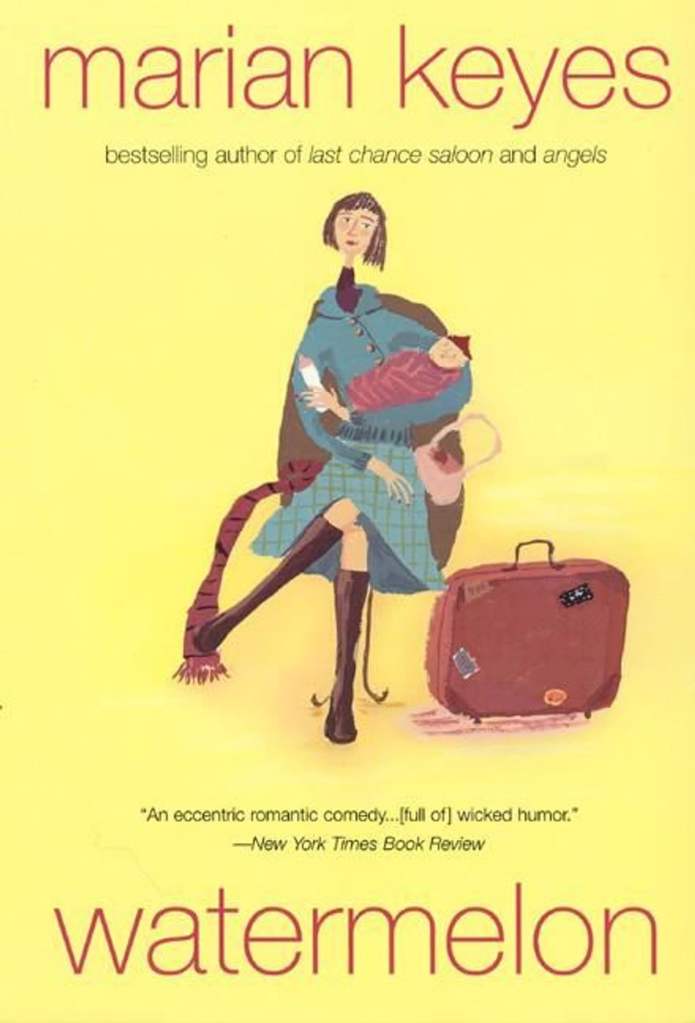
Watermelon

By Marian Keyes

“Temporary Insanity had come a-knocking and I had shouted “Come on in the door is open.” Luckily, Reality had come unexpectedly and found Temporary Insanity roaming the corridors of my mind unchecked, going into rooms, opening cupboards, reading my letters, looking in my underwear drawer, that kind of thing. Reality had run and got Sanity. And after a tussle, they both had managed to throw out Temporary Insanity and slam the door in his face. Temporary Insanity now lay on the gravel in the driveway of my mind, panting and furious, shouting, “She invited me in, you know. She asked me in. She wanted me there.”

I’ve been re-reading Marian Keyes’s books on Audible for the last couple of years. They have been so rich and funny. I had only read Watermelon, Keyes’s introduction to the Walsh family, one time, and it was a long time ago. I remember not being too impressed with it.
I re-read Rachel’s Holiday (again) in 2022 in preparation for its long-anticipated sequel, Again, Rachel. I had previously listened to Helen’s story, The Mystery of Mercy Close, in 2020, and somewhere in there  Mammy Walsh’s A-Z of the Walsh Family, because I felt the need to re-acquaint myself with Helen and the rest of them. In those latter books, Claire is an interesting but not particularly nice woman. In fact, she is rather unlikable. Not so in this one. I was amazed by how different she is in this first book from how I remembered her. Perhaps because I listened to it on Audible rather than read it, I loved Watermelon this time. I thought it was hilarious and engaging throughout. Part of this may have been the narrator’s charming Irish accent and inflections which made Claire, who narrates her story in first person, even more sympathetic and charming than on paper. I was rooting for her all the way. Another reason I was so taken with her was that she addresses the reader directly in a metatextual way which made me feel a personal connection to her.

This is not a plot-driven book. The book begins with Claire, having just given birth, being told by her husband while she is still in the hospital, that he is leaving her for another woman.

Who’s in charge around here? I’d like to complain about my life. I distinctly ordered a happy life with a loving husband to go with my newborn baby and what was this shoddy travesty that I’d been served up instead?

From there, we go with her on her journey from grief and devastation, confusion, and anger to healing and a fresh start with a new and wonderful man. But first, she leaves London and goes home to Dublin to live with her parents and two of her sisters, Helen and Anna, who still live at home. The book mainly consists of Claire’s musings, observations, and memories. As she remembers it and tells it, her marriage with James was blissful, and James, as she remembers him to us, seems like a great guy and her perfect match. Until he finally shows up, that is. We see that he is actually a pompous sanctimonious pig. For me, this added an extra layer of interest because I started to wonder about Claire’s reliability as a narrator if not her sanity. Or does James have a point when he accuses her of being childish, selfish, and a total flake? Claire had expected regret and shame from James but instead, he actually blames her for his having the affair. At first, James has Claire completely gaslighted. She starts to believe him and he has her under his thumb with her apologizing to him and promising to change her ways to save their marriage. Luckily her delusion was very brief and she comes to her senses with a vengeance.

No more humiliation for me, thanks very much. No more swallowing my anger. Honestly, I couldn’t manage another mouthful.

In many of her later books, Marian’s heroines are victimized and bamboozled by bad men throughout the whole book. I was thrilled such was not the case with Claire. She pretty much sees him for what he is, but is very confused and she feels she has to try again for the sake of their baby.

I loved the character of Adam, Claire’s love interest. He is such a great guy that the fact that he loves and admires Claire serves to reassure us that however flawed and crazy she sometimes is, she is a lovable and good person. Their romance is sweet, as is her love for her baby Kate. And of course, the rest of the Walshes are a constant source of entertainment and amazement.

Next to read on my agenda is Angels, which features Margaret, the “good” sister, who was not in this one. After that, hippy-dippy druggie Anna’s story, which I remember as being heartrending, and then a re-read of scary and combative Helen’s story. It will be interesting to meet Claire again in those and see how (or if) she changes or if this book is just another side of her.

Rating: 5 out of 5.

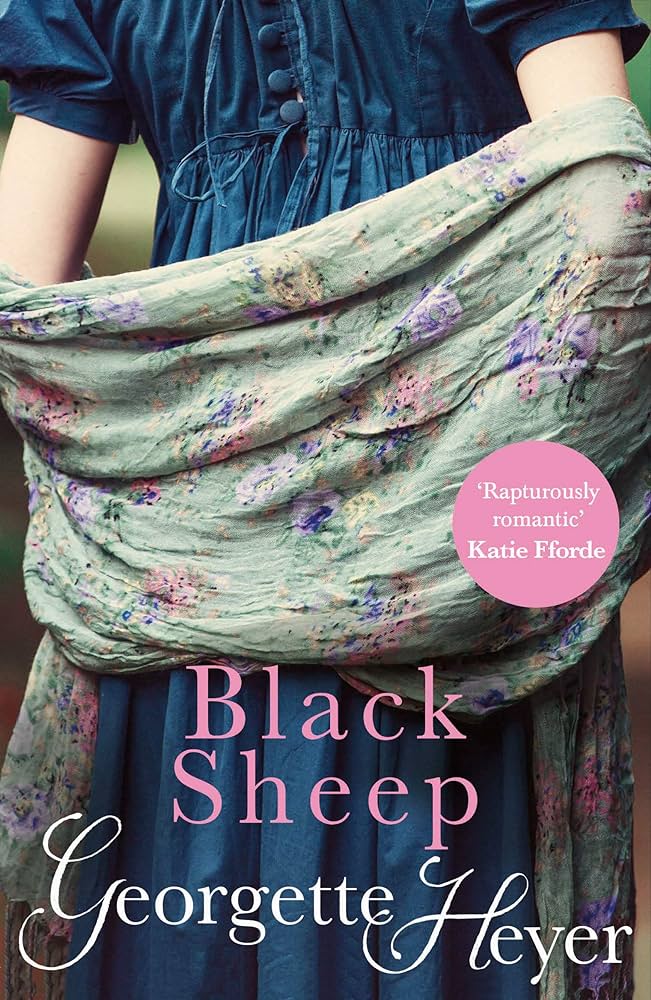
Black Sheep

By Georgette Heyer

“She thought, in touching innocence, that in Miles Calverleigh she had found a friend, and a better one by far than any other, because his mind moved swiftly, because he could make her laugh even when she was out of charity with him, and because of a dozen other attributes which were quite frivolous – hardly attributes at all, in fact – but which added up to a charming total, outweighing the more important faults in his character.”

“I love you, you know,’ he said conversationally. ‘Will you marry me?’ The manner in which he made this abrupt proposal struck her as being so typical of him that a shaky laugh was dragged from her. ‘Of all the graceless ways of making me an offer – ! No, no, you are not serious! you cannot be!’ ‘Of course I’m serious! A pretty hobble I should be in if I weren’t, and you accepted my offer!


I can’t deny Black Sheep by Georgette Heyer 5-star status. It was formerly a 4-star and thus relegated to second-tier status (for a Heyer). This is not a book I re-read over and over like These Old Shades, Frederica, Cotillion, or Arabella to name a few. It was one of her later books (though the book right after Frederica, one of my favorites,) when her powers were not at their height. The one after this was the almost universally disparaged Cousin Kate, and the one after that was the boring and flat Charity Girl, and the one after that was Lady of Quality, which is really just a pale imitation of this one. And we will let the unfortunate My Lord John lay there undisturbed out of respect. But this one is a fan favorite and when it was on sale at Audible with a new reader, Natalie Simpson, I bought it and took the opportunity to reacquaint myself with it and discover what is behind its popularity. And I did.

The reader was “unexceptional” which in Heyer-speak means perfectly fine. I won’t go into the plot except that it revolves around our heroine coming to Bath to prevent a disastrous misalliance between her much loved 17-year-old niece and Stacy Caverleigh, a suave and charming cad and fortune hunter. She tries to enlist the help of his uncle, Miles Caverleigh, who has recently returned from 20 years of exile in India. Unfortunately for Abigail, if Miles had any religion, it would be against his to get involved.

He was not a rebel. Rebels fought against the trammels of convention, and burned to rectify what they saw to be evil in the shibboleths of an elder generation, but Miles Calverleigh was not of their number. No wish to reform the world inspired him, not the smallest desire to convert others to his own way of thinking. He accepted, out of a vast and perhaps idle tolerance, the rules laid down by a civilised society, and, when he transgressed these, accepted also, and with unshaken good-humour, society’s revenge on him. Neither the zeal of a reformer, nor the rancour of one bitterly punished for the sins of his youth, awoke a spark of resentment in his breast. He did not defy convention: when it did not interfere with whatever line of conduct he meant to pursue he conformed to it; and when it did he ignored it, affably conceding to his critics their right to censure him, if they felt so inclined, and caring neither for their praise nor their blame.


Abigail and Miles are perfect for each other from the very beginning. Their attraction to each other was palpable throughout. I particularly loved Miles. He kind of reminded me of Rhett Butler: Somewhat of a “loose screw”, but ultimately a good man who goes his own way and doesn’t care two hoots about the silly conventional rules of society.

But, we come to learn, he respects the feelings and values of people who really matter to him (when they aren’t being swayed by pesky outside influences, that is.) By people who matter, I mostly mean Abigail, of course. As beloved as she is to her older clingy sister Serena, and her young niece, Fanny, to the rest of her conventional conservative family, she is almost as much of a Black Sheep as Miles is to society at large. He turns out to be the missing piece she didn’t know she lacked to break her free from her constricted life and become truly free and happy. Which will only happen after the final delightful scene in the book.

As for Miles, it is through his machinations which we only suspect are going on behind the scenes, and then not until the book is in its final chapters, that things work out to the satisfaction of all of those we like, and the disgruntlement of those we don’t. Young Fanny is saved and is well on her way to a suitable love match with another, Stacy, the villain, is vanquished in 6 different ways to Sunday, society and conventional forces are flouted but will soon be brought to heel, and those that love and depend on Abigail a little too much are gently set aside. As for Abigail and Miles they will embark on a marriage and a life that we imagine will be filled with passion, adventure, and even peace when it suits them. And it is all pretty epic.
Other than Venetia, I think it is one of the most romantic of Heyer’s Novels. Brava to the genius of Georgette Heyer.

Rating: 5 out of 5.

Spin

By Catherine McKenzie

“So, most days you need something to make you feel happy?” I knew it was a trick! “I guess.” “And if you weren’t drinking, would you be unhappy most days?” My eyes wander to the oblong window above Saundra’s head. The sky is gray and cloudy. “I don’t know . . . I really don’t think of myself as unhappy . . .” “Katie, when you’re using alcohol regularly to alter your mood, it’s generally an indication that there’s something that needs to be altered.”

This one started out full of promise and possibilities, and very reminiscent of Rachel’s Holiday, the almost classic Marian Keyes novel. But because I couldn’t help but compare them, it was ultimately disappointing. Rachel’s Holiday was so deep, dark, and hilarious. There were definitely some good things about this one. The premise was a great idea and roped me in right away.

Kate, a talented but struggling writer is in denial about her alcoholism. When she is invited to interview for a position in a respected music review magazine, The Line, she is thrilled. This is her dream job. She is invited by a friend to go out to celebrate this and her upcoming birthday the night before the interview. She puts up a weak resistance knowing she has to be on her game for the interview, but goes out anyway for “just one drink.” She shows up at the interview still drunk from the night before and simultaneously hung over. I’ll draw a veil. But when Amber Shepard a young star and current tabloid fodder enters rehab, they remember Kate. One of The Line’s affiliates is a celebrity gossip rag and they tap her to follow Amber into rehab to get the goods on the young erratic “It Girl.” If she does a good job, The Line will hire her for their magazine.

Written in first person by Kate, it was funny, serious, and well-written. I liked her voice. But the book doesn’t go deep enough. It’s kind of vague about many things. For example, how much does Kate really drink? We know it’s a lot. She randomly tells the doctor she drinks 2 bottles of wine every day which is what she guesses would qualify to get her into Cloudspin Oasis, the rehab facility, but is she lying or telling the truth? Kate is a liar about many things. It would have been effective if we find out that Kate is either lying to the reader, or if the reader is clear about the truth.  We meet a few of the patients but we never get their journeys. They really don’t add anything to the story. Of course, get to know Amber as Kate is successful in befriending her and gaining her trust. Amber is a good character, but Kate is warned not to let her get too close because she is dangerous. That knowledge keeps us suspicious and watchful of Amber, but nothing really plays out.

Amber is famously entangled with Connor Parks, another hot movie actor who plays the Young James Bond in a movie franchise. He follows her to rehab (why?) and it is when he enters the scene, about halfway through, that I started losing interest. It was one inauthenticity too many. First off that would never be allowed.  Things became just so facile and contrived. Connor has a personal assistant who is allowed to enter rehab with him to look after him. What? Wouldn’t happen. He is Kate’s love interest and boring. I just can’t invest in a romance where the guy is an enabler of a bad person and addict just because he is an old-school friend. It conflicts with his character big time. The “why” of their relationship is a mystery and could have been intriguing but ended up to be more unexplored potential.  Kate is able to smuggle in an Apple iTouch to submit copy to the gossip rag and is never caught. Wouldn’t happen. The doctors and therapists are naive and gullible. They seem incapable of holding anyone’s feet to the fire. There is no meaningful therapy that goes on. We never really get to the source of Kate’s addiction. Her friends, both enabling and disapproving, visit her but nothing comes of it. There was some hope when Kate’s eccentric and permissive old hippie parents were introduced. Failing anything interesting happening with her friends, I was hoping for some drama, revelations, and secrets uncovered involving them but it just fizzled as well. It looked like something might come of her relationship with her hostile and jealous sister, but again it came to nothing. We never get to the pain. Once Kate is out of detox which if Kate is anything to go by is no big deal, there are no struggles stemming from being cut off from alcohol and forced sobriety. When she finishes her 30 days and is released there is no real battle to remain sober. She does fall off the wagon once but just climbs back on again and all is well. Easy peasy.

Once out of rehab and sober, Kate does have one problem. How can she betray Amber who she likes and is now her friend? This is what triggers her short relapse. And then Amber finds out. This part of the book, the last 20% or so, where Kate’s dilemma is resolved in a satisfactory way, is pretty good.

I gave the book 3 stars because I kept reading and didn’t end up skipping through to get to the end. It kept my interest, but it just didn’t fulfill the potential that it promised in the beginning. For such a long book, it took too many shortcuts.

Rating: 3 out of 5.

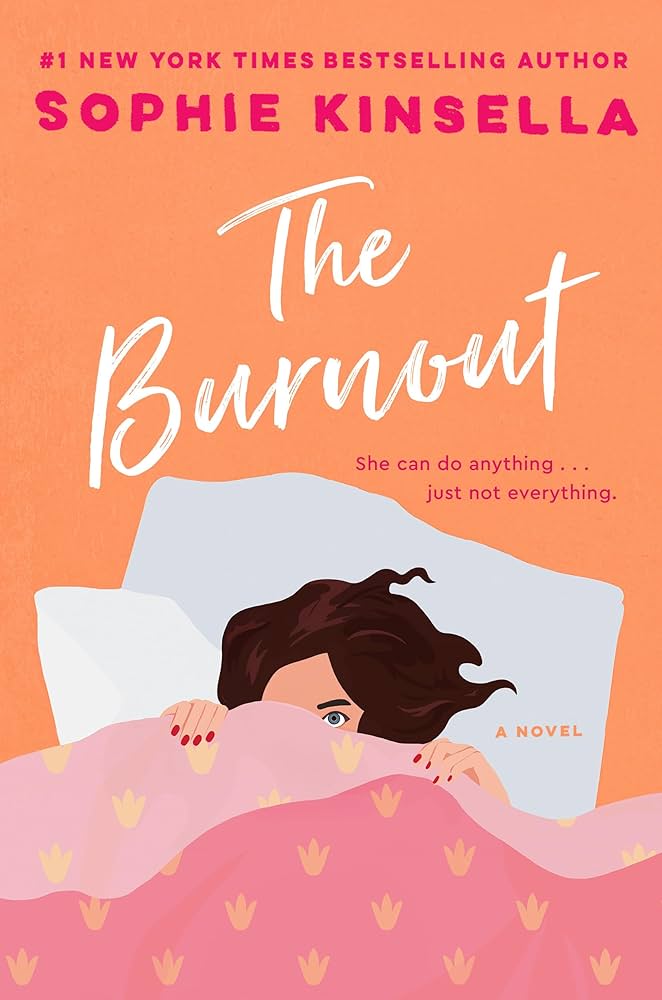
The Burnout

By Sophie Kinsella

“Don’t worry,” I say hastily. “It’s fine.”
“It is not fine.” He shakes his head mournfully. “It is far from fine. These are not the high standards we expect of ourselves at the Rilston. We have let you down and we have let ourselves down….
“Believe me, Ms. Worth, I am mortified by our failure. I will get you that noni juice, if I have to squeeze the noni myself.” “Well…thank you,” I say, feeling embarrassed….
“Other than that, has your stay been comfortable so far? You’re here for a health break, I understand? Ah, here’s Nikolai with your green smoothie,” he adds. “In the absence of organic kale, our chef used frozen Birds Eye peas.” Birds Eye peas?

This was a delightful and entertaining new Sophie Kinsella, just not my favorite. I liked the premise and the romance. As usual, although portraying women, their foibles, and ultimate healing and triumph is her specialty, she always creates a romance with a worthy and intriguing hero. This one was no exception. I loved both Sasha and Finn. And as always, there were plenty of laughs and plenty of heart. Kinsella’s humor is effortless. And our heroine was not the silly flake on the edge of disaster that so many of her women characters are through many of her books.

Oh, she starts off pretty crazy. Sasha works at a prestigious and successful company in the marketing department. Unfortunately, it is very poorly run which is frustrating to her, and poor management has resulted in much work and too little time to do it. To add to her stress, she has to answer to Joanne, her boss’s henchwoman, whose main priority is an “aspirations mood board” and insists that she must use the little time she has to “find her joy”. Or else. When Sasha finally breaks down in a panic attack, it is both funny and alarming. She tries to join the convent next door and knocks herself out by literally running into a brick wall. Put on medical leave by her doctor, she retreats to a haven of her childhood, Rilston Beach, of which she has so many happy memories. Her mother books her a room in the formerly fabulous and elite Rilston Hotel, which was far above her family’s touch when they spent their summer vacations in the town. But it is the off-season. And I mean off in more ways than one. There at the all but deserted hotel, she meets a fellow sufferer from burn-out, Finn Birchall. And as usual in a Kinsella novel initial antipathy and misunderstanding eventually turns to friendship and then love. Along the way, they make friends with the quirky and endearing skeleton staff of the once glamorous resort hotel, some of the townspeople, and most importantly the beloved and legendary surf instructor, Terry, who is now sadly suffering from dementia in his old age. And we get a mystery or two to keep things chugging along.

Unfortunately, the ending was a disappointment. Oh, it was a happy one of course. But it was just too pat and easily won. The reader is prepared for a real struggle that Finn is going through between a painful breakup with his girlfriend of 10 years and his new relationship with Sasha. We are led to believe it was the reason for his freak-out at work. Sasha learns about this through a rather sketchy action on her part. Usually, when our heroine does something she should probably be ashamed of (like spying or lying) she gets caught out, and embarrassed, and it causes a big problem with the hero. But refreshingly, Kinsella does not rely on this cliched cause of drama. I was very relieved. But in the end, we learn that the break up with his ex-girlfriend was not such a big deal after all. His heart is free. The whole problem which separated them for 6 months was just glossed over with no explanation. Even though his 10-year relationship with his ex, Olivia, was all but forgotten (I guess), he kept it a secret from Sasha for some mysterious reason. Actually, we don’t know if he went through any pain at all over it. It seems like it must have been pretty traumatic going by Olivia’s Instagram that Sasha understandably pours over. Was she the lovely woman that she seems? Did their lives take different directions and they just each agreed to move on with no drama? Was it something more hurtful or shocking? Or was it just that her Instagram was not an accurate portrayal of their lives together at all? This was the theme of the last Kinsella novel I read, My Not So Perfect Life.
We are left in the dark, and I don’t like being left in the dark. It didn’t ruin the book, but it was just so confoundedly weird and unnecessary.

Rating: 4 out of 5.