Northanger Abbey

by Jane Austen

The current image has no alternative text. The file name is: northangera.webp

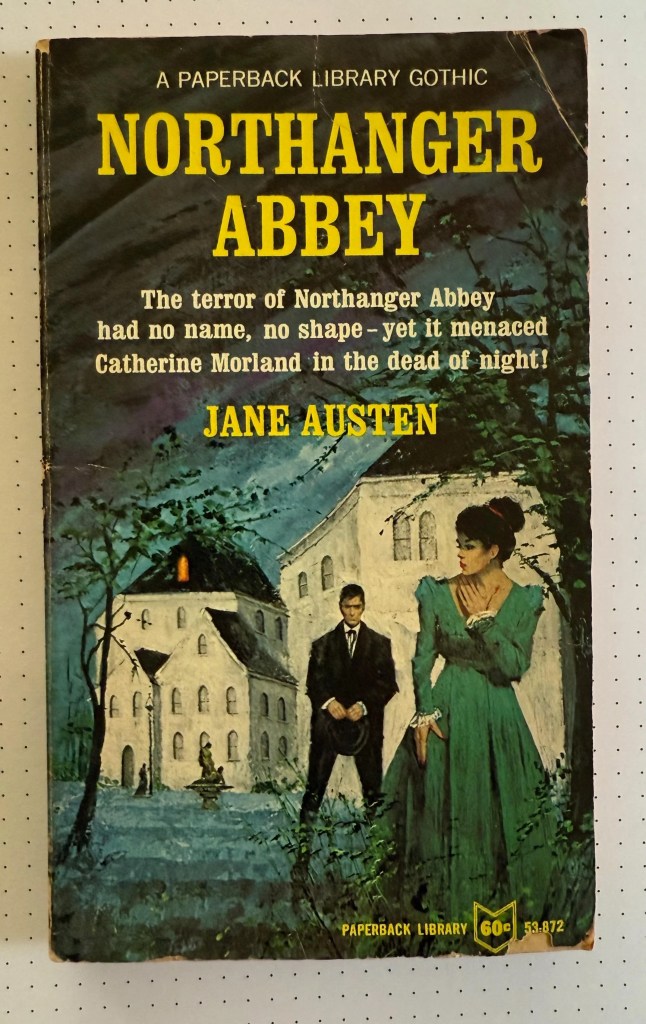
Although I had never read this novel before, I knew the plot backwards and forwards thanks to the two BBC productions I have watched numerous times. Also I listened to an abridged version several years ago. I had started Val McDermid’s modern re-working of Northanger Abbey and it was not going well. It started me to thinking, “why am I reading this, when I still haven’t actually read the real one”? I decided to listen to it again since I have had the unabridged version in my Audible library for years. It was very funny right from the the start. It did go well. Of course I knew all the ins and outs of the plot. But I probably would have enjoyed it more if it were the first go round of any kind. Also, I suspect I would have picked up even more of the humor if I had read it on the page.

The book begins with Jane Austen informing the reader of all reasons why Catherine Morland, our heroine, is not suited to the role. In fact, The Narrator (Austen) pulls no punches in eviscerating Catherine and detailing her lack of heroic qualities. Brains? Nope.

She never could learn or understand anything before she was taught; and sometimes not even then, for she was often inattentive, and occasionally stupid.

Beauty? Nope

…and Catherine, for many years of her life [was] as plain as any. She had a thin awkward figure, a sallow skin without colour, dark lank hair, and strong features…” No mention of “speaking, twinkling, intelligent, or laughing gray eyes, you will notice. But… At fifteen, appearances were mending…she had now the pleasure of sometimes hearing her father and mother remark on her personal improvement. “Catherine grows quite a good-looking girl-she is almost pretty today.”

Talents and accomplishments? Nope.

Her taste for drawing was not superior. though whenever she could obtain…any…odd piece of paper, she did what she could in that way, by drawing houses and trees, hens and chickens, all very much like one another. Writing and accounts she was taught by her father; French by her mother: her proficiency in either was not remarkable, and she shirked her lessons in both whenever she could. What a strange, unaccountable character!—

I laughed aloud at the idea of a house, a tree and a chicken looking very much alike. After being assured that Catherine’s father “is not the least addicted to locking up his daughters” we read that her mother was a woman of useful plain sense, with a good temper, and, what is more remarkable, with a good constitution.”

So having assured us that Catherine does not fit the mold of a Gothic heroine she eventually plops her in the middle of a plot worthy of any respectable gothic romance. In her own mind. For Catherine is a little obsessed with gothic novels. Taken to Bath by well off family friends, Catherine is drawn in and befriended by the manipulative Isabella Thorpe and her crass brother who tries to worm his way into her affections. She also meets the upstanding and witty Henry Tilney and his nice sister Eleanor. Catherine develops a tendre for him and he seems to reciprocate her feelings. Eleanor invites her to their ancestral home, Northanger Abbey, for several weeks, and Catherine is in a state of shivery delight that the Tilney’s ancestral home is an actual Abbey.


Her passion for ancient edifices was next in degree to her passion for Henry Tilney…With all the chances against her of house, hall, place, park, court, and cottage, Northanger turned up an abbey…long damp passages…narrow cells and ruined chapel…the hope of some traditional legends, some awful memorials of an injured and ill-fated nun.”

Although unlike the films, the Abbey does not live up to her imagination, (not an “antique chimney”, dirt, or cobwebs in sight-Neither “awful forebodings of future miseries” nor “sighs of the murdered” either) she finds plenty of fuel for her fantasies. She convinces herself that Henry and Eleanor’s intimidating, strange-acting, and hot-tempered father murdered their mother (or possibly has her imprisoned somewhere in a secret cell.) When she is caught snooping in a place she should not be by Henry, he sets her straight and makes no bones about what he thinks of her deluded fantasies. In the face of his disdainful take-down she comes to her senses with a decided ker-plunk. (But he still likes her.) Ironically, it is after her wake-up call when General Tilney genuinely does her a shocking cruelty and even puts her life in danger by his rude and heartless actions. So maybe not so detached from reality after all.

Although Catherine Morland is not the crispiest chip in the bag, I grew to like her very much. She is kind and good-hearted, and if she is sometimes silly it stems from naivety and innocence rather than brainlessness. I was completely won over by this passage:

[Henry Tilney] looked as handsome and as lively as ever, and was talking with interest to a fashionable and pleasing-looking young woman, who leant on his arm, and whom Catherine immediately guessed to be his sister; thus unthinkingly throwing away a fair opportunity of considering him lost to her forever, by being married already… he had never mentioned a wife, and he had acknowledged a sister. From these circumstances sprang the instant conclusion of his sister’s now being by his side; and therefore, instead of turning of a deathlike paleness and falling in a fit on Mrs. Allen’s bosom, Catherine sat erect, in the perfect use of her senses, and with cheeks only a little redder than usual.

And she shines in comparison to two other women in the story: Isabelle Thorpe and Mrs. Allen. Mrs. Allen makes Catherine seem sensible and resolute and Isabelle highlights Catherine’s virtues by being her opposite. That Catherine has been able to attract the friendship and liking of such a role model as Eleanor Tilney also speaks very well of her. And how can one be too hard on someone who is such a voracious reader of novels? Unfortunately, although witty and tolerant, I found Henry a bit prosy and self satisfied. Not as likable as the Henry Tilney of the films.


“Henry,” said Miss Tilney, “you are very impertinent. Miss Morland,…He is forever finding fault with me, for some incorrectness of language, and now he is taking the same liberty with you. The word “nicest,” as you used it, did not suit him…”Very true, said Henry, “and this is a very nice day, and we are taking a very nice walk and you are two very nice young ladies. Oh! It is a very nice word indeed! It does for everything. Originally perhaps it was applied only to express…”

And blah blah blah.

But that aside, I found myself chuckling at the wry humor, admiring Austen’s characterizations, and the skewering of the gothic novels of her day. Even though I am an old Gothic reader myself, I am not at all tempted to read one of the many of Catherine’s reading list based on the little snatches we are favored with in Northanger Abbey. I now have read all of Jane Austen’s books except Sense and Sensibility and Pride and Prejudice several times. I guess you could say I’m saving it.
Rating: 3 out of 5.

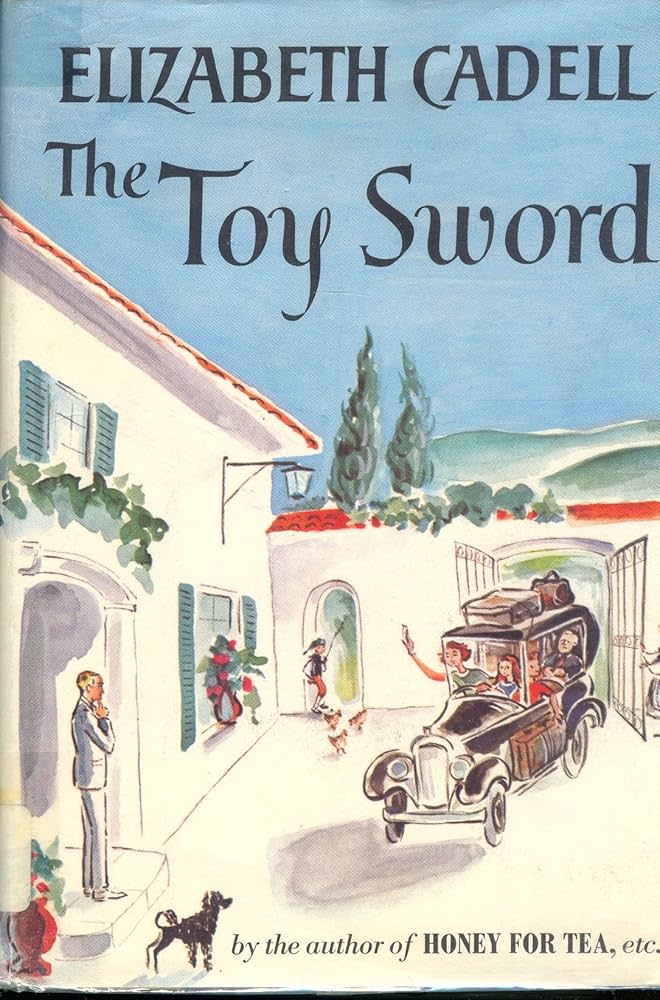
Language of the Heart (The Toy Sword)

By Elizabeth Cadell

The current image has no alternative text. The file name is: toysword.jpg

This was Elizabeth Cadell at her finest. In most ways, it is a perfect example of the amusing old-fashioned English stories she writes. Everything typically revolves around a romance of varying importance to the plot, but there are always plenty of side stories and characters to entertain.

In the usual Cadell story, a nice, good, and attractive hero or heroine has somehow lost the plot and is not living his or her best life. They are often dominated by the wrong romantic partner. They leave the city for the country and find what is missing in their life. Usually, they are shown the way by getting involved, against their will, with someone who seems totally wrong for them, but turns out to be the right romantic partner after all. And throw in an eccentric character (usually elderly) or two that also contribute to our main character starting to see things in a different light. But this one set itself apart in more than a few ways:

  1. A more deliciously nasty than usual fiancé for our hero to escape from. After Edmund gets back from his little life-changing vacation in Portugal, he is (cluelessly) looking forward to reconnecting with his beautiful, dignified, and sensible Angela again. To his befuddlement, he is greeted by her horrible mother who returns Angela’s engagement ring. He has committed the ultimate sin of doing something counter to his strong-willed fiancé’s stated wishes (orders). She will not even speak to him until he fixes what (she thinks) he did. Edmund handles the situation with grace and dignity. Unfortunately for Angela, Edmund has started to get a new perspective on life in general and doesn’t come to heel immediately as she expected. This is thanks to meeting…
  2. Fran. And her little family while at his little farm in Portugal, Montebarca. She is a real charmer and the complete opposite of everyone he is used to: openhearted, kind, talkative, and spontaneous. To top it off, she loves and appreciates the primitive Montebarca, unlike his luxury-loving fiancé. She is made even more likable by …
  3. The narration by Anna Guerrier. She gave our heroine Fran a real Hayley Mills vibe, and I can’t imagine the rest of the characters any other way but how she interpreted them. I love the way she gave Edmund a quietness that was an intriguing contrast with Fran’s garrulous personality.
  4. Portugal. The author obviously knows and loves this country, and, as in many of her books, it becomes almost a third character. A metaphor exposing everything that is wrong with “London” Edmund and his normal life there. Edmund’s love for the country and his Montebarca reveal that he is a man worth saving from himself and his poor taste in fiancés.
  5. There was one really great confrontation between Fran and Edmund after Edmund finds out how Fran interfered in his life behind his back. Edmund really lets fly, telling her off, and as much as I loved Fran and her generous heart, I was like, “He’s right! How dare she!” Then Fran had a go defending herself and eviscerating his character, and I changed my mind again.
  6. There were some real surprises towards the end. Everything looked like it was wending its way predictably towards a lovely happy ending, but wait. Not so fast. There is a little secret that is revealed that puts a surprising new slant on Edmund’s two eccentric relatives he has given a home to and his supposed act of generosity towards them. And then all of our friends are confronted with scandal and infamy and end up in court. London is rocked. Didn’t expect that at all!

I can’t remember if justice is ever served to the meanies offstage in any of Cadell’s novels. But the comeuppances are front and center here. It was classic Cadell, but extra. An absolute delight.

Rating: 5 out of 5.

Sylvester, or The Wicked Uncle

The current image has no alternative text. The file name is: sylvesteror.jpg

By Georgette Heyer

“Do you mean that I am redoubtable? Oh, you are quite mistaken!” “Am I? Then let us say intrepid!” She sighed. “I wish I were! The case is that I am a wretched coward.” “Your father gives you quite another character.” “I don’t fear fences.” “What, then?” “People – some people! To – to be slain by unkindness.” He looked at her with a slight frown…

Sylvester, or The Wicked Uncle has always been right on up there with my favorite Heyers. I think it’s because of the unusual heroine and the complex hero. Most of her heroines have charm to spare and are, if not extremely beautiful, at least attractive with some outstanding feature or another. Phoebe is a drab little “sparrow” who is only at home and comfortable in a stable. She has been bullied and dominated her whole life by a rigid and cold stepmother whose mission in life seems to be to beat every spark of Phoebe’s own unconventional personality out of her and into a model of perfect but insipid behavior. As for our hero, although a large percentage of Heyer heroes are formidable and proud, very few, like Sylvester, have to undergo growth and change in order to find their happy endings. Of course as in all romances, Heyer included, one or both individuals must change towards each other, but not their actual mentalities. In this novel, although Phoebe comes into her own to a certain extent, It is Sylvester’s journey to self awareness that is the significant one.

The Duke of Salford has decided it is time for him to do his duty, get married, and perpetuate the House of Rayne. He has prepared a list of five candidates for the honor of his hand each more well born, well behaved, charming, and beautiful than the next. It makes no difference to him, so he takes his list to his beloved mother to see if she has any input as to which of the fortunate ladies to favor with a proposal of marriage. His wise and gentle mother’s suspicions are confirmed: Although always open, loving, and warm with her, (and his 6 year old nephew and current heir, Edmund) to all others he has closed himself off from any emotional attachment. He is considerate and well-mannered to his servants and his peers and is popular with all. But his exemplary behavior to others is not out of any empathy or warm feeling but because it is what is due to his proud family name and station. He says and does the right things always, but beneath this surface he is cold and aloof. Encouraged by his mother and godmother, on a whim he decides to meet one other candidate for the position of the Duchess of Rayne: Phoebe, the daughter of his mother’s long-deceased best friend and his godmother’s granddaughter. He is not impressed. And neither is Phoebe. To add to her discomfort, she has secretly written a novel which is about to be published and she has based the villain of the bloodthirsty gothic tale on Sylvester. She had met him at a ball once and she noticed his distinctive satanic-looking eyebrows and was hurt by his haughtiness and boredom with her. Of course Sylvester doesn’t remember her at all. Due to a misunderstanding, she has been told that he has travelled to her family’s country home with the intent of actually proposing marriage to her and she better accept him, or else. Horrified and panic-stricken by the prospect, she decides to run away to her grandmother in London (yes, that same one) escorted by her loyal friend Tom. Sylvester is considerably peeved, as well as incredulous, that such a plain and vapid chit of a girl would hold the idea of a proposal of marriage from him in such abhorrence that she would flee from home in a snowstorm. He leaves as well, and inevitably the 3 fugitives meet in a small inn and are marooned together for several days. As they get to know each other, Phoebe learns that Sylvester is actually a pretty good guy beneath the arrogant facade, and Sylvester learns that out from under her stepmother’s thumb, Phoebe is a clever, funny, and forthright original. She is mortified and guilt- stricken that she has made Sylvester her villain in a novel that will potentially hold him up to ridicule and suspicion. And Sylvester is embarrassed to realize that Phoebe’s initial poor opinion of him may be justified.

Adventures, escapades, and misunderstandings ensue. Despite its romp of a plot, there is a serious undertone to this book. Sylvester’s aloofness is self protection and is due to a terrible tragedy in his past. Before he is shaken off his high horse by Phoebe (and the down to earth Tom) he is on his way to a loveless marriage and, except for his care for his invalid mother and his little nephew, an emotionless half-life. The emotional abuse Phoebe has had to endure her whole life is the source of her hypersensitivity and fearfulness in society. Other than her writing, her future is bleak and lonely.

The book contains Heyer’s usual humor and comedy and the light tone is there. But although some of her comic set pieces involving Edmund’s flighty, shallow, and selfish mother and her silly fop of a husband are amusing, there is a potentially a very sad side to even them. When the couple actually kidnap Edmund from the guardianship of his Wicked Uncle (inspired by the plot of Phoebe’s unexpectedly successful novel) Edmund’s life is actually in danger due to their inattention and thoughtlessness, and he is exposed to the cruelty of neglect. Luckily for him, it is Phoebe and Tom to the rescue. And luckily for Sylvester and Phoebe, it is Sylvester’s lovely mother (and Phoebe’s eventual kindred spirit) who will save the day for them. The Duchess of Rayne’s cleverly engineered and tender reconciliation of the two soulmates continually at odds is one of my favorite endings in all of Georgette Heyer’s works.

Rating: 5 out of 5.

Far and Away

by Amy Poeppel

The current image has no alternative text. The file name is: farandaway.jpg

This is the story of what happens when a family from an upper middle class Dallas suburb exchanges homes for the summer with an affluent husband and wife from urban Berlin. Despite each being thrust into totally unfamiliar cultures and settings they manage to not only survive, but thrive. More or less. The core characters were all likable good people, which is the key to their ultimate success. And the premise was very entertaining. I’ve read 3 other books by this author and this was a close second to Small Admissions, still my favorite by this author. Lucy decides to get the hell out of Dodge Dallas when her sweet, brilliant and somewhat nerdy son Jack is expelled from school and cruelly crucified on social media and in their social circle (It was all a big misunderstanding). I was caught up in the injustice of it all and my fondness for Jack. Always in the background was my hope for eventual redemption and comeuppances. Lucy has a very happy and solid marriage but unfortunately she has to deal with the crisis on her own as her husband, a NASA scientist, is on a special project and incommunicado for 6 months. On the other side of the Atlantic, Otto, a surgeon, who is unhappy at his work and with his colleagues, gets a temporary job in Dallas and moves himself and his wife Greta, a private art curator. I should say loyal wife Greta moves them, because stiff and formal Otto is very much a traditional husband, and it is Greta that handles all of the day to day home type business.

Amy Poeppel’s books are all about the characters, although this one is jam packed with plot developments and many exploits as well. There is never a dull moment. In this novel, it is Greta and Otto who go through the most growth and change. They are different people by the end of this story. Lucy, Jack, and Lucy and Mason’s young twin girls are perfectly fine and happy as they are, barring Jack’s struggles and the fear for his crumbling future. They have other challenges, don’t get me wrong. In addition to trying to keep her rambunctious twins from breaking all of Greta’s priceless antiques in the lovely but museum-like (but tiny!) city apartment, Lucy has to contend with how to keep her bosses from finding out she is no longer in the United States (she mostly works from home), and more importantly, dealing with Jack wanting to meet his Scandinavian biological father when he doesn’t even know Jack exists, as well as the absence of her loving and normally involved husband. Meanwhile Otto and Greta have to contend with how to get Lucy’s huge modern suburban smart home to obey them, their (shock!) unruly dogs, too friendly and interested neighbors, Otto’s sociable new work colleagues, barbeques, and the very casual lifestyle of Dallas. On top of that, Greta has an ethical struggle and possible career-ender regarding a Vermeer painting that might have been painted by his daughter Maria instead. She also is concerned about her daughter Emmi who seems to be pulling away from her, and a mother that might be having an affair with a much younger man.

Stern and formal Otto’s enthusiastic embrace of everything to do with the Dallas lifestyle combined with Greta’s bewilderment over her husband’s new personality and her own more cautious and suspicious approach, provide much of the humor. When kitchen-adverse Otto brags that he has learned how to bake “stickerpoodles”, Greta is totally flummoxed. Despite his failures as a husband, Otto was very endearing in his ultimately successful efforts to fit in and his fracturing of the American language was too funny.

But the book is so much more than two fish out of water stories and how they end up being just what the doctor ordered. Amy Poeppel has a lot to say about social media, hypocrisy, gossip and how vicious and destructive it can be. And it shows how ordinary people can be brave and not go with the toxic mob mentality and make a difference with kindness, common sense, and fairness. It is not a romance at all, but by the end we have five happy couples, or maybe more, I lost count. The epilogue was all that I hoped, which means it was probably a little over the top.

Rating: 4.5 out of 5.

Celia’s House

By D. E. Stevenson

The current image has no alternative text. The file name is: celia.jpg

Of all of the D.E. Stevensons I have read, this one is right up there. I almost didn’t choose this book to listen to. I usually wait 4 or 5 months between Stevensons and I had just read one last month. But I knew I didn’t want to read another contemporary romantic comedy because the last one I read was so good, nothing else could measure up. I was still on hold for the scary book of my choice at the library and I had just read a domestic thriller and a Georgette Heyer. And some books I just like to read the words, not listen to them.

This one is a little different from most Stevensons because it moves through the years and the stories of various members of the Dunne family. We start in 1905 with Celia Dunne, in her 90s, who has decided not to bequeath her home and estate to the childless (and insufferable) son of her oldest brother who has every expectation of inheriting. Instead, she has settled on a more distant connection, her great nephew, Humphrey, who is a struggling Lieutenant Commander in the Navy with a young and growing family. She leaves her estate to the astounded and confused Humphrey on the condition that Dunnian will eventually go, not to his oldest son, Mark, but, extraordinarily, to a daughter, yet to be born, whom he will name Celia.

Humphrey is a good and loving father although we are told he does not have a sense of humor. His wife Alice is beautiful and sweet but is not too bright (as we see evidence of throughout their story.) We soon realize that the main focus of the story will be their oldest son Mark whom we first meet when he is 5 1/2. We spend a good deal of time with the growing family. Humphrey and Alice add a son, Billy and, sure enough, a daughter, Celia, to their brood. They also take on the care of a cousin, Deb, who comes to live with them when her disinterested mother remarries and moves to India. Unlike her cousins, she is plain and shy. As the children grow to adulthood the Dunne’s story starts to mirror Jane Austen’s Mansfield Park. Deb is devoted to Mark, and Mark is in love with a scheming and manipulative neighbor. Eventually Deb, who eventually blossoms, is pursued by her brother, a bit of a rake. Other parallels emerge with other members of the family. But curiously, we see little of the youngest daughter, Celia, except for a few anecdotes that show that she is an unusual child: lovable, spirited, and with a mind of her own. Rather like her namesake, as a matter of a fact. Sprinkled throughout are some mysterious coincidences and ghostly sightings which hint of a guiding hand from beyond. After Deb and Mark’s fate is settled, we skip ahead to 1932, where we get a another peek at Celia, in her early 20s. She is still uninterested in marriage. She is waiting. When she was 13, we had learned that she didn’t care to get married unless it was to someone “quite different”: Someone like Lochinvar “out of the west.” Quickly, we skip ahead 10 years to 1942. Mark and Billy are doing their bit in the war, while still unattached Celia and newly pregnant Deb are keeping the home fires burning with retired Admiral Humphrey, now in his 70s. There is only one chapter to go. How Celia finally meets “the one” in that last chapter moved me to tears.

I had read the follow up to this one, The Listening Valley before Celia’s House, and that was probably a good thing. Had I read it first, I would have been so anxious to learn more about what became of Celia and Dunnian, that I wouldn’t have been able to concentrate on the first half of our heroine, Tonia’s, story. She does not land in Ryddelton, where Dunnian house is located, until midway through the book. In The Listening Valley, we also are filled in more about the original Celia’s younger years and the ties that bind her to her young namesake’s love story. To anyone interested in trying D.E. Stevenson, you couldn’t do better than Celia’s House, followed by The Listening Valley.

Rating: 5 out of 5.

Regency Buck

By Georgette Heyer

The current image has no alternative text. The file name is: regencybuck.jpg

As familiar as I was with this story, listening to it being read (Audible-Jasmine Blackborow),as always, gave me a fresh outlook and enjoyment. The narrator was excellent, and I must credit her with making the ever-irate Judith a little less irritating and childish-seeming and Worth’s highhandedness understandable. This was the first Regency Romance by the mother of the genre. So this is the book, folks. The origin of it all. The urtext if you will. And as such, a more archetypal example there could not be. Judith is the quintessential strong, fiery, and headstrong type heroine. Worth is the all-knowing all powerful hero, a Corinthian, no mere Dandy, who excels at everything he does. Heyer mixed and matched all kinds of other personalities in her books of course, but this has sure been a popular combination of hers and her followers through the years.

The story unfolds around the country-raised and very rich Miss Judith Taverner and her eager but dumb brother Perry coming to London for the season after the death of their father. Due to a massive error on his part (like father like son in the brain department), they are under the guardianship of the 5th Earl of Worth, not his deceased father, the 4th Earl. Judith must have taken after her mother. To make a long story short, Worth gets on the independent-minded Judith’s bad side from the start with his arrogant dismissive ways, and they are at loggerheads throughout the novel. It is, in fact, an enemies to lovers trope, and a good one. Julian Audley, 5th Earl of Worth is not one of the more popular Heyer heroes. Some find him too overbearing, cold, and dictatorial. His behavior at their second meeting manhandling the prickly Judith into his phaeton (for her own good) and purposely provoking her by giving her a little kiss hasn’t won him any points among enlightened readers on the lookout for sexual harassment either. But I’ve always been a fan. His deft parryings of poor Judith’s every effort to get the better of him are very humorous. I did sympathize with and even admired her persistent efforts to exert her independence but for an intelligent girl she was not very wise when it came to her guardian. “Mad as a wet hen” is a phrase that comes to mind. She was forever letting her emotions and temper get the better of her brain while always trying to maintain her dignity. Worth’s overbearing maneuvers were often only to save her from cutting off her nose to spite her face while purposely provoking her for his own amusement. He just couldn’t help it.

As the Taverners are immersed in all manner of sport, culture, fashion, entertainments, and ways of the elite of society (AKA “The Ton”) in her introduction to London, so is the reader. The plot provides Georgette Heyer the perfect framework to display all of her meticulous research into the Regency period. The book could be used as a primer for aspiring writers of regency romances. Various real historical figures of the time are woven into the narrative including the Duke of Clarence (who proposes marriage), Gentleman Jackson the boxer, The Prince Regent (who makes a pass at her), and particularly Beau Brummel, who is a great friend of Worth and who becomes a wise advisor to Judith. We are treated to many actual quotes from the great Brummel woven into his conversations with Judith. Some readers count all of the factoids, long descriptions, historical details against the book. And I probably skimmed through a lot of it myself in previous readings. But listening to it all seemed different. I couldn’t just skip ahead and I liked it all. It is so obvious that GH took such delight in sharing all she had learned, and worked hard to include all of her little nuggets as seamlessly as possible. After writing historical romances set in other periods for 14 years prior to this first Regency, she finally found her niche, and it seemed to me like she was having a ball with the writing of it.

On top of the slow burn romance and Judith’s adventures amongst The Ton, we have a mystery! Someone is trying to kill Perry. It’s really not much of a mystery. Readers reading the book at the time might have been a little misled, but those who have read other Heyers or almost any other regency or gothic romance written in the years following this one will not be fooled. We 100% know who Judith will end up with from their first meeting so we know he is not the murderer. There is only one other person with a motive, and though he fools Judith, as savvy readers, we see right through him.

After our two combatants/lovers declare their true feelings, we are treated to a long happy conversation in which they have a lot of fun dissecting their relationship. We get a lot along the lines of “What did you think when I…? And when you did this, I just…! How could you have…? I thought I had lost you when…! Oh that day at…! This is very unusual for Georgette, and I absolutely loved it. Usually it’s declarations, clinch, and “The End.”

Georgette would continue to refine her style as the years went by, but this one, although it doesn’t have some of the subtle or hilarious characterizations of some of her later works, should not be missed. It is the foundation of a genre.

Rating: 5 out of 5.

Auntie Mame: An Irreverant Escapade.

By Patrick Dennis

The current image has no alternative text. The file name is: auntie.jpg

It’s been many many (many) years since I have reread this mid-century classic gem and old favorite of mine. I’ve read a few of Patrick Dennis’s books, many now very hard to find and undeservedly out of print. Two of the three books that are still readily available are (strangely) ones that I haven’t read and have no desire to. I guess that means my taste in novels by Patrick Dennis must be a little off. Around the World with Auntie Mame is still available and is now on my TBRR (To Be Re-Read) list. I’ve also read Guestward Ho, The Loving Couple, and The Joyous Season, which is one of my favorite books of all time, surpassing even this, his most well-known work. The Joyous Season is out of print and rarely mentioned when the subject of Patrick Dennis and his books come up in my poking around the internet. The reason why has always been confounding to me. I absolutely adored the 10-year-old narrator Kerry and his 6-year-old sister Missy whose upper-crust Manhattan parents’ marriage blows up one disastrous and hilarious Christmas Day. Besides the laughs on every page, I loved the romantic comedy aspects to it. I’ll stop there because otherwise this review of Auntie Mame will turn into trying to convince readers to read The Joyous Season instead. (But then read Auntie Mame, because it is a comedy classic and the basis for an award winning Broadway play and Hollywood movie for good reason.)

I listened to this on Audible and the narrator, Christopher Lane, was fine, although I would have wished for a more youthful voice as the book is narrated by Patrick whose adventures with his eccentric Aunt start when he is orphaned in 1929 at 10-years-old and ends around 3 years after his graduation from University. Mame Dennis’s guardianship is abruptly curtailed early on by his conservative trustee when young Patrick is discovered in an avant-garde school where all of the students and two teachers are racing around naked. From then on Mame only gets her “depraved” hands on him Christmases and summers.

I have seen the movie quite a few times and fairly recently. Most of the scenes play out much the same, with the book having the advantage of Patrick’s loving but sometimes acerbic narration and commentary on his and Mame’s life together. And of course the hilarious if sometimes harrowing episodes in their lives are unabridged. The first 3 chapters about Patrick’s and Mame’s first meeting up to when he is shipped off to boarding school for his own protection are pretty much the same. After that we are only favored with Patrick and Mame together only sporadically, while Patrick fills us in on what he knows about her adventures while he is safely at school. With the stock market crash and Auntie Mame “ruined, ruined, ruined!” (not by a long shot), she is forced to keep up with her expenditures by relying on her considerable social contacts for gainful employment. Her adventures on the stage with her great friend, Broadway star Vera Charles, down to her adventures selling roller skates at Macy’s, are almost identical to the movie. It is at Macy’s that she meets the love of her life, the fabulously wealthy Beauregard Pickett Burnside III, one of the “big, genial, easygoing, lovable” southerners. The movie only slightly curtails her clash with the old-time southern culture of Beau’s family and friends in the horsey set revolving around Peckerwood, Beau’s Georgia plantation. However, in the book, (trigger warning) horses die. I had forgotten that. After Beau’s untimely death (kicked in the head by a horse rather than falling off a mountain) Auntie Mame, as his widow, inherits all and is free to indulge her eccentric and lavish lifestyle once again. Upon Patrick’s prep school and then college years things start to diverge from the movie in plot, but not in spirit. The Agnes Gooch affair is much longer and set in Apathy, Massachusetts, home of Patrick’s St. Boniface Academy. Patrick is up to his neck with Agnes while trying to keep her and his aunt isolated from the school authorities to avoid possible expulsion. Agnes’s fate is a much happier one in the book. While in College (Ivy League, of course) we have Patrick entangled with a stripper named Bubbles, and Mame trying to recapture her youth by adopting Patrick’s social set as her own. Patrick’s engagement to the caricature of shallow wealthy WASP-dom, Gloria Upson, and her even more offensive family in the Connecticut suburbs are almost word for word. Except that in the book, they are even more racist, ridiculous, and pompous. Patrick as a young man is not as lovable as Patrick as a child. He takes way too long to rid himself of Bubbles, and to wake up to Gloria and her family. How he ever got engaged to her is a mystery other than she is beautiful and “stacked.” Wouldn’t be the first time, I guess. Moving on to WWII, Auntie Mame takes in some British War Orphans who are nothing more than thugs and reprobates who leave her with a permanent white streak in her hair. This is not in the movie at all, and Patrick’s meeting with his future wife, Pegeen, is completely different. Book Pegeen is a hoot. Patrick was a lucky guy, and sorry to say, given his history with women, I was somewhat amazed he had the good sense to nab her. As in the movie, everything comes full circle with Auntie Mame “kidnapping” their son Mike for an educational summer in India(Ha!).

Mame and Patrick become entwined with any manner of humanity likely to be ensconced in New York or environs from 1929 to 1945. And all are skewered in equal measure be they elite or common, liberal and avant-garde or conservative and stuffy. Some with affection, some not. Only two escape Patrick Dennis cynical wit: Beau, Mame’s late husband, and Pegeen (and maybe her father, Mickey the Mick.)

Despite their devotion to each other, Patrick is under no illusions as to Mame’s foibles and sometimes foolhardy impulses, And this applies to Mame’s insights into Patrick’s youthful follies and sometimes unfortunate tendencies. But the bottom line is that she raised a good man which we know by reading between the lines. Despite his understandable frustrations and complaints, he is always there for his Auntie Mame, and she for him (although as a master manipulator she is too wise to always lay all of her cards on the table.)

Rating: 5 out of 5.

I Hope This Finds You Well

by Natalie Sue

The current image has no alternative text. The file name is: ihope.jpg

Jolene recalls the time she brought juice and milk instead of coffee and soda to an office potluck and they think it’s funny:

After that, I decided that limiting my interactions was the best way to keep people from hating me. But over time, embarrassment became resentment. I was annoyed that Rhonda had me buy drinks if coffee and the watercooler would’ve done it. That was the first step down a road. The thing about annoyance is that once there’s a spark, you can find more things to stoke it. It grew and amplified between me and them. And eventually the abyss stared back.

This was an entertaining and funny read with serious overtones. The darkness mostly stems from having to do with a heroine who has social anxiety and other damage due to a childhood tragedy that she was wrongly blamed for. She suffers from guilt that her family had to move to another city to escape the gossip and blame. Her mental state is not helped by an overbearing mother whose ill-judged parenting skills create stress and expectations she can not hope to meet. Therefore she lies about her career success and her romantic life, creating more stress. She is a bitter and very unhappy person.

She works in an office and to say that Jolene does not fit in is an understatement. Her office mates try to ignore her weird ways but are also hostile and hateful. They speculate on the chances of her going postal with a deadly weapon at some point, and they are half serious. And I’m not sure that I wouldn’t feel the same way about her (though I hope I wouldn’t be hostile and mean).

Her personal life is not any better. Her apartment is filthy and she is a borderline alcoholic. But since we are privy to her interior life and funnily sarcastic and incisive if black takes on the world and the people around her, I couldn’t help but like her while shaking my head at her self-sabotage. And I knew from the get-go that the book would be about Jolene’s journey out of the depths to happiness and health. So I was willing to put up with quite a bit from her.

The crux of the novel is how Jolene, due to some kind of computer foul up, is suddenly able to secretly read all of the private emails of her work mates and bosses. She finds out that massive layoffs are coming, and she will probably be first on the chopping block due to her, well, everything about her. She starts to play the social and political game to save her job. In the process, she finally gets to know the people she works with and everything that is going on beneath the surface. Needless to say, some people confirm her low opinion of them, and some do not. She gets to know Cliff, the new HR guy with whom she has to meet regularly for Sensitivity Training. He is a wonderful guy, and she starts to fall for him, and for some reason, he for her. With him, she is quick witted, funny, and nice with a refreshingly rebellious yet well-founded cynicism that he relates to.

There are many aspects of this book that are 5 star worthy. By itself, the premise of Jolene’s access to the secret thoughts and professional and personal lives of everyone in her office was a rich trove of humor and horror. There are revelations galore which made for quite the page turner. Eventually we know there will be hell to pay on many fronts when the truth comes out. We fear for Jolene while recognizing that justice is not on her side. But to me, Jolene’s growth came too late and then, too quickly in the book. I didn’t feel her journey was well managed. I was impatient with her constant negative attitude towards the good people in her life, especially Cliff. She always assumes the worst. I hoped that her relationship with Miley, a neglected little girl who lives in her apartment building would be the making of both her and Miley but the connection never really delivers on its promise.

The ending was satisfying and happy, just the way I like it. But I can’t give it 5 stars. Jolene disappointed me too often, until she didn’t.

Rating: 4 out of 5.

The Wedding People

By Alison Espach

The current image has no alternative text. The file name is: theweddingpeople.jpg

Having not read a novel I really really liked in forever unless by one of my core favorite authors, which are few and far between, I thought I’d branch out a little. This had won several awards, received a lot of hype, and going by the reviews and the description of the plot, it seemed like it would fit the bill. It’s described as heartwarming literary fiction with dark humor, wisdom, wit, hope, and maybe a bit of romance. And it was all of those things.

We meet our main character, Phoebe Stone, as she arrives alone at the grand Cornwall Inn in Newport RI. Curiously, after reading the reviews and the first pages of this book, I had the idea that Phoebe was in her 50s or 60s. But she is only maybe 42. We also learn she is an adjunct English professor at a small college in St. Louis, Missouri. She is still haunted by her divorce and we learn that she has also wrestled with fertility problems. She has been isolated and lonely, her only companion being her cat, Harry, who has just died of cancer. Fed up with herself and her life, and armed with a bottle of Harry’s pain pills, her plan is to commit suicide. But the hotel, which she has longed dream of visiting, has been taken over by a lively wedding party which has the whole place exclusively booked for 6 days. Phoebe, as usual, is an outsider. But what does she care? After a nice dinner in the best room in the place, she plans to do the deed that night anyway. She meets the Lila bride in the elevator, and, since Phoebe really has nothing left to lose, frankly tells her, when questioned, why she is there. Lila is upset about that, not out of compassion or empathy, but because she does not want a dead body to ruin her perfect wedding. She follows Phoebe to her room to try to get her to change her mind. Or at least wait until after her wedding is over. Phoebe has always led a controlled, careful, and small life, never wanting to rock any boats. But now that she just doesn’t care anymore, for the first time ever, she is honest and fearless in her interaction with the spoiled bride. And she likes it. We find out that Lila, brash and not afraid to show her true self to Phoebe, is an entirely different person with her friends and family. Lila’s confidences spark Phoebe’s curiosity. After Lila finally leaves Phoebe to join her party beneath Phoebe’s balcony, she finds she doesn’t want to die just yet.

The crowd laughs, and Phoebe wonders if Lila is laughing…. But Phoebe will never know what happens—by the time Lila’s mother is finished talking, Phoebe will be dead. Phoebe will not get to know how the speech ends—or how anything ends. And Phoebe does not like this. Phoebe always finishes a book or a movie, even a bad one.

Energized by the freedom of being herself with Lila, she decides to hang around a while. (The feline pain pills proving to be ineffective.) She is drawn into Lila’s world and gets to know many of the wedding party, eventually agreeing to be Lila’s maid of honor. She is liked and respected by all for her common sense and wit. Lila is not the only one who seems to want to seek her out and confide in her.

Phoebe has nothing to lose here. She is not part of this family. She is not part of anything anymore. She is free in a way none of them are, so she kneels down and looks directly at the girl, as if it’s her from many years ago.
“We do ask that you keep all your belongings inside the boat,” the captain says softly. Juice looks at Phoebe as if she is making a choice about who to be, and Phoebe makes a choice, too. “Go ahead,” Phoebe says, because fuck it. If she is going to live, she’s going to live differently this time. “Let’s have our funeral.”

I really (really) liked this. Phoebe and Lila’s backstories added to their portrayal, and there were some twists and surprises which are always welcome. I loved the gossip and the peaks behind the curtain of the rich and privileged. Although not a very admirable character, I learned to care for the outrageous and unpredictable Lila as well as Phoebe. We are introduced to the important characters and fraught relationships in Lila’s life through her eyes, and, no surprise, learn there is a lot more to them than we may have thought. Phoebe’s inner observations are smart and funny, and there is plenty of situational comedy as well. As the actual wedding day approached, I found myself fervently hoping for certain outcomes and I was not disappointed.

Unfortunately, the book did lag in the middle, largely due to Phoebe’s unending learning curve. Her constant introspection and little insights into her life and why she acted the way she did were repetitious. It seems like nothing would do, when the author made a point, but for her to make it another dozen times in another dozen ways. Some entertainingly, yes, but some just overkill.

But her excellent writing carried the way past these patches and even though a little tiresome, I was always entertained.

Rating: 4 out of 5.

The Grand Sophy

by Georgette Heyer

“You are shameless!” he said angrily.
“Nonsense! You only say so because I drove your horses,” she answered. “Never mind! I will engage not to do so again.”
“I’ll take care of that!” he retorted. “Let me tell you, my dear Cousin, that I should be better pleased if you would refrain from meddling in the affairs of my family!”
“Now, that,” said Sophy, “I am very glad to know, because if ever I should desire to please you I shall know just how to set about it. I daresay I shan’t, but one likes to be prepared for any event, however unlikely.”

There are few strong Georgette Heyer heroines that match Sophy for their spirit and agency, but none that have her combination of sangfroid, confidence, and levelheadedness. Serena? Too hot-tempered. Deb? Too impulsive. Judith? Too bullheaded. Babs? Too tempestuous. Yes, they are all formidable. But Sophy is a “fixer.” She will stop at nothing to prevent people from going down their chosen path if she knows it will only lead to misery. To the point that she will take out her ladylike pistol and shoot someone for their own good. Luckily. she is always right or she would be intolerable.

“Resolution is all that is needed!” she said. “One should never shrink from the performance of unpleasant tasks to obtain a laudable object, after all!”

Plus she is wise, kind, brave, charming, and witty. Is she my favorite heroine? Surprisingly, No. That would be Arabella. I listened to this book on audible and my enjoyment and admiration for the book was increased by the narrator who got my attention by imbuing the energetic Sophie with a languid tone that gave her a new dimension.

Most of Heyer’s male characters are the kind of heroes that the reader feels are so “Master of the Universe” that every other character seems like they are dancing to their tune. Sophie is the only female character that I think matches her male heroes in that kind of power and leadership. When Lady Ombersley welcomes “little cousin” Sophy into her home for the season, Sophy discovers a lively and charming family of nine, three of whose members have seemingly put themselves on paths to an unhappy future. Her new temporary family discovers that Sophy’s father’s description of her as “a good little thing…not an ounce of vice in her” doesn’t even begin to describe the force of nature that is Sophia Stanton-Lacy. It isn’t long before Sophy discerns what ails them. Cecilia, the eldest daughter, has turned her back on the perfect man and has fallen head over heels for a dreamy (in looks and spirit) poet who will never amount to anything and never be able to support a wife. The second oldest son, Hubert, has gotten himself into trouble with a moneylender and is afraid to tell the de facto head of the household about it, his older brother Charles. And Charles, under the strain of rescuing the family from his father’s gambling debts, has, longing for respite, gotten himself engaged to a very proper and sensible woman of good family but who, under her facade of kindly helpfulness, is a cold and spiteful prig. Charles, against his better nature, but encouraged by his fiance, has kept too tight a rein on his family in an effort to repress the careless and irresponsible behavior that has nearly driven them into disaster. He’s become a bit of a tyrant, and as a result, His mother and the 2 oldest of his 6 siblings have become fearful or hostile towards him.

Sophy has her work cut out for her and sets about putting everything to rights. It takes her the whole book, but by the end, Cecelia is disentangled from her poet and engaged to the right man, and Hubert’s troubles have been uncovered and the moneylender has been dispatched at the point of Sophie’s gun. Charles himself, trapped by propriety to remain engaged to a woman whose unpleasantness, thanks to Sophy, he has finally come to discover, has been rid of her without scandal. And thoroughly in love with Sophie. And vice versa. I assume. But it’s hard to tell. The book concludes with Charles hauling Sophy away in his curricle and Sophy protesting, “Charles! You cannot love me”, and Charles kissing her and “savagely” responding “I don’t: I dislike you excessively!” And that is my one quibble with this book. I wish there had been more romantic interaction between the two. It seemed obligatory only that the two ended up together. Even for Heyer, the “happily ever after”, though a given, left a lot to the imagination.

Rating: 5 out of 5.