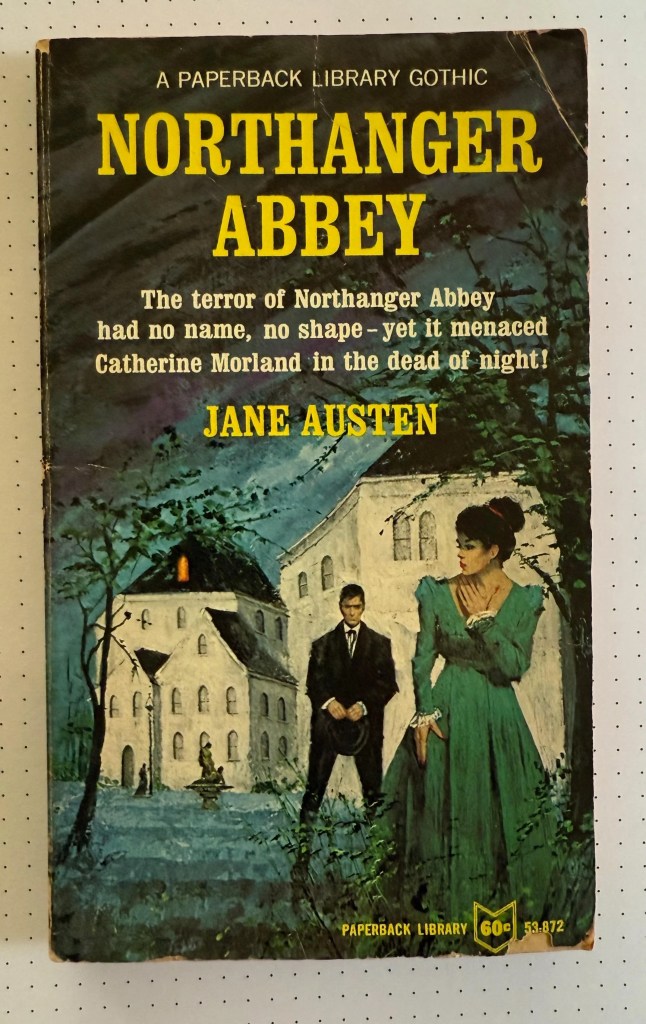
Northanger Abbey

by Jane Austen

The current image has no alternative text. The file name is: northangera.webp

Although I had never read this novel before, I knew the plot backwards and forwards thanks to the two BBC productions I have watched numerous times. Also I listened to an abridged version several years ago. I had started Val McDermid’s modern re-working of Northanger Abbey and it was not going well. It started me to thinking, “why am I reading this, when I still haven’t actually read the real one”? I decided to listen to it again since I have had the unabridged version in my Audible library for years. It was very funny right from the the start. It did go well. Of course I knew all the ins and outs of the plot. But I probably would have enjoyed it more if it were the first go round of any kind. Also, I suspect I would have picked up even more of the humor if I had read it on the page.

The book begins with Jane Austen informing the reader of all reasons why Catherine Morland, our heroine, is not suited to the role. In fact, The Narrator (Austen) pulls no punches in eviscerating Catherine and detailing her lack of heroic qualities. Brains? Nope.

She never could learn or understand anything before she was taught; and sometimes not even then, for she was often inattentive, and occasionally stupid.

Beauty? Nope

…and Catherine, for many years of her life [was] as plain as any. She had a thin awkward figure, a sallow skin without colour, dark lank hair, and strong features…” No mention of “speaking, twinkling, intelligent, or laughing gray eyes, you will notice. But… At fifteen, appearances were mending…she had now the pleasure of sometimes hearing her father and mother remark on her personal improvement. “Catherine grows quite a good-looking girl-she is almost pretty today.”

Talents and accomplishments? Nope.

Her taste for drawing was not superior. though whenever she could obtain…any…odd piece of paper, she did what she could in that way, by drawing houses and trees, hens and chickens, all very much like one another. Writing and accounts she was taught by her father; French by her mother: her proficiency in either was not remarkable, and she shirked her lessons in both whenever she could. What a strange, unaccountable character!—

I laughed aloud at the idea of a house, a tree and a chicken looking very much alike. After being assured that Catherine’s father “is not the least addicted to locking up his daughters” we read that her mother was a woman of useful plain sense, with a good temper, and, what is more remarkable, with a good constitution.”

So having assured us that Catherine does not fit the mold of a Gothic heroine she eventually plops her in the middle of a plot worthy of any respectable gothic romance. In her own mind. For Catherine is a little obsessed with gothic novels. Taken to Bath by well off family friends, Catherine is drawn in and befriended by the manipulative Isabella Thorpe and her crass brother who tries to worm his way into her affections. She also meets the upstanding and witty Henry Tilney and his nice sister Eleanor. Catherine develops a tendre for him and he seems to reciprocate her feelings. Eleanor invites her to their ancestral home, Northanger Abbey, for several weeks, and Catherine is in a state of shivery delight that the Tilney’s ancestral home is an actual Abbey.


Her passion for ancient edifices was next in degree to her passion for Henry Tilney…With all the chances against her of house, hall, place, park, court, and cottage, Northanger turned up an abbey…long damp passages…narrow cells and ruined chapel…the hope of some traditional legends, some awful memorials of an injured and ill-fated nun.”

Although unlike the films, the Abbey does not live up to her imagination, (not an “antique chimney”, dirt, or cobwebs in sight-Neither “awful forebodings of future miseries” nor “sighs of the murdered” either) she finds plenty of fuel for her fantasies. She convinces herself that Henry and Eleanor’s intimidating, strange-acting, and hot-tempered father murdered their mother (or possibly has her imprisoned somewhere in a secret cell.) When she is caught snooping in a place she should not be by Henry, he sets her straight and makes no bones about what he thinks of her deluded fantasies. In the face of his disdainful take-down she comes to her senses with a decided ker-plunk. (But he still likes her.) Ironically, it is after her wake-up call when General Tilney genuinely does her a shocking cruelty and even puts her life in danger by his rude and heartless actions. So maybe not so detached from reality after all.

Although Catherine Morland is not the crispiest chip in the bag, I grew to like her very much. She is kind and good-hearted, and if she is sometimes silly it stems from naivety and innocence rather than brainlessness. I was completely won over by this passage:

[Henry Tilney] looked as handsome and as lively as ever, and was talking with interest to a fashionable and pleasing-looking young woman, who leant on his arm, and whom Catherine immediately guessed to be his sister; thus unthinkingly throwing away a fair opportunity of considering him lost to her forever, by being married already… he had never mentioned a wife, and he had acknowledged a sister. From these circumstances sprang the instant conclusion of his sister’s now being by his side; and therefore, instead of turning of a deathlike paleness and falling in a fit on Mrs. Allen’s bosom, Catherine sat erect, in the perfect use of her senses, and with cheeks only a little redder than usual.

And she shines in comparison to two other women in the story: Isabelle Thorpe and Mrs. Allen. Mrs. Allen makes Catherine seem sensible and resolute and Isabelle highlights Catherine’s virtues by being her opposite. That Catherine has been able to attract the friendship and liking of such a role model as Eleanor Tilney also speaks very well of her. And how can one be too hard on someone who is such a voracious reader of novels? Unfortunately, although witty and tolerant, I found Henry a bit prosy and self satisfied. Not as likable as the Henry Tilney of the films.


“Henry,” said Miss Tilney, “you are very impertinent. Miss Morland,…He is forever finding fault with me, for some incorrectness of language, and now he is taking the same liberty with you. The word “nicest,” as you used it, did not suit him…”Very true, said Henry, “and this is a very nice day, and we are taking a very nice walk and you are two very nice young ladies. Oh! It is a very nice word indeed! It does for everything. Originally perhaps it was applied only to express…”

And blah blah blah.

But that aside, I found myself chuckling at the wry humor, admiring Austen’s characterizations, and the skewering of the gothic novels of her day. Even though I am an old Gothic reader myself, I am not at all tempted to read one of the many of Catherine’s reading list based on the little snatches we are favored with in Northanger Abbey. I now have read all of Jane Austen’s books except Sense and Sensibility and Pride and Prejudice several times. I guess you could say I’m saving it.
Rating: 3 out of 5.

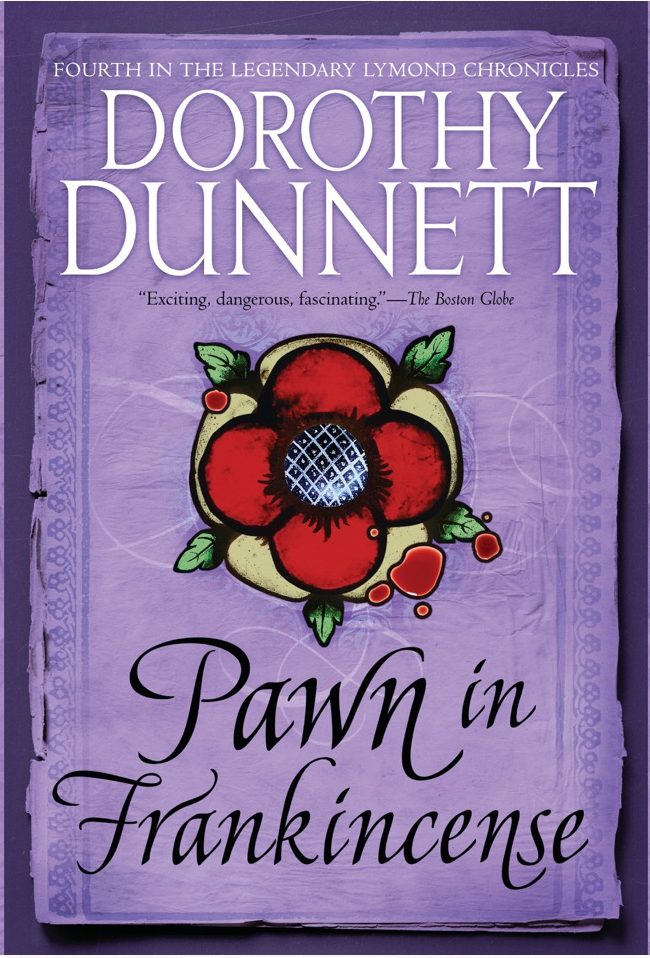
Pawn in Frankincense (#4 in the Lymond Chronicles)

The current image has no alternative text. The file name is: pawn-e1758880080116.jpg

By Dorothy Dunnett

Evil matters. So does love. So does pity. My pilgrim,’ said the Dame de Doubtance gently, ‘you have still three bitter lessons to learn.’

The penultimate scene of The Disorderly Knights foreshadows the age-old ethical dilemma that one is devastatingly confronted with in this, Pawn in Frankincense: When does the greater good outweigh the good of the individual? When it is a matter of life or death, how does one choose the sacrifice, and how will one live with the consequences of the decision?
Francis Crawford of Lymond’s hand is stayed by the redoubtable Philippa Somerville just as he is about to execute the malevolent and malignant Graham Reid Malett a.k.a. Gabriel. In the devastating scene Malett has shockingly revealed that Francis has a baby son who is under his power and if he dies, his son dies. Nevertheless, Francis, knowing the depth of threat Malett represents to the world is determined to carry through killing him after besting him in mortal combat. He is willing to sacrifice one child (Is GRM even telling the truth?) to save thousands.

And a child’s voice, echoing his in turn said, “No!”… No, Mr. Crawford!” cried Philippa forbiddingly, and ducking under the snatching arms that tried to prevent her, she ran forward…..sinking on her knees she shook, in her vehemence, Lymond’s bloodstained arm…There is a baby. You can’t abandon your son!” …Philippa Somerville, who believed in action when words were not enough, had leaned over and snatched the knife from Lymond’s left hand.

It is enough. Gabriel escapes back to the Ottoman Empire as, thanks to Lymond, he is persona non grata anywhere in Europe. There, in this book, he will betray his brothers, the Knights of St. John, and abandon all pretense of Christianity. He will successfully consolidate the power he craves under Suleiman the Magnificent while planning the entrapment and downfall of Lymond using his son as a pawn in the game.

The final scene in the preceding book has Lymond in front of a church altar vowing to find and save his lost son while somehow destroying Gabriel. Pawn in Frankincense is his quest.

We start out in Baden, in the Swiss Confederation, where Philippa, accompanied by Lymond’s sidekick, the usually very confused Jerott Blythe, has snuck away from her mother Kate and tracked Lymond down. She has come, she says, to look after the baby once he is found. One may ask, how could Lymond agree to take a 15 year old schoolgirl, the daughter his one of his closest friends, on such a treacherous journey?

As I have said before, and am now saying for the last time, I cannot tell you with what awe my family and friends, not to mention yours, would receive the idea that I should ship a twelve- year- old girl along the Barbary coast——’

Not surprisingly (if one has gotten to know her) Philippa prevails. And thank God for it. She provides the only safe haven and flashes of light in a book full of tension, fear and horror. Somehow, we know that she will always be all right. She is a master of “the feat of keeping her head, her reason and her sense of the ridiculous amid conditions of civilized lunacy.” Not that she doesn’t have a difficult journey. At one point, Lymond decides he must place killing Gabriel over finding his son and sends Philippa back home. He thinks. Philippa decides to continue the hunt virtually on her own and ends up entering the Sultan’s harem to protect the young toddler (because of course she finds him) from the cruel tentacles of Gabriel. As she writes to her mother, Lymond’s good friend,

Dear Kate. As you will see from the address, I am staying as a concubine in the harem of Sultan Suleiman the Magnificent, son of Sultan Setim Khan, son of Sultan Bayezid Khan, King of Kings, Sovereign of Sovereigns; Commander of All that can be Commanded, Sultan of Babylon, Lord of the White Sea and the Black Sea, most high Emperor of Byzantium and Trebizond, most mighty King of Persia and Arabia, Syria and Egypt, Supreme Lord of Europe and Asia, Prince of Mecca and Aleppo, Possessor of Jerusalem and Lord of the Universal Sea….There are two hundred and ninety- nine other girls here: but no one else from Northumberland. Tell Betty I have the dearest little black page.

We meet and continue our acquaintance with many intriguing characters, some fictional, some not. Some lovable, some not. They include Marthe, a young woman who could be Lymond’s twin. Sybilla’s child? But that’s impossible. Isn’t it? We learn there are two supposedly indistinguishable babies in peril, the other one being Gabriel’s own son from an unspeakable union. At times it seems we are in a retelling of the Odyssey, at others, Raiders of the Lost Ark, Ladyhawke, or an Errol Flynn pirate movie situation. Even once, a very strange romantic comedy fake marriage, one bed trope. At one point, horribly, Sophie’s Choice came to mind.

Dunnett’s books are very cinematic thanks to the lush realism of her descriptions. She is merciless with what she puts Lymond and those he cares for through and they will not emerge triumphant unscathed. In one of the last chapters, I was physically trembling as I read. I love Dorothy Dunnett, but thanks to this at times painful book, I kind of hate her too.

Rating: 5 out of 5.

Great Big Beautiful Life

by Emily Henry

The current image has no alternative text. The file name is: greatbig.jpg

“I’m fine. Everything’s fine.”

I have had mixed feelings about the very ballyhooed Women’s Fiction/Romcom/Chick Lit author, Emily Henry. She is good, don’t get me wrong, but I do not understand all of the hype considering there are much better and more consistently great authors out there in the same genre. At least in my (not very shared) opinion. Case in point. I believe there are five of her books being adapted for the screen, the last I counted. I approached this one hopefully but not too confidently. I also did not have a great mindset when I started it as I was anxious to get it over with (it was a library book) so I could get back to the very involving historical fiction series I am in the middle of. But I thought it was excellent and right up there with her best. It would have even been 5 stars except for a lame temporary break up of the couple near the end caused by a totally unnecessary and silly inability to communicate what was going on. It could have been done without compromising anyone. I get enough of that irritating and overused plot device with Hallmark. It was out of place here, considering everything which had gone before. That brought it down ½ of a star.

It was a dual time line plot, which we all know can be tricky since almost inevitably the reader is lots more interested in one story than the other. But in this case, both stories were engaging and interesting. (I was surprised and prepared to kind of speed read through the back story one, but to my irritation I had to read every word. Haha.) Two journalists are given the chance to write the authorized biography of a famous former media star and tragic poor little rich girl heiress of yesteryear who has, until journalist #1, Alice, tracks her down, and journalist #2, Hayden, is summoned to her small coastal town, where she has been hiding in plain sight for 20 years. Margaret will allow herself to be interviewed by the competing writers for the right to tell her story in full. But it isn’t long before Alice and Hayden agree that there is something weird going on. Margaret is not telling the whole truth to one or both of them. Alice is a cheerful, gregarious, and likable writer for a light-weight People Magazine type publication. And Haydon is a Pulitzer prize winning serious biographer who is hard, reserved, and moody. You know the drill.

The romance between the two writers was sweet, well paced and believable. I really liked how Hayden opened up and fell so hard for sweetie-pie Alice step by step. It’s told from Alice’s point of view so we know her inner feelings, but Emily Henry did a wonderful job of showing Hayden’s developing inner feelings towards Alice by his words and actions.

“I murmur, “Tell me something no one knows about you,” and he’s quiet and still for so long I start to wonder if I’ve crossed a line. Then he tips his chin down to his clavicle to meet my eyes and says simply, “I’m in love with you.”

For me, authors need to bring a lot more to the table than just a romance, and EH delivered in that department as well. Margaret’s tale of her life, starting with how her great grandfather made his fortune, Her grandfather’s, grandmother’s, father’s and mother’s ups and downs, and then her own romance with a rock idol and her relationship with her almost pathologically shy sister went from at least tolerably interesting to fascinating and gripping. Additionally, as the story developed, some mysteries emerged both in the past and the present. I was in anticipation of the answers and resolutions and hoped for happy outcomes. Alice had a difficult relationship with her mother and the exploration and resolution to that also added a lot of interest to the story. To top it off there was a twist that I didn’t see coming in how Margaret’s narrative of her family results in a reveal about a main character’s history.

There were parts of Margaret’s story that seemed a little weak, especially some decisions she made concerning her relationship with her sister. Didn’t make a whole lot of sense and seemed to be manufactured to create drama. I also wished for more closure to Alice’s relationship with her largely “off screen” boyfriend. Definitely expected him to show up at some point so Alice could give them the heave-ho he so richly deserved. But on the whole, I thought this was almost her best book. But then, I lean towards women’s fiction with the romance not being the be all and end all.

Rating: 4.5 out of 5.

Queen’s Play (# 2 ofThe Lymond Chronicles)

By Dorothy Dunnett

The current image has no alternative text. The file name is: queensplay.webp

Lymond’s behaviour, as always, went to the limits of polite usage and then hurtled off into space.

**Spoilers**

It is 2 years after the events of the Game of Kings, the 1st of the Lymond Chronicles. Francis Crawford of Lymond has returned to the bosom of his family. His reputation throughout Europe has not only been restored but his talents are held in such high esteem that he is called upon by Mary of Guise, the Dowager Queen of Scotland to come to France with her to protect her daughter, the 7 year old “High and Mighty” Mary, Queen of Scots from rumored danger of assassination.

Notoriously, at some time, every faction in the kingdom had tried to buy Lymond’s services. Nor was the bidding restricted to Scotland, or to statesmen, or to men. Europe, whenever he wished, could provide him— and probably did— with either a workshop or a playground.

He agrees to do so, but on his own terms, making clear that his loyalty is not to the powerful and ambitious Queen Mother, but to Scotland. He will not be her beholden acolyte and in turn, she will not, can not, intercede if he gets into trouble. And thus we are off to the decadent and dissolute French Court of Henry II of France, which Lymond will infiltrate in order to stay close to the threatened little Queen and to discover who is behind the assassination attempts. For indeed, we learn the child’s life is in grave danger. As his disguise he creates a character so eccentric and unlikely that no one will suspect his true identity but will allow him to use the talents and skills that Francis Crawford of Lymond is well known to have mastered. As the fat, perpetually drunk, and slovenly attendant to an unimportant-by-choice Irish Chieftain, he seduces the court:

Each in its nest of gauze and gilt thread, of tissue and taffeta, swathed in silver and satin, in velvet and white fur sugared with diamonds, each face painted, each brow plucked, hair hidden by sparkling hair of raw silk, the well- born of France sat in waxlight and flowers like half a hundred candied sweets in a basket. Last at the last table, soggy gristle next the sugar plums, sat Thady Boy Ballagh.

At levée and reception, at ball and after sport, during meals and after supper parties, Thady was expected as a matter of course. His playing had become as fashionable as a drug. He made music in public and in private for them all: …and already they thought nothing and less than nothing of how he looked. Then, that goal reached, he hardened his long fingers in their entrails of icing and sugar and started to twist.

The plot is complex as are the many characters who people this book. As in G of K, Dunnett expertly fills in the blanks of history with her fictional story ostensibly going on behind the scenes. For example, The main villain was a real person with significant connections to powerful people, but little is known about his actual life or what he may or may not have been up to. Those about whom much is known stay authentic to what history knows about their characters and actions. How Dunnett weaves her fiction around what is factual is nothing less than amazing. Rather than go through the plot and try to touch on all the fascinating characters, both real and imagined, I’ll just mention two characters that stood out for me.

The first is the “wholly spoiled, wholly self-centred, ruthless, neurotic, worldly- wise” character of the French Court itself. It was fascinating and unpredictable. In one of the attempts on Queen Mary’s life, her beloved pet rabbit, Susannah, is stolen and let loose amongst the other prey to be sport to the hunting Cheetahs. As predicted, the little girl escapes her minders and rushes to rescue her pet. In the resulting maelstrom of confusion, panic, and violence, A brave and noble Irish wolfhound, (as well as poor little Susannah) meet heartbreaking ends. The French court, once the little queen is off stage and safe, cheers the Cheetah. They care for nothing but the thrills and excitement provided by bloodlust.
Yet, taken individually, many are funny and insightful. Thankfully, because no group of people can perpetually be that dissolute and depraved (can they?), they prove to be capable of change, much to my surprise. Later in the story, a race down from a tower results in the death of many horses and men. Thady boy is framed and blamed for the tragedy and he escapes from the court he once dominated with his talents, wit, and pursuit of pleasure.

“What had been vulgarly clever, in the light of bare exhumation looked bleakly coarse; what had been vivid looked vulgar; what had been witty looked common; what had been forthright looked outrageous.
A sense of acute spiritual discomfort hung over the flower of France, the aftermath of its brilliant flare of indulgence. If Thady Boy had come back— a Thady Boy even absolved from the treachery imputed to him— they would have had him beaten from the room by their valets.”

The other character that I became fascinated with was Phelim O’LiamRoe, who, as Thady Boy’s supposed master, provides him with his cover. At first he was kind of a silly non-entity. Intelligent, humorous, cheerful, but having no ambition or purpose to his life at all. He was kind of a bore.

In terms of followers, O’LiamRoe was one of the mightiest chieftains in English-occupied Ireland, except that it had never yet occurred to him to lead them anywhere.

But he starts to change at the death of his noble Luadhus, his dog who threw himself between the deadly cheetah and the little queen. He starts to think and question his life. Meanwhile, he falls deeper in love with a beautiful and fiery Irish revolutionary who holds him in contempt until he proves his mettle with an act of bravery. He convinces her to give him the name of the man who can prove the guilt of the powerful mastermind of the assassination attempts. He will save Mary and also save Lymond from execution.
But first they must part.

Her hands lay cold in his. Searching her empty face he said, ‘We shall meet?’ ‘At the fall of night, on the far side of the north wind,’ she said.’ ‘Love me.’ ‘All my days,’ said Phelim O’LiamRoe, Prince of Barrow, dropping into the tongue of his land. ‘Dear stranger, dear mate of my soul: all my days.’ And walking quiet and blind, he let slip her two hands and left.

To the rescue!:

Dark in the misty June morning, Châteaubriant was still. Dim through the painted shutters, the hoof beats of a single horse burst, applauding the cobbles, and were gone.

Before the book ends O’LiamRoe will not only be instrumental in saving Francis from death, but in setting his life on a different more mature and thoughtful path. Thanks partially to him, Francis will become the great leader of men he was destined to be.

Dorothy Dunnett is a wonderful writer. Her prose is beautiful, evocative, and clever. But still, I had my problems with some of the details of the book as much as I admired and enjoyed it.

It seemed pretty impossible that Lymond’s disguise as Thady Boy held up so long and with so many. Keeping his blond roots covered under black dye, his pale skin constantly having to be stained, his slender nimble body disguised under thick padding, all the while bedding God knows how many men and women in the French Court? With a fake stomach? And what about Lymond’s slender delicate fingers which are referred to regularly? That doesn’t track with Thady’s fat pudgy body.

The recuperative powers of two of the characters who were on death’s door one minute and engaging in physical heroics the next reminded me of a Roadrunner cartoon.

Too much knowledge is withheld from the reader and too much important action happens off stage. I found this to be true of Game of Kings as well. When did Lymond figure out who the master villain was and how? Once it is finally revealed to the reader, he claims he already knew who it was. Then why was it so important to send O’LiamRoe to the Tower of London to get his name from his hitman, Robin Stewart? Lymond was released from prison just in time to save the queen. It seemed very easily done without much justification. Some obscure sculptor knew a guy who knew a guy who said so? The bad guy might be guilty, so Lymond must be freed-and immediately? How did they get let in to see the Constable again with Robin Stewart’s undelivered letter? One minute we leave him locked up, and the next he’s free and racing to save the little Queen from being blown to kingdom come with her retinue.

Some things do not bear too much looking into and no doubt a careful reread would set me straight. . But sometimes, even in great books, you just have to roll with it, and revel in the brilliance, not the WTFuckery. Everyone says Dunnett historical research and authenticity is unimpeachable. Sometimes I found some of the fiction parts a little far-fetched. But maybe that’s OK. As Lymond says in Game of Kings,

“Versatility is one of the few human traits which are universally intolerable. You may be good at Greek and good at painting and be popular. You may be good at Greek and good at sport, and be wildly popular. But try all three and you’re a mountebank. Nothing arouses suspicion quicker than genuine, all-round proficiency.”

Rating: 4.5 out of 5.

The Game of Kings (#1 of The Lymond Chronicles)

By Dorothy Dunnett

The current image has no alternative text. The file name is: dunnett1.jpg

To the men exposed to his rule Lymond never appeared ill: he was never tired; he was never worried, or pained, or disappointed, or passionately angry. If he rested, he did so alone; if he slept, he took good care to sleep apart. “—I sometimes doubt if he’s human,” said Will, speaking his thought aloud. “It’s probably all done with wheels.

This series first came to my attention probably over 30 years ago. I bought the beautiful Vintage Paperback editions around 25 years ago when a local book seller was having a sale. And there they sat. Looking very pretty and impressive, giving my library a certain intellectual credibility. The series would tap me on the shoulder every so often, but I never seriously considered starting them until recently. I read a recent review from one of my Goodreads friends https://www.goodreads.com/review/show… and I thought “people are still reading these?” Then I read some more reviews, and then I read a few scholarly type blog posts and essays. I started to get excited, but very very intimidated at the prospect of reading the first one, The Game of Kings. But then I thought, “Becky if you’re going to read these before you lose your faculties, you better get a move on. You can do hard things!” So I did.

And it was daunting. It is a deep dive into 16th century history, arts, culture, warfare, and politics that our formidable author assumes you are already familiar with. She also assumes you are fluent in multiple languages. There are no translations or footnotes-those are in a whole separate 400 page book. And a lot of the actual English isn’t that comprehensible either. Here’s an example:

“Johnnie Bullo! Man, I wish you’d take to wearing clappers on your breeches; you’re desperate sore on the arteries. And that last damned powder you gave me would have done Jimmie of Fynnart a twelve- month and pointed up the whole of Linlithgow if you laid it on with a trowel. Will ye bring to mind it’s my inner workings you’re repairing, not the Toll Brig o’ Dumfries.”

The book is peopled with real historical figures both obscure and famous. And Lymond of Crawford, our main character, mostly talks in poetry, double entendres, quotations from sources no modern reader has any business even hearing of, let alone being passing familiar with.
“ I wish to God,” said Gideon with mild exasperation, “that you’d talk–just once– in prose like other people.”
If Gideon Somerville was not a favorite character before, he certainly was one after that comment to our hero. I almost gave up several times. But I did some more research, trying to take good care to avoid spoilers (though didn’t always succeed), and found out that virtually everyone felt the same way I did at the beginning. But to a man and woman, I was assured that it would get easier and I would be rewarded.
I quote from a blog entry called “The Game of Kings in 15 minutes”. https://archiveofourown.org/chapters/… Highly recommend if you’ve already read the novel

RANDOM SCOTTISH PEOPLE: Lymond is back.
READERS: And we’ll have to wait hundreds of pages to find out why.
LYMOND: *is incomprehensible*
PIG: *is drunk*
READERS WHO ARE NEW TO THE SERIES: wtf?
READERS WHO HAVE READ THE WHOLE SERIES: You’ll learn.

Two things in particular helped me. One, someone wrote that The Game of Kings could be read as a stand alone (I have commitment issues with series books and tv shows) and I discovered a wonderful website improbably named “Now You Have Dunnett” https://nowyouhavedunnett.blogspot.co… for which I am eternally grateful. It took me through each chapter and scene almost paragraph by paragraph, translating the more important foreign language quotes, explaining the context when it was important, giving historical background, and pointing out little things that I might have missed that would become important later on. I would read a chapter, sometimes two and then go back to the website on those chapters to check for understanding. Eventually, I could go for longer and longer periods with confidence before having to check back to make sure I understood what was going on. At about the 25% mark, I not only started to comprehend without help (forgetting the foreign language quotes and esoterica which I just skipped over) but started to see the appeal and actually enjoy what I was reading. I started to get The Scarlet Pimpernel, The Count of Monte Cristo, and unabridged Les Miserables vibes. The first two being youthful favorites re-read many times, and the last reminding me of the feeling of pride and accomplishment as I waded through it without skipping.

So what about the actual book, you may ask? Enough already about your personal relationship with it! Well, as I said, the first sentence of the book is “Lymond is Back”. Back Where? From Where? The setting is Scotland in 1547, a time of war with England and great unrest politically, religiously, and every other way. King Henry the VIII has just died and the English powers that be want his young son Edward, (A.K.A. The Prince of The Prince and The Pauper) to be betrothed to Mary, the 5-year-old Scottish Queen. Loyal Scots do not want that.

We first meet our hero robbing and pillaging a friend of the family’s castle, to insure ultimate chaos, introducing the victim’s pet pig to the joys of adult beverages. Then he moves to his own family’s castle where, drunk, he breaks in with his gang of mercenaries, flirts with his new sister-in-law, robs his mother’s guests, threatens their lives, exchanges barbs with the mother he hasn’t seen for over 5 years, and stabs her best friend. He finishes off his busy day by locking them inside the castle and setting it on fire. Lymond is indeed living down to his reputation as obnoxious, amoral, ruthless, and other synonyms too numerous to list including brilliant and funny. He is a notorious proven traitor to Scotland and an outlaw also wanted for a crime so horrible and shocking that I won’t say what it is. And if possible, the English hate him almost as much as the Scots. But all is not what it seems. No, indeed. Because Lymond is back to *spoiler alert* prove his innocence, restore his reputation as a loyal Scotsman, serve his country, and protect his family. Not an auspicious start, Lymond.

And that is the most detailed I am going to get about the plot. Because if I went on, it would take me a long long time and I wouldn’t know where to stop. There are whole books written about this novel alone, only the first book in the series, as well as on the whole series. But we have many adventures and meet many people both very very good, very very bad, and very in between. Also very clever, wise, and cunning, and very and very obnoxiously thick-headed (I’m looking at you, Richard.) There is espionage, betrayal, revenge, romance, secrets, alchemy, reconciliation, tragedy, comedy, a duel considered one of the best ever written for the page, and a courtroom trial/very welcome info dump to rule them all.

This was Dorothy Dunnett’s first novel. As she says in the forward, she grew in wisdom as she wrote. And I think she meant that she saw the need to make the subsequent books a little more accessible to the other  99% of the population of potential readers. Either that, or a wise editor firmly took her in hand. From all accounts the best are yet to come, so now that I have conquered, that is, managed to survive, this first in the series…Onward

Rating: 5 out of 5.

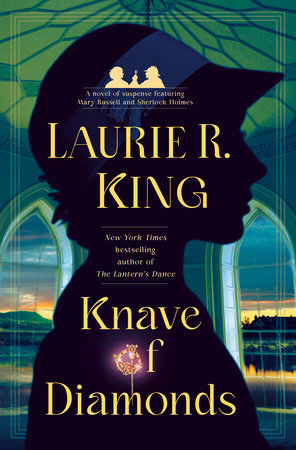
Knave of Diamonds

By Laurie R. King

The current image has no alternative text. The file name is: knave.jpg

“I loved my big brother,” the younger man said at last. “He stood up for me, even sometimes when he shouldn’t have. And his wife was the greatest person in the world. Judith always treated me like a trusted friend, even though she must have known I could be pretty crooked. I loved my nephew, Levi, who was a weird kid with a brain like a clock. He’d have done great things for the world. And…” He reeled his gaze in from the far distance to meet Holmes’ eyes. “I love my niece. I let her down when she needed me, and the decisions I made after that might not have been the right ones. But I won’t do it again. Not with anything that matters.” Oh, Jacob, Holmes thought sadly. You just had to add that caveat at the end, didn’t you?

While all of Laurie R. King’s mysteries, after Dreaming Spies have been top tier for me, the one before this one, Lantern’s Dance was on the level of her earlier books and one of the later ones, The Murder of Mary Russell. There definitely have been some peaks and valleys along the way, as is to be expected in a long series. But as with another historical mystery series I was devoted to, Anne Perry’s Charlotte and Thomas Pitt books, they will continue to be auto-buys for me on both Kindle and Hardcover as long as they continue.

In this one, we are re-introduced to Mary’s long lost Uncle Jake. We had met Jake before in a short story, Mary’s Christmas. (Found in Mary Russell’s War.) That little adventure occurred when Mary was 11 years old and her brother and parents were still alive. Reading that story first is not necessary, but would add to the enjoyment of this book. Jake, who was disowned from the Russell Family for bad behavior, shows up on Russell and Holmes’ doorstep after they have returned home from the wedding of Holmes’ son, Damian Adler. Significantly, Jake appears after Holmes leaves to meet with his brother Mycroft at his request about an “old case that had come to life.” As it turns out, Mycroft wants Holmes’ help in locating the stolen Irish Crown Jewels. New information has come to light in this case that Holmes originally investigated back in 1907. His recommendations were ignored, and the jewels were never recovered. The robbery is true history and the mystery of what became of the Jewels is still unsolved to this day. LRK always incorporates real historical figures and events into her books. It is a big part of their appeal for me.

Meanwhile, back in Sussex, Jake asks Mary’s help in locating the same jewels. He was an accomplice in their theft which just might be one reason why Jake has taken pains not to cross paths with the great detective. Even though it goes against her own ethical values and will potentially put her at odds with her husband, Mary decides to accompany Jake to Ireland to try to find the treasure. Despite everything, he was her childhood hero and she still feels love and loyalty towards him. But unbeknownst to Jake, Mary ensures that Holmes will follow them by leaving him clues as to her whereabouts. And that she is safe. When Holmes returns to their empty home and reads Mary’s seemingly innocuous note, it doesn’t take him long to figure it all out. He has no interest in assisting Mycroft find the jewels, but he is very very interested in the health and safety of his wife. Mary and Jake are not alone together in their quest for long.

The books in this series are usually told primarily from Mary’s first person point of view. Sometimes we also switch to Sherlock Holmes’ 3rd person perspective. In this one we also have Jake’s 1st person account of the adventure and it is interesting to see glimpses of Russell and Holmes through his eyes. I love the way Laurie differentiated the first person narration of Mary and her Uncle Jake. Mary says “One could hear America in his voice.” And this was true on the page as well.

My enjoyment of the book was somewhat compromised in that I really did not like Jake right from the get go, and my dislike did not diminish much as the book went on. I found myself rooting for some kind of takedown. I found him shifty and smug, and his supposed charm was lost on me. He is never truthful with Holmes or Mary unless it suits his interests. The fact that they saw through him from the beginning and still he persisted in trying to obfuscate made me feel contempt as well as distaste. We weren’t meant to trust him or take him at face value, so maybe those feelings were unfair. Even the reveal of his true motives at the end did not restore him to my good graces.

As always in the books, Holmes and Mary spend a good deal of time apart, but that only heightens the anticipation for when they meet up again. I’ve long since stopped hoping for warmth or any obvious loving intimacy between the two. In fact, I don’t know what I would think if their feelings for each other were conspicuous rather than between the lines. This is what passes as grand romance between the two:

He stared at me, seated firmly on a man’s back, then saw the front of my coat. “You’re bleeding!” he exclaimed.
I looked down at my front, and my hands. “It’s not mine. The dogs—” But to my surprise, he yanked me to my feet, and flung his arms around me. Then, more reassuringly, he stood back and seized both my shoulders to berate me.

After the matter of the Jewels are satisfactorily disposed of, we are left to wonder if we will ever see Jake again. I wouldn’t bet against it. But I hope it won’t be for a while. Another character is introduced in this one that I know will become a fixture, at least for a while. And we still have Mycroft’s reaction to the secret revealed in the last book to look forward to. The perfect ending. **4 1/2 stars**

Rating: 4.5 out of 5.

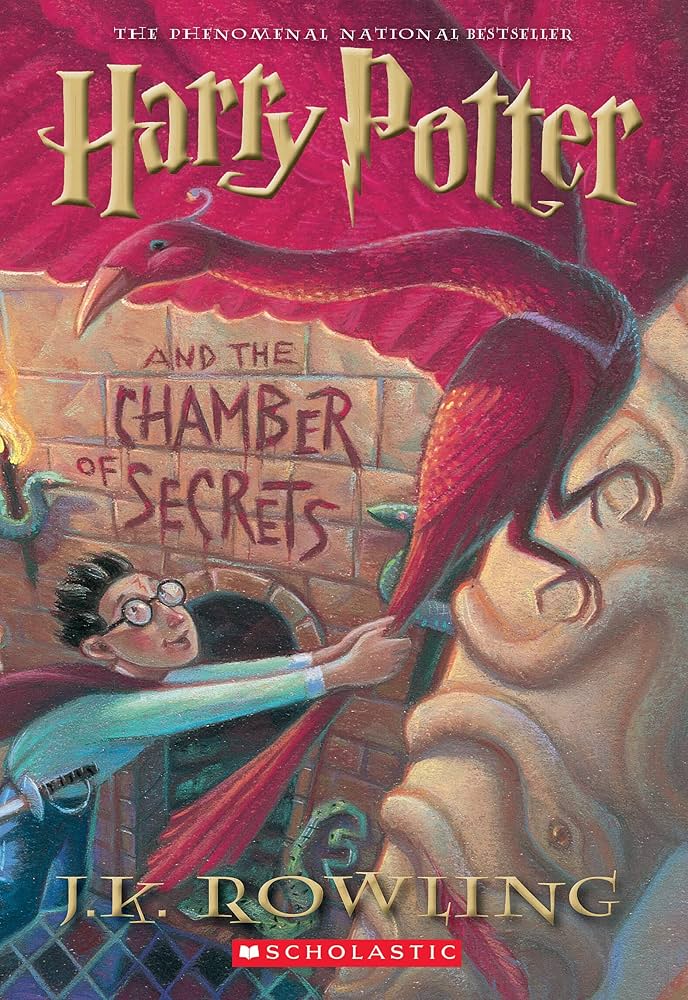
Harry Potter and the Chamber of Secrets

By J. K. Rowling

The current image has no alternative text. The file name is: chamber.jpg

“Not kill you, sir, never kill you!” said Dobby, shocked. “Dobby wants to save Harry Potter’s life! Better sent home, grievously injured, than remain here, sir! Dobby only wanted Harry Potter hurt enough to be sent home!”

**Original thoughts, 2018, on the American Audible version**

Going through all of the HPs, listening on Audible. I have listened to the Stephen Fry Philosopher’s Stone, but all the rest I have are the Jim Dale versions. I much prefer the Stephen Fry, as Jim Dale has some odd intonations and I don’t like his pronunciation of Voldemort and other words. Sometimes Dale sounds really whiny and wheedling, especially with the children’s voices.

**re-read on kindle 06/2025**

Even though this remains a Harry Potter that is not a favorite of mine, it cannot be skipped. It is the introduction of Dobby, Lucious Malfoy, Tom Riddle, Ginny Weasley, Arthur Weasley, the first Horcrux, The Burrow, Polyjuice Potion, the Sword of Gryffindor, Borgin and Burkes, Aragog, Moaning Myrtle, and Fawkes. And probably some others I don’t remember. It gives so much context to many momentous events to come. So many aspects which have far reaching influence on our key players’ final outcomes and fates start here. Nevertheless, it still comes across as a children’s’ book (which it is, of course) but, for me, minus much of the wonder, and, though there were some funny lines, humor, of its predecessor. I almost think the movie surpassed the book in many areas particularly in its portrayal of Dobby. It brilliantly captured the amazing, almost impossible, mix of annoying and adorable, funny and tragic, victim and victor.

And a few things took me out of the book. I couldn’t get over why Harry was shunned and suspected of being the Heir of Slytherin when Draco Malfoy should have been the obvious suspect of everyone from the start.

Then someone shouted through the quiet. “Enemies of the Heir, beware! You’ll be next, Mudbloods!” It was Draco Malfoy. He had pushed to the front of the crowd, his cold eyes alive, his usually bloodless face flushed, as he grinned at the sight of the hanging, immobile cat.

But there is no reaction to this outburst! Where is the outrage? It is a harbinger of Harry being celebrated one minute and vilified the next that repeats itself throughout the series.

Also the whole Polyjuice Potion scheme was a very high risk, low reward plan. It could only succeed in possibly satisfying the trio’s suspicion of Draco’s guilt or innocence, but would prove nothing to anyone else and could never accomplish anything.

Hermione’s infatuation with the nincompoop Lockhart seemed very out of character.

Of course Chamber of Secrets is part of Harry Potter so I liked it a lot. I am enjoying noticing things I didn’t notice before. Listening to books on Audible holds many joys, but you miss some detail and subtleties. This is my second time reading Harry Potter in “print” on Kindle and it’s been quite a few years. I am enjoying all of the re-discoveries. One of these worth noting is the part where Harry first hears the name “Riddle”. He thought it sounded vaguely familiar. He knew he had never heard it before but it “still seemed to mean something to him almost as though Riddle was a friend he’d had when he was very small and had half forgotten.” Chilling. It’s a clue and dark foreshadowing as to what is going on with the connection between Harry and Voldemort that will gradually be revealed in the coming books.

Rating: 3 out of 5.

The Last Flight

by Julie Clark

The current image has no alternative text. The file name is: lastflight-1.jpg

“If I left him, I’d have to do it in a way where he could never find me. Look what happened to Maggie Moretti.”

This was cleverly plotted and tightly constructed. Two beleaguered women from opposite ends of the social spectrum encounter each other at an airport. They are strangers but both are trying to escape life threatening situations. They exchange identities and flights in order to throw off their powerful pursuers. One gets on the plane back to the other’s home town, while her co-conspirator takes her place on a political relief mission to Puerto Rico. It was an off the cuff arrangement born of desperation, but if all works as planned, both will appear to vanish into thin air and be able to start normal new lives. But then one of the planes crashes with no survivors.

Both women and their stories share the focus in this novel. We go back and forth between the two. We trace Claire, who is the abused wife of a powerful political scion, from how she got to be in the desperate position she finds herself, to her meticulously planned escape which blows up in her face at the last minute, to her grasp at the last straw solution that Eva offers at the airport. Then we follow her to Eva’s home in Berkeley, California where she poses as a friend of the vacationing Eva. She tries to remain hidden from the long reach of her powerful husband who is starting to suspect that something fishy is going on and runs into those that are pursuing Eva. It soon becomes clear that Eva did not tell her the truth about why she wanted to change places. The focus of Eva’s story is her past life and how she got into the dangerous situation she finds herself in. As we become invested in Eva’s story up to the day of the crash, we learn that she may not have gotten on that plane after all, and may still be alive. This hope keeps our interest in Eva at a high pitch even though she is not as sympathetic a character as Claire.

There is more than one good twist as things come to their conclusion, one of which explains a coincidence that was just too far-fetched to be believed. It made the book a lot smarter than I thought it was. I was engaged in both women’s stories almost equally but probably Claire’s a little more as it is her we follow in present day as she tries to solve the mystery of Eva, navigates a new identity in a strange town, keeps tabs on her husband, and also must deal with the dangers and secrets in Eva’s life as well. There was just the right amount of tension and suspense for me which means occasional relief from unremitting anxiety. The ending was a bit bittersweet, which I usually don’t like, but it seemed right and was accomplished admirably. The sweet part of the ending thoroughly made up for the aspects that didn’t end up quite the way I wanted.

Rating: 3.5 out of 5.

Regency Buck

By Georgette Heyer

The current image has no alternative text. The file name is: regencybuck.jpg

As familiar as I was with this story, listening to it being read (Audible-Jasmine Blackborow),as always, gave me a fresh outlook and enjoyment. The narrator was excellent, and I must credit her with making the ever-irate Judith a little less irritating and childish-seeming and Worth’s highhandedness understandable. This was the first Regency Romance by the mother of the genre. So this is the book, folks. The origin of it all. The urtext if you will. And as such, a more archetypal example there could not be. Judith is the quintessential strong, fiery, and headstrong type heroine. Worth is the all-knowing all powerful hero, a Corinthian, no mere Dandy, who excels at everything he does. Heyer mixed and matched all kinds of other personalities in her books of course, but this has sure been a popular combination of hers and her followers through the years.

The story unfolds around the country-raised and very rich Miss Judith Taverner and her eager but dumb brother Perry coming to London for the season after the death of their father. Due to a massive error on his part (like father like son in the brain department), they are under the guardianship of the 5th Earl of Worth, not his deceased father, the 4th Earl. Judith must have taken after her mother. To make a long story short, Worth gets on the independent-minded Judith’s bad side from the start with his arrogant dismissive ways, and they are at loggerheads throughout the novel. It is, in fact, an enemies to lovers trope, and a good one. Julian Audley, 5th Earl of Worth is not one of the more popular Heyer heroes. Some find him too overbearing, cold, and dictatorial. His behavior at their second meeting manhandling the prickly Judith into his phaeton (for her own good) and purposely provoking her by giving her a little kiss hasn’t won him any points among enlightened readers on the lookout for sexual harassment either. But I’ve always been a fan. His deft parryings of poor Judith’s every effort to get the better of him are very humorous. I did sympathize with and even admired her persistent efforts to exert her independence but for an intelligent girl she was not very wise when it came to her guardian. “Mad as a wet hen” is a phrase that comes to mind. She was forever letting her emotions and temper get the better of her brain while always trying to maintain her dignity. Worth’s overbearing maneuvers were often only to save her from cutting off her nose to spite her face while purposely provoking her for his own amusement. He just couldn’t help it.

As the Taverners are immersed in all manner of sport, culture, fashion, entertainments, and ways of the elite of society (AKA “The Ton”) in her introduction to London, so is the reader. The plot provides Georgette Heyer the perfect framework to display all of her meticulous research into the Regency period. The book could be used as a primer for aspiring writers of regency romances. Various real historical figures of the time are woven into the narrative including the Duke of Clarence (who proposes marriage), Gentleman Jackson the boxer, The Prince Regent (who makes a pass at her), and particularly Beau Brummel, who is a great friend of Worth and who becomes a wise advisor to Judith. We are treated to many actual quotes from the great Brummel woven into his conversations with Judith. Some readers count all of the factoids, long descriptions, historical details against the book. And I probably skimmed through a lot of it myself in previous readings. But listening to it all seemed different. I couldn’t just skip ahead and I liked it all. It is so obvious that GH took such delight in sharing all she had learned, and worked hard to include all of her little nuggets as seamlessly as possible. After writing historical romances set in other periods for 14 years prior to this first Regency, she finally found her niche, and it seemed to me like she was having a ball with the writing of it.

On top of the slow burn romance and Judith’s adventures amongst The Ton, we have a mystery! Someone is trying to kill Perry. It’s really not much of a mystery. Readers reading the book at the time might have been a little misled, but those who have read other Heyers or almost any other regency or gothic romance written in the years following this one will not be fooled. We 100% know who Judith will end up with from their first meeting so we know he is not the murderer. There is only one other person with a motive, and though he fools Judith, as savvy readers, we see right through him.

After our two combatants/lovers declare their true feelings, we are treated to a long happy conversation in which they have a lot of fun dissecting their relationship. We get a lot along the lines of “What did you think when I…? And when you did this, I just…! How could you have…? I thought I had lost you when…! Oh that day at…! This is very unusual for Georgette, and I absolutely loved it. Usually it’s declarations, clinch, and “The End.”

Georgette would continue to refine her style as the years went by, but this one, although it doesn’t have some of the subtle or hilarious characterizations of some of her later works, should not be missed. It is the foundation of a genre.

Rating: 5 out of 5.

Same Time, Next Week

The current image has no alternative text. The file name is: sametime.jpg

by Milly Johnson

Timewise, I can never be too far from a Milly Johnson book. I’ve been re-reading them sporadically on Audible while waiting for a new one by her. This time, I ended up reading this new title at the same time as I was listening to an old favorite, The Woman in the Middle. Unfortunately the main heroine of the older book bore a great similarity to one of the main characters in this one in personality as well as her challenges and journey. So every time I returned to this one after listening to the other, I had to get my thoughts together and reset, so to speak. It wasn’t too difficult as “Middle” had only one main story to Same Time, Next Week’s fairly equally distributed stories of five women’s paths to love and inner growth.

Same Time… follows the lives of women who start out at, or soon reach, very low points in their lives. How they find their ways to happiness, success, and their just deserts is the very familiar foundation to any reader of Milly Johnson. It didn’t break too much new ground, that’s for sure. And I am more than fine with that. With Milly, it’s not the plot, but the writing, humor, and the way she makes you care about her characters. And you can’t beat the way she always makes sure the good guys triumph and the bad guys get what they deserve. With Milly, due rewards and punishments are super-sized. And that’s a good thing, because she really puts her characters through the gauntlet at the hands of their tormentors. When the character you grow to care about suffers, you suffer along with them. The fact that you know revenge and justice are coming for all makes it all worth it.

In this one, I would say the two main characters are Amanda and Mel. Amanda is in her 50s and suffering mightily from the symptoms of menopause. Milly gives us a play by play on this stage of life, and it’s not pretty. For those who have yet to go through this, I hope your experience does not mirror Amanda’s. Take hope that her experience is not a universal one. Some sail through with just a few blips. She is faithfully and lovingly taking care of her elderly mother who does not appreciate her and has never really loved her. On the other hand, she worships her worthless and immoral son, Bradley, who only cares about what he can get out of her and is eagerly anticipating his inheritance. The elderly, those that care for them, and their struggles, is an issue that Milly has tackled before. This one is more harrowing and heartbreaking than usual.

Mel has been married, she thinks happily, to Steve for 30 years. He goes to a highschool reunion and starts having an affair with a woman he meets there. My first question was why Mel didn’t go with him, but it is never even mentioned as a consideration. Perhaps school reunions are different in the U.K. It’s not a good idea not to accompany your spouse to a high school reunion, in my view. If Mel had gone with Steve, none of her story would have happened, and that would have been a bad thing. Bad for the reader, and, as it turns out, bad for Mel. Because life without Steve teaches her that she was not so happy in her marriage after all.

Astrid, Sky, and Erin round out the quintet of women who, through the friendship group that Amanda starts, become friends and supporters of each other through their trials and tribulations. The group meets in the newly opened Ray’s Diner, a new business in Spring Hill Square, a little center that has made a number of appearances in previous books. Sky is in her late twenties and haunted by a false accusation that her father was a serial killer. It ruined his life and keeps raising its ugly head. Her sweet and gentle nature is also being taken advantage of by her landlord from hell who moved in on her and is a creepy pervert to boot. This part of the story was very disturbing and I didn’t understand how this could have been allowed to happen. She is in love with her boss who is 20 years older and the ex-husband of…Erin. The two exes were and are great friends but were unhappy in their marriage. Erin is struggling with guilt and the death of the woman she left her ex, Bon, for. Astrid, who is a trans woman, played a prominent role in Afternoon Tea at The Sunflower Cafe and was also in The Mother of all Christmases., and The Queen of Wishful Thinking. She is struggling with the death of her husband and a lack of purpose. Astrid is a great character, a real “cracker,” pun intended. “Cracker” as in the British slang version, I hasten to add.

Once again, Milly expertly weaves a lot of threads together to fashion very entertaining and satisfying journeys of all her protagonists. And of course that includes finding love as well as their paths forward through grief of all sorts to the promise of happiness and fulfillment.

Rating: 4 out of 5.