by Jane Austen
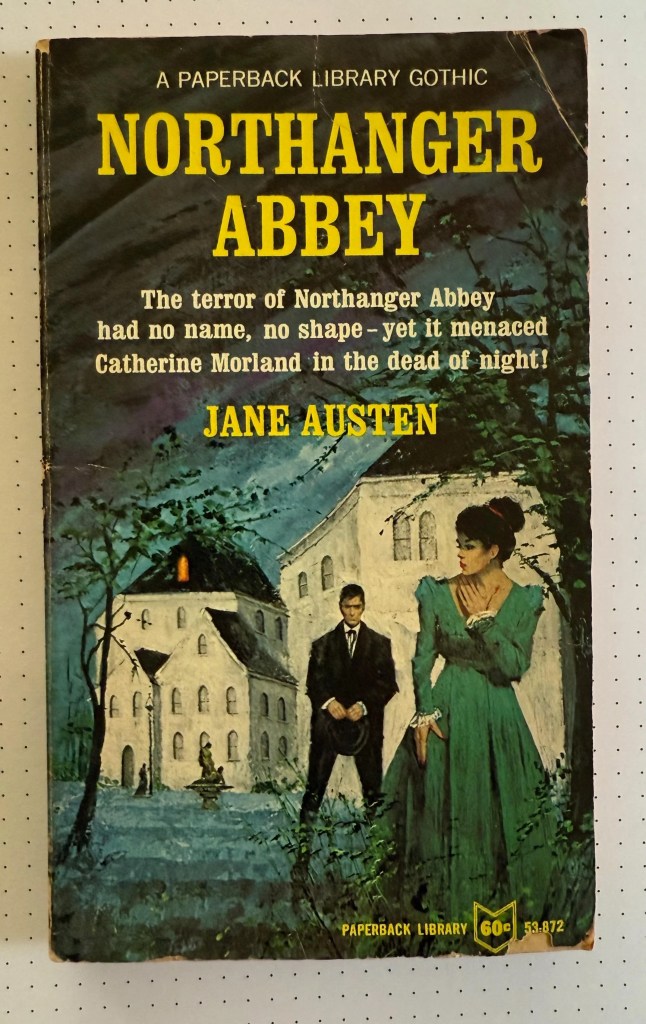
Although I had never read this novel before, I knew the plot backwards and forwards thanks to the two BBC productions I have watched numerous times. Also I listened to an abridged version several years ago. I had started Val McDermid’s modern re-working of Northanger Abbey and it was not going well. It started me to thinking, “why am I reading this, when I still haven’t actually read the real one”? I decided to listen to it again since I have had the unabridged version in my Audible library for years. It was very funny right from the the start. It did go well. Of course I knew all the ins and outs of the plot. But I probably would have enjoyed it more if it were the first go round of any kind. Also, I suspect I would have picked up even more of the humor if I had read it on the page.
The book begins with Jane Austen informing the reader of all reasons why Catherine Morland, our heroine, is not suited to the role. In fact, The Narrator (Austen) pulls no punches in eviscerating Catherine and detailing her lack of heroic qualities. Brains? Nope.
She never could learn or understand anything before she was taught; and sometimes not even then, for she was often inattentive, and occasionally stupid.
Beauty? Nope
…and Catherine, for many years of her life [was] as plain as any. She had a thin awkward figure, a sallow skin without colour, dark lank hair, and strong features…” No mention of “speaking, twinkling, intelligent, or laughing gray eyes, you will notice. But… At fifteen, appearances were mending…she had now the pleasure of sometimes hearing her father and mother remark on her personal improvement. “Catherine grows quite a good-looking girl-she is almost pretty today.”
Talents and accomplishments? Nope.
Her taste for drawing was not superior. though whenever she could obtain…any…odd piece of paper, she did what she could in that way, by drawing houses and trees, hens and chickens, all very much like one another. Writing and accounts she was taught by her father; French by her mother: her proficiency in either was not remarkable, and she shirked her lessons in both whenever she could. What a strange, unaccountable character!—
I laughed aloud at the idea of a house, a tree and a chicken looking very much alike. After being assured that Catherine’s father “is not the least addicted to locking up his daughters” we read that her mother was a woman of useful plain sense, with a good temper, and, what is more remarkable, with a good constitution.”
So having assured us that Catherine does not fit the mold of a Gothic heroine she eventually plops her in the middle of a plot worthy of any respectable gothic romance. In her own mind. For Catherine is a little obsessed with gothic novels. Taken to Bath by well off family friends, Catherine is drawn in and befriended by the manipulative Isabella Thorpe and her crass brother who tries to worm his way into her affections. She also meets the upstanding and witty Henry Tilney and his nice sister Eleanor. Catherine develops a tendre for him and he seems to reciprocate her feelings. Eleanor invites her to their ancestral home, Northanger Abbey, for several weeks, and Catherine is in a state of shivery delight that the Tilney’s ancestral home is an actual Abbey.
Her passion for ancient edifices was next in degree to her passion for Henry Tilney…With all the chances against her of house, hall, place, park, court, and cottage, Northanger turned up an abbey…long damp passages…narrow cells and ruined chapel…the hope of some traditional legends, some awful memorials of an injured and ill-fated nun.”
Although unlike the films, the Abbey does not live up to her imagination, (not an “antique chimney”, dirt, or cobwebs in sight-Neither “awful forebodings of future miseries” nor “sighs of the murdered” either) she finds plenty of fuel for her fantasies. She convinces herself that Henry and Eleanor’s intimidating, strange-acting, and hot-tempered father murdered their mother (or possibly has her imprisoned somewhere in a secret cell.) When she is caught snooping in a place she should not be by Henry, he sets her straight and makes no bones about what he thinks of her deluded fantasies. In the face of his disdainful take-down she comes to her senses with a decided ker-plunk. (But he still likes her.) Ironically, it is after her wake-up call when General Tilney genuinely does her a shocking cruelty and even puts her life in danger by his rude and heartless actions. So maybe not so detached from reality after all.
Although Catherine Morland is not the crispiest chip in the bag, I grew to like her very much. She is kind and good-hearted, and if she is sometimes silly it stems from naivety and innocence rather than brainlessness. I was completely won over by this passage:
[Henry Tilney] looked as handsome and as lively as ever, and was talking with interest to a fashionable and pleasing-looking young woman, who leant on his arm, and whom Catherine immediately guessed to be his sister; thus unthinkingly throwing away a fair opportunity of considering him lost to her forever, by being married already… he had never mentioned a wife, and he had acknowledged a sister. From these circumstances sprang the instant conclusion of his sister’s now being by his side; and therefore, instead of turning of a deathlike paleness and falling in a fit on Mrs. Allen’s bosom, Catherine sat erect, in the perfect use of her senses, and with cheeks only a little redder than usual.
And she shines in comparison to two other women in the story: Isabelle Thorpe and Mrs. Allen. Mrs. Allen makes Catherine seem sensible and resolute and Isabelle highlights Catherine’s virtues by being her opposite. That Catherine has been able to attract the friendship and liking of such a role model as Eleanor Tilney also speaks very well of her. And how can one be too hard on someone who is such a voracious reader of novels? Unfortunately, although witty and tolerant, I found Henry a bit prosy and self satisfied. Not as likable as the Henry Tilney of the films.
“Henry,” said Miss Tilney, “you are very impertinent. Miss Morland,…He is forever finding fault with me, for some incorrectness of language, and now he is taking the same liberty with you. The word “nicest,” as you used it, did not suit him…”Very true, said Henry, “and this is a very nice day, and we are taking a very nice walk and you are two very nice young ladies. Oh! It is a very nice word indeed! It does for everything. Originally perhaps it was applied only to express…”
And blah blah blah.
But that aside, I found myself chuckling at the wry humor, admiring Austen’s characterizations, and the skewering of the gothic novels of her day. Even though I am an old Gothic reader myself, I am not at all tempted to read one of the many of Catherine’s reading list based on the little snatches we are favored with in Northanger Abbey. I now have read all of Jane Austen’s books except Sense and Sensibility and Pride and Prejudice several times. I guess you could say I’m saving it.
 Rebekah's Readings and Watchings