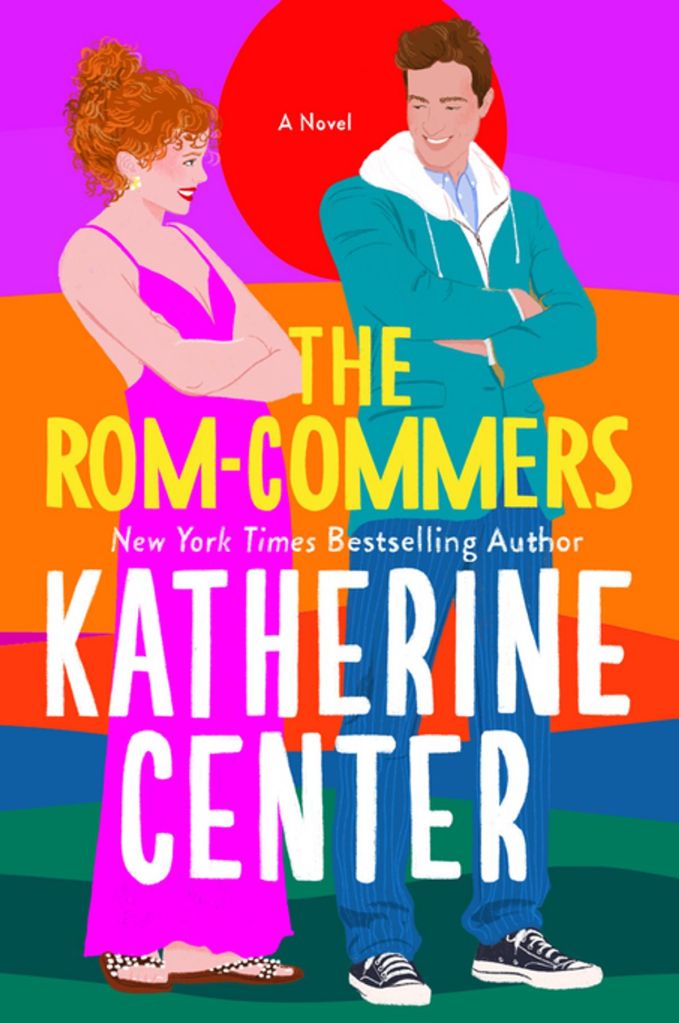
By Katherine Center
How foolish are you to hope for the best? How pathetic is it to try to win after you’ve already lost? How naive must you be if you don’t know that humanity is dark and vicious and totally irredeemable? But… If those are the only stories we tell about ourselves, then those are the only stories we have.…If you try to write stories about love and kindness, you really are risking being ridiculed. Which might be the worst form of social death. But… be brave and try….Poor happy endings. They’re so aggressively misunderstood.…Tragedy is a given. There is no version of human life that doesn’t involve reams of it. The question is what we do in the face of it all.
Emma is a failed screenwriter living in Houston Texas. This is because she has to take care of her Dad, who, due to a rock climbing accident, has Ménière’s disease which puts him in constant danger of falling and seriously injuring himself or worse. And she does this happily because
My dad was always the dad everybody wanted. If there were a dad store, he’d be a bestseller. They’d have rows and rows of him for sale, right up front. He was always warm and encouraging and connected and goofy—even before.
When she is offered the career opportunity of a lifetime and a chance to kick-start her life working on a screenplay/script with her writing idol, Charlie Yates, she initially refuses and has to be talked into accepting. As much as I loved this book and ended up liking Emma very much, at first, I didn’t care much for her. She was very martyr-y about her family, and I have read just about enough of heroines who will sacrifice all for a husband, parent, sibling, or whatever no matter how wrong and unjust. Especially when they seem to get some kind of charge out of being the all-important irreplaceable lynchpin without whom everything would collapse. We kiss all of that goodbye after her Dad is left in her sister’s capable hands and Emma’s adventure in Hollywood begins. As does the rom part of the rom-com.
Charlie starts out being very rude and hurtful to Emma and otherwise very ornery. He seems more concerned with showing the world how cool and unorthodox he is- too important to follow the protocols of basic human courtesy and respect. But if you’re going to do grumpy/sunshine best have a grumpy one, and the grumpier the better. He has been forced to write a screenplay for a Romantic Comedy, a genre he has only contempt for, in order to get another project green lighted. It is so bad that Emma, a romantic comedy guru, has been called in by their mutual agent to help him fix it.
“I’ve just read a romantic comedy script,” I said, “that will destroy human civilization as we know it.”
Although on the surface, Charlie at first comes across as off the chart as far as difficult and unpleasant, It becomes obvious pretty quickly that he respects Emma’s talent and work and is falling head over heels in like and love with her. Also, Emma gives him a lot of lip and is not intimidated one bit.
“Let me ask you a question,” I said next when I was all set up. “Do you want me to be honest? Or do you want me to blow smoke up your ass?” “I want you to be honest,” Charlie said—no hesitation. But that didn’t mean much. Writers always want you to be honest—but only if you love it. “Because I didn’t love it,” I said. “I figured that out when you called it ‘apocalyptically shitty.’” “Buckle up, then”
Katherine Center masterfully manages to include as many romantic comedy tropes as possible in this romantic comedy tribute to the romantic comedy: opposites attract, enemies to lovers, grumpy/sunshine, forced propinquity, work adversaries, unequal status, fish out of water, dark secret, emotional scars, sworn off relationships, unrequited love, everyone can see it, ugly duckling (unmanageable red hair), break up to save him/her, and big public love confession/tribute. I’ve probably left some out. She embraces the genre within an inch of its life but does not sacrifice a great story and characters we care about for parody.
Towards the end of the book, A crisis returns Emma to her family and her behavior towards her sister Sylvie is hateful. But since Emma has been telling her story to us from a perspective of gained wisdom and insight, often breaking the fourth wall, we can’t get too disgusted with her. We know that she knows she was wrong (and she knows we know it.)
I insisted on taking the first shift that first night—still unshowered…which allowed me to extend the enjoyable feeling of having been wronged. Not only was Sylvie guilty of attempted patricide and saying the meanest-thing-ever to me, she also wouldn’t let me go home to take a shower. What a monster.
I usually like my love stories to be secondary to the main plot. In this book, it is the main attraction. It still engaged me 100% while still leaving a lot of room for family drama, personal growth and lots of comedy and sharp banter. Thanks to what Emma calls “gaps in information” my curiosity about certain things also kept me turning the pages. (It’s a … gap in information.” “It’s a writing term for how to create curiosity in the audience by leaving out crucial information.”) Yes, it worked.
As icing on the cake, in the Author’s Notes, Katherine Center continues her defense of the Love Story and specifically, the Romantic Comedy genre, that she began in her previous book, Hello Stranger.
Exciting news: I’ve chosen the hill I’m going to die on. And it’s the hill of standing up for love stories….If you’re a writer, and if you’ve spent your life reading and loving and studying and obsessing over stories, and if the stories that you genuinely, authentically love the most—by a mile—just happen to be the stories that are the most disdained, the most dismissed, the most ridiculed, and the most eye-rolled at . . . you’re gonna have some work to do.
It was great. Amen, Katherine Center, Amen. Another book like this and Hello, Stranger and I might have to move Katherine Center to auto-buy status. And it’s probably time to give her backlist another try.
 Rebekah's Readings and Watchings
Nice review.
LikeLiked by 2 people