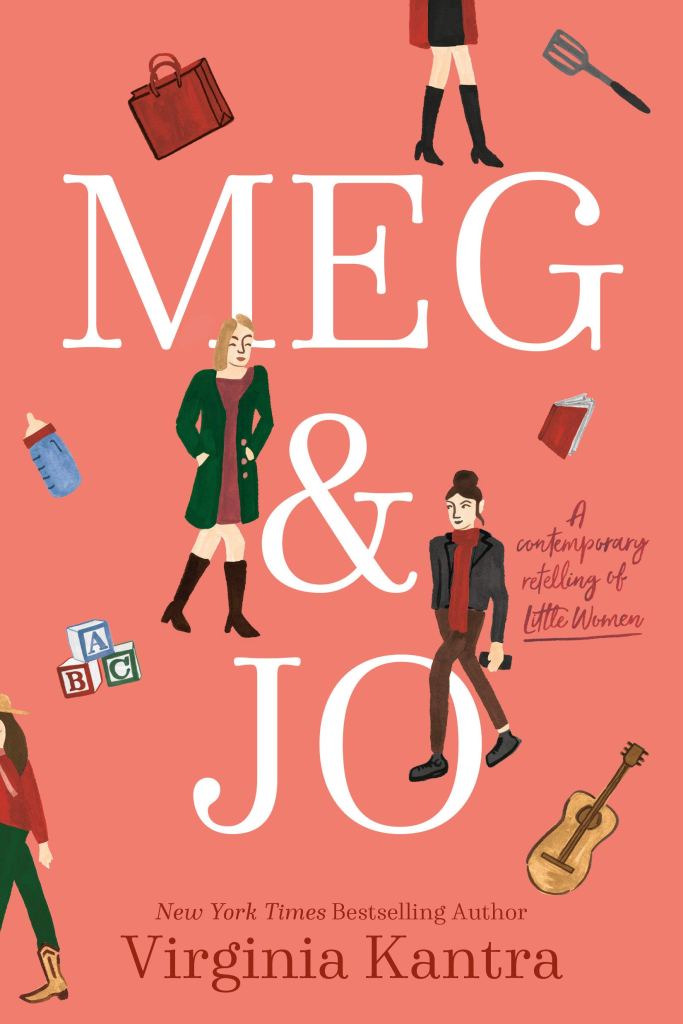
by Virginia Kantra

Our mother, who never took a day’s vacation in her life, had encouraged all of us girls to work hard and follow our dreams. Meg was the perfect mother to two perfect children. Jo was a bestselling author. Beth was a budding country star. And I . . . I made accessories. It didn’t matter how many Instagram followers or employees I had. In my family’s eyes, I was still little Amy, playing with scraps from Miss Hannah’s quilting bag.
You know that Virginia Kantra’s updating of Little Women to the 21st century is legit when by the end, half of the March family ends up in therapy. She did a thoughtful and effective job crafting a story that reflects the problems and challenges of young women of today just as the original Little Women, did for the girls of that era.
To my surprise, I didn’t enjoy this one quite as much as Meg and Jo. I’ve always thought Amy was the most interesting sister with a good character arc. And Beth, well, Beth. I liked Amy and Trey (Laurie) and their romance, but I’m afraid Beth drove me a little crazy. She was such a wet noodle.
Amy is a successful designer of high-end handbags based in New York City. Her past that fueled her ambition to equal or outdo her sisters, especially Jo, includes her being an innocent victim of a sexting scandal in high school resulting in her being labelled “Easy A.” She also hooked up with Trey (Laurie) in Paris while he was still raw from Jo’s rejection. Giving in to her lifelong crush, he breaks her heart.
Beth was a little tough to take. She is a Grammy award-winning songwriter and rising country music star. But she suffers from stage fright and hates performing. Her powerful boyfriend is a selfish jerk and runs roughshod over her. She keeps saying how in love with him she is, yet she does not enjoy sex with him and fakes her orgasms. She subjugates herself to him and allows herself to be used and taken advantage of while mentally flagellating herself.
We soon find out that she suffers from lifelong eating disorders (she started throwing up on purpose at 10 years old, not to get thin, but to get out of school.) This has somehow morphed into not eating, continuing to purge, obsessively counting calories, and over-exercising to be thin and exert control over her body. But where did all this come from? She had always been loved, supported, and encouraged. There just didn’t seem to be any triggers to cause her disease. In Little Women, Beth was shy, timid, kind, and good. But she was never weak. Far from it. I’m not talking about the eating disorder here, but how she let people treat her. It was wise to choose to have Beth suffer from anorexia rather than scarlet fever, or cancer, for example. I have little doubt that Beth’s thoughts and feelings and the symptoms of her disease are well-researched and authentic. But, for me, the author didn’t really give Beth the foundation or proper backstory the character needed for her problems and behavior to be understood and empathized with. I guess I needed to go on that terrible journey with her. I really needed to understand how she got there, rather than just being presented with the fact. My reaction to Beth bothered me. Because I failed to understand her, her lack of backbone and passivity really started to annoy me early. I grew very impatient and frustrated with her constant tricks and lies in order to appear “normal” in front of her loving family.
It just didn’t seem credible that her family didn’t catch on sooner. She had to be found on the side of the road in convulsions before the “Are you all right?” “I’m fine.” mantra failed to appease them. Or the constant “Have something to eat.” “ I’m not hungry” or “I already ate”, for that matter. Considering everything she was doing to her body and not doing, She would have looked horrible in real life long before she was hospitalized.
I liked how Kantra transplanted some characters from Little Men to round up some love interests for two of the characters. Her weaving of scenes we remember from the original novel with the creative and original modern developments was well done. The exploration of Abby and Ash’s (Mr. And Mrs. March) marriage and personalities was deft. All in all the novel was a message of hope, and working on the relationship with your loved one(s). It was also a message of rising above disappointments and bad things to make a better life than you would have otherwise. In the end, Amy realizes that she wouldn’t have become the person and success she is without them. In Meg and Jo, the characters of Rose, her adopted sister Phoebe, and Charlie Campbell are mentioned. If these characters from Eight Cousins are of the same universe of these two companion novels and are signs of another novel to come, I can’t wait. **3 out of 4 stars**
June 26, 2021
 Rebekah's Readings and Watchings