By Patrick Dennis
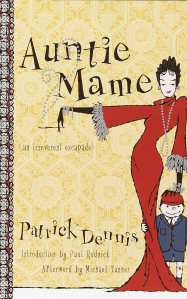
It’s been many many (many) years since I have reread this mid-century classic gem and old favorite of mine. I’ve read a few of Patrick Dennis’s books, many now very hard to find and undeservedly out of print. Two of the three books that are still readily available are (strangely) ones that I haven’t read and have no desire to. I guess that means my taste in novels by Patrick Dennis must be a little off. Around the World with Auntie Mame is still available and is now on my TBRR (To Be Re-Read) list. I’ve also read Guestward Ho, The Loving Couple, and The Joyous Season, which is one of my favorite books of all time, surpassing even this, his most well-known work. The Joyous Season is out of print and rarely mentioned when the subject of Patrick Dennis and his books come up in my poking around the internet. The reason why has always been confounding to me. I absolutely adored the 10-year-old narrator Kerry and his 6-year-old sister Missy whose upper-crust Manhattan parents’ marriage blows up one disastrous and hilarious Christmas Day. Besides the laughs on every page, I loved the romantic comedy aspects to it. I’ll stop there because otherwise this review of Auntie Mame will turn into trying to convince readers to read The Joyous Season instead. (But then read Auntie Mame, because it is a comedy classic and the basis for an award winning Broadway play and Hollywood movie for good reason.)
I listened to this on Audible and the narrator, Christopher Lane, was fine, although I would have wished for a more youthful voice as the book is narrated by Patrick whose adventures with his eccentric Aunt start when he is orphaned in 1929 at 10-years-old and ends around 3 years after his graduation from University. Mame Dennis’s guardianship is abruptly curtailed early on by his conservative trustee when young Patrick is discovered in an avant-garde school where all of the students and two teachers are racing around naked. From then on Mame only gets her “depraved” hands on him Christmases and summers.
I have seen the movie quite a few times and fairly recently. Most of the scenes play out much the same, with the book having the advantage of Patrick’s loving but sometimes acerbic narration and commentary on his and Mame’s life together. And of course the hilarious if sometimes harrowing episodes in their lives are unabridged. The first 3 chapters about Patrick’s and Mame’s first meeting up to when he is shipped off to boarding school for his own protection are pretty much the same. After that we are only favored with Patrick and Mame together only sporadically, while Patrick fills us in on what he knows about her adventures while he is safely at school. With the stock market crash and Auntie Mame “ruined, ruined, ruined!” (not by a long shot), she is forced to keep up with her expenditures by relying on her considerable social contacts for gainful employment. Her adventures on the stage with her great friend, Broadway star Vera Charles, down to her adventures selling roller skates at Macy’s, are almost identical to the movie. It is at Macy’s that she meets the love of her life, the fabulously wealthy Beauregard Pickett Burnside III, one of the “big, genial, easygoing, lovable” southerners. The movie only slightly curtails her clash with the old-time southern culture of Beau’s family and friends in the horsey set revolving around Peckerwood, Beau’s Georgia plantation. However, in the book, (trigger warning) horses die. I had forgotten that. After Beau’s untimely death (kicked in the head by a horse rather than falling off a mountain) Auntie Mame, as his widow, inherits all and is free to indulge her eccentric and lavish lifestyle once again. Upon Patrick’s prep school and then college years things start to diverge from the movie in plot, but not in spirit. The Agnes Gooch affair is much longer and set in Apathy, Massachusetts, home of Patrick’s St. Boniface Academy. Patrick is up to his neck with Agnes while trying to keep her and his aunt isolated from the school authorities to avoid possible expulsion. Agnes’s fate is a much happier one in the book. While in College (Ivy League, of course) we have Patrick entangled with a stripper named Bubbles, and Mame trying to recapture her youth by adopting Patrick’s social set as her own. Patrick’s engagement to the caricature of shallow wealthy WASP-dom, Gloria Upson, and her even more offensive family in the Connecticut suburbs are almost word for word. Except that in the book, they are even more racist, ridiculous, and pompous. Patrick as a young man is not as lovable as Patrick as a child. He takes way too long to rid himself of Bubbles, and to wake up to Gloria and her family. How he ever got engaged to her is a mystery other than she is beautiful and “stacked.” Wouldn’t be the first time, I guess. Moving on to WWII, Auntie Mame takes in some British War Orphans who are nothing more than thugs and reprobates who leave her with a permanent white streak in her hair. This is not in the movie at all, and Patrick’s meeting with his future wife, Pegeen, is completely different. Book Pegeen is a hoot. Patrick was a lucky guy, and sorry to say, given his history with women, I was somewhat amazed he had the good sense to nab her. As in the movie, everything comes full circle with Auntie Mame “kidnapping” their son Mike for an educational summer in India(Ha!).
Mame and Patrick become entwined with any manner of humanity likely to be ensconced in New York or environs from 1929 to 1945. And all are skewered in equal measure be they elite or common, liberal and avant-garde or conservative and stuffy. Some with affection, some not. Only two escape Patrick Dennis cynical wit: Beau, Mame’s late husband, and Pegeen (and maybe her father, Mickey the Mick.)
Despite their devotion to each other, Patrick is under no illusions as to Mame’s foibles and sometimes foolhardy impulses, And this applies to Mame’s insights into Patrick’s youthful follies and sometimes unfortunate tendencies. But the bottom line is that she raised a good man which we know by reading between the lines. Despite his understandable frustrations and complaints, he is always there for his Auntie Mame, and she for him (although as a master manipulator she is too wise to always lay all of her cards on the table.)


 Rebekah's Readings and Watchings