Northanger Abbey

by Jane Austen

The current image has no alternative text. The file name is: northangera.webp

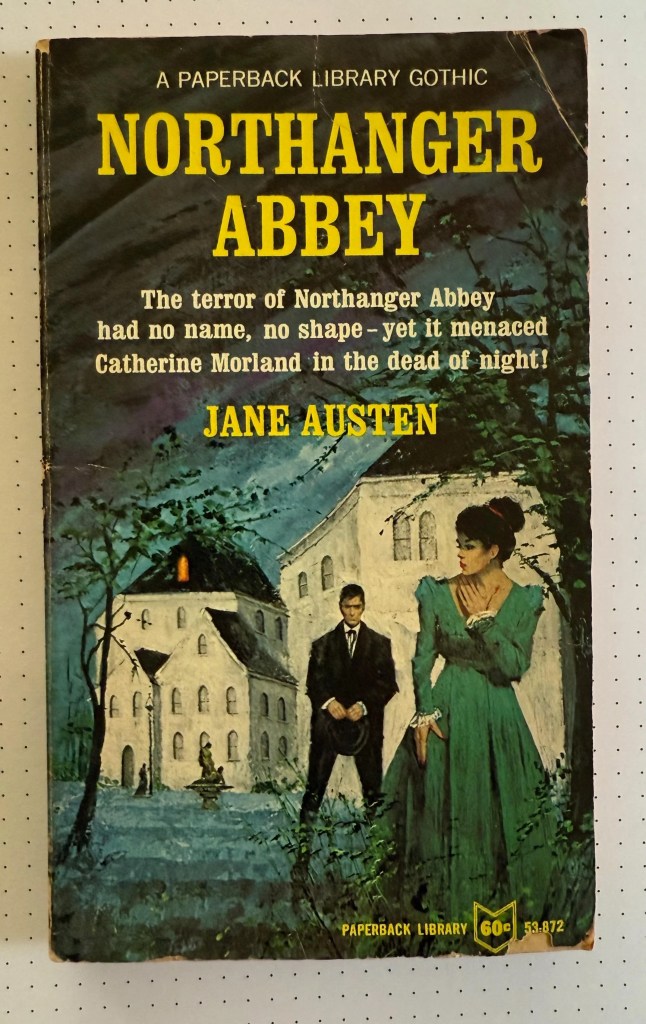
Although I had never read this novel before, I knew the plot backwards and forwards thanks to the two BBC productions I have watched numerous times. Also I listened to an abridged version several years ago. I had started Val McDermid’s modern re-working of Northanger Abbey and it was not going well. It started me to thinking, “why am I reading this, when I still haven’t actually read the real one”? I decided to listen to it again since I have had the unabridged version in my Audible library for years. It was very funny right from the the start. It did go well. Of course I knew all the ins and outs of the plot. But I probably would have enjoyed it more if it were the first go round of any kind. Also, I suspect I would have picked up even more of the humor if I had read it on the page.

The book begins with Jane Austen informing the reader of all reasons why Catherine Morland, our heroine, is not suited to the role. In fact, The Narrator (Austen) pulls no punches in eviscerating Catherine and detailing her lack of heroic qualities. Brains? Nope.

She never could learn or understand anything before she was taught; and sometimes not even then, for she was often inattentive, and occasionally stupid.

Beauty? Nope

…and Catherine, for many years of her life [was] as plain as any. She had a thin awkward figure, a sallow skin without colour, dark lank hair, and strong features…” No mention of “speaking, twinkling, intelligent, or laughing gray eyes, you will notice. But… At fifteen, appearances were mending…she had now the pleasure of sometimes hearing her father and mother remark on her personal improvement. “Catherine grows quite a good-looking girl-she is almost pretty today.”

Talents and accomplishments? Nope.

Her taste for drawing was not superior. though whenever she could obtain…any…odd piece of paper, she did what she could in that way, by drawing houses and trees, hens and chickens, all very much like one another. Writing and accounts she was taught by her father; French by her mother: her proficiency in either was not remarkable, and she shirked her lessons in both whenever she could. What a strange, unaccountable character!—

I laughed aloud at the idea of a house, a tree and a chicken looking very much alike. After being assured that Catherine’s father “is not the least addicted to locking up his daughters” we read that her mother was a woman of useful plain sense, with a good temper, and, what is more remarkable, with a good constitution.”

So having assured us that Catherine does not fit the mold of a Gothic heroine she eventually plops her in the middle of a plot worthy of any respectable gothic romance. In her own mind. For Catherine is a little obsessed with gothic novels. Taken to Bath by well off family friends, Catherine is drawn in and befriended by the manipulative Isabella Thorpe and her crass brother who tries to worm his way into her affections. She also meets the upstanding and witty Henry Tilney and his nice sister Eleanor. Catherine develops a tendre for him and he seems to reciprocate her feelings. Eleanor invites her to their ancestral home, Northanger Abbey, for several weeks, and Catherine is in a state of shivery delight that the Tilney’s ancestral home is an actual Abbey.


Her passion for ancient edifices was next in degree to her passion for Henry Tilney…With all the chances against her of house, hall, place, park, court, and cottage, Northanger turned up an abbey…long damp passages…narrow cells and ruined chapel…the hope of some traditional legends, some awful memorials of an injured and ill-fated nun.”

Although unlike the films, the Abbey does not live up to her imagination, (not an “antique chimney”, dirt, or cobwebs in sight-Neither “awful forebodings of future miseries” nor “sighs of the murdered” either) she finds plenty of fuel for her fantasies. She convinces herself that Henry and Eleanor’s intimidating, strange-acting, and hot-tempered father murdered their mother (or possibly has her imprisoned somewhere in a secret cell.) When she is caught snooping in a place she should not be by Henry, he sets her straight and makes no bones about what he thinks of her deluded fantasies. In the face of his disdainful take-down she comes to her senses with a decided ker-plunk. (But he still likes her.) Ironically, it is after her wake-up call when General Tilney genuinely does her a shocking cruelty and even puts her life in danger by his rude and heartless actions. So maybe not so detached from reality after all.

Although Catherine Morland is not the crispiest chip in the bag, I grew to like her very much. She is kind and good-hearted, and if she is sometimes silly it stems from naivety and innocence rather than brainlessness. I was completely won over by this passage:

[Henry Tilney] looked as handsome and as lively as ever, and was talking with interest to a fashionable and pleasing-looking young woman, who leant on his arm, and whom Catherine immediately guessed to be his sister; thus unthinkingly throwing away a fair opportunity of considering him lost to her forever, by being married already… he had never mentioned a wife, and he had acknowledged a sister. From these circumstances sprang the instant conclusion of his sister’s now being by his side; and therefore, instead of turning of a deathlike paleness and falling in a fit on Mrs. Allen’s bosom, Catherine sat erect, in the perfect use of her senses, and with cheeks only a little redder than usual.

And she shines in comparison to two other women in the story: Isabelle Thorpe and Mrs. Allen. Mrs. Allen makes Catherine seem sensible and resolute and Isabelle highlights Catherine’s virtues by being her opposite. That Catherine has been able to attract the friendship and liking of such a role model as Eleanor Tilney also speaks very well of her. And how can one be too hard on someone who is such a voracious reader of novels? Unfortunately, although witty and tolerant, I found Henry a bit prosy and self satisfied. Not as likable as the Henry Tilney of the films.


“Henry,” said Miss Tilney, “you are very impertinent. Miss Morland,…He is forever finding fault with me, for some incorrectness of language, and now he is taking the same liberty with you. The word “nicest,” as you used it, did not suit him…”Very true, said Henry, “and this is a very nice day, and we are taking a very nice walk and you are two very nice young ladies. Oh! It is a very nice word indeed! It does for everything. Originally perhaps it was applied only to express…”

And blah blah blah.

But that aside, I found myself chuckling at the wry humor, admiring Austen’s characterizations, and the skewering of the gothic novels of her day. Even though I am an old Gothic reader myself, I am not at all tempted to read one of the many of Catherine’s reading list based on the little snatches we are favored with in Northanger Abbey. I now have read all of Jane Austen’s books except Sense and Sensibility and Pride and Prejudice several times. I guess you could say I’m saving it.

Rating: 3 out of 5.

Celia’s House

By D. E. Stevenson

The current image has no alternative text. The file name is: celia.jpg

Of all of the D.E. Stevensons I have read, this one is right up there. I almost didn’t choose this book to listen to. I usually wait 4 or 5 months between Stevensons and I had just read one last month. But I knew I didn’t want to read another contemporary romantic comedy because the last one I read was so good, nothing else could measure up. I was still on hold for the scary book of my choice at the library and I had just read a domestic thriller and a Georgette Heyer. And some books I just like to read the words, not listen to them.

This one is a little different from most Stevensons because it moves through the years and the stories of various members of the Dunne family. We start in 1905 with Celia Dunne, in her 90s, who has decided not to bequeath her home and estate to the childless (and insufferable) son of her oldest brother who has every expectation of inheriting. Instead, she has settled on a more distant connection, her great nephew, Humphrey, who is a struggling Lieutenant Commander in the Navy with a young and growing family. She leaves her estate to the astounded and confused Humphrey on the condition that Dunnian will eventually go, not to his oldest son, Mark, but, extraordinarily, to a daughter, yet to be born, whom he will name Celia.

Humphrey is a good and loving father although we are told he does not have a sense of humor. His wife Alice is beautiful and sweet but is not too bright (as we see evidence of throughout their story.) We soon realize that the main focus of the story will be their oldest son Mark whom we first meet when he is 5 1/2. We spend a good deal of time with the growing family. Humphrey and Alice add a son, Billy and, sure enough, a daughter, Celia, to their brood. They also take on the care of a cousin, Deb, who comes to live with them when her disinterested mother remarries and moves to India. Unlike her cousins, she is plain and shy. As the children grow to adulthood the Dunne’s story starts to mirror Jane Austen’s Mansfield Park. Deb is devoted to Mark, and Mark is in love with a scheming and manipulative neighbor. Eventually Deb, who eventually blossoms, is pursued by her brother, a bit of a rake. Other parallels emerge with other members of the family. But curiously, we see little of the youngest daughter, Celia, except for a few anecdotes that show that she is an unusual child: lovable, spirited, and with a mind of her own. Rather like her namesake, as a matter of a fact. Sprinkled throughout are some mysterious coincidences and ghostly sightings which hint of a guiding hand from beyond. After Deb and Mark’s fate is settled, we skip ahead to 1932, where we get a another peek at Celia, in her early 20s. She is still uninterested in marriage. She is waiting. When she was 13, we had learned that she didn’t care to get married unless it was to someone “quite different”: Someone like Lochinvar “out of the west.” Quickly, we skip ahead 10 years to 1942. Mark and Billy are doing their bit in the war, while still unattached Celia and newly pregnant Deb are keeping the home fires burning with retired Admiral Humphrey, now in his 70s. There is only one chapter to go. How Celia finally meets “the one” in that last chapter moved me to tears.

I had read the follow up to this one, The Listening Valley before Celia’s House, and that was probably a good thing. Had I read it first, I would have been so anxious to learn more about what became of Celia and Dunnian, that I wouldn’t have been able to concentrate on the first half of our heroine, Tonia’s, story. She does not land in Ryddelton, where Dunnian house is located, until midway through the book. In The Listening Valley, we also are filled in more about the original Celia’s younger years and the ties that bind her to her young namesake’s love story. To anyone interested in trying D.E. Stevenson, you couldn’t do better than Celia’s House, followed by The Listening Valley.

Rating: 5 out of 5.

Sense and Sensibility

Very Respectable Effort

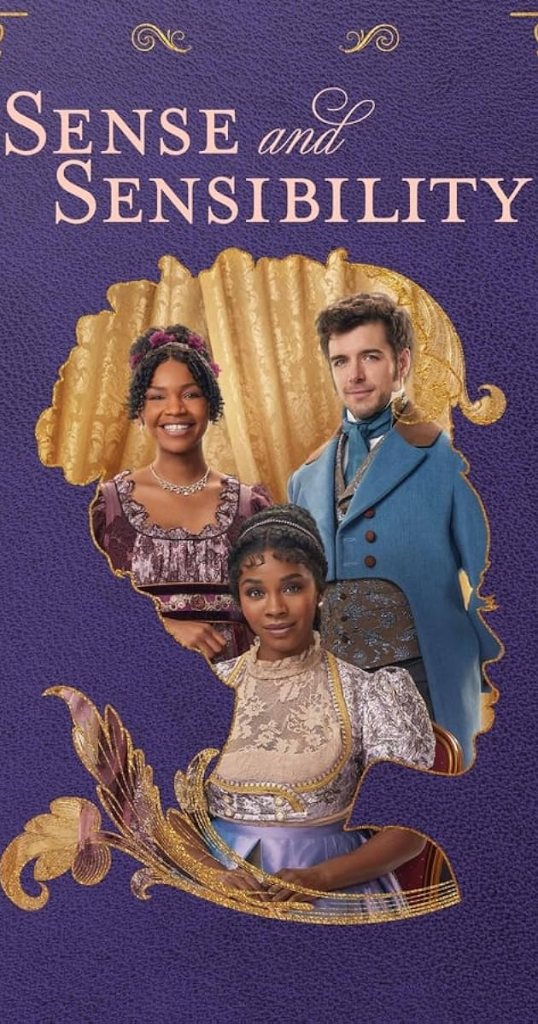
Since I was unavoidably delayed in watching this 4th and last of the Jane Austen-based Loveuary Hallmarks, I couldn’t help but read some of the reviews and comments about it on the usual social media sites. This was not a reworking, or a homage, or modernization, or a 20th-century woman thrust back into the time of the book, but an actual straight up serious treatment of the book. Granted it featured not an all-black cast, but a mostly-black cast. In fact, the only main characters who were not black were Eleanor and Maryanne’s weak and greedy half-brother John Dashwood, his brother-in-law, nice Edward Ferrars Elinor Dashwood’s love interest, and generous Sir John Middleton. Except for the mostly ridiculous user reviews on IMDb (don’t get me started) the movie was almost unreservedly enjoyed by almost all. Many admired how the production managed to be so faithful to the book despite the short running time of 8o-odd  minutes. The production values, acting, sets, and costumes were also highly regarded. I certainly concur! I am not going to regurgitate the plot of Sense and Sensibility because if you haven’t read it or seen one of the many adaptations, including the Oscar-winning movie version starring…well, everyone, shame on you. Kidding, but I highly recommend changing that state of affairs. If indeed you haven’t seen it, SPOILERS AHEAD.

Of course, there were some aspects of the plot that were cut, consolidated, or condensed, but this did not seem to negatively impact the main thrust of the story in my opinion. For example, Mrs. Jennings’ daughter, Mrs. Palmer, is missing in action, as is her sister Lady Middleton, John Middleton’s wife. No loss at all concerning the latter most will agree. Without the comedically mismatched Palmers though, when Marianne has her breakdown they stop over at their former estate, Norland, instead of the Palmer estate on the way back home to their cottage. It is there that Maryanne almost dies of pneumonia.  That stop over at their former home is at half-brother John’s invitation, somewhat redeeming his character. Plus he said sorry. I kind of liked that, TBH, but I am not a purist and I like redemption. Essentially all of the important plot points and characters were there and the essential dynamics were not compromised. Even Eliza, Colonel Brandon’s unhappy and victimized ward makes an appearance at the wedding uniting Eleanor and Edward. And in typical Hallmark fashion, she is happy and smiling. I liked that little touch as well.

I was afraid I would just be bored by this treatment as I know the story so well, but that was not the case either. The mixed-race cast mostly did a very credible job of keeping my interest with special kudos to Dan Jeannotte who played Edward and Deborah Ayorinde who played Eleanor. Carlyss Peer was a very satisfactory villainess and Martina Laird was funny as Mrs. Jennings.  Unfortunately, the racial aspect of the casting could have lent a more interesting dynamic than it did. When horrible Fanny Dashwood discourages her sister-in-law from hoping for a match between Elinor and her brother Edward by saying Edward must wed “the right kind of woman,” Mrs. Dashwood replies with dignity “I understand you perfectly.” This conversation is right out of the book but could have been given a social nuance that would have added significance and drama had Fanny been played by a white actress.  Actually, I thought Carlyss Peer was white at first and was impressed by the meaning it subtly gave that conversation. I only found out later that she is black. Oh well. Along these same lines, I would have welcomed a white actor playing the scoundrel, Willoughby. His cold and distant reaction to meeting her at the London ball would have made Marianne’s heartbreak and humiliation all the more affecting and layered had this been the case. Marianne got too little development probably due to the understandable time constraint, but as a consequence her learning curve was too easy, and thus less affecting. While I am quibbling, I need to add that The Dashwood “cottage” that they were “reduced” to settle for was so huge and well-appointed that I had a hard time feeling bad for the displaced and struggling little family. It made Mrs. Dashwood’s complaints about how far they had fallen seem whiny and silly.

But all in all, kudos to Hallmark for attempting these tributes to Jane Austen and doing a more than credible job in the execution. As well done as this one was, I have to add “for a Hallmark.” I put this one in third place behind An American in Austen and Paging Mr. Darcy.

Rating: 7.5 out of 10.

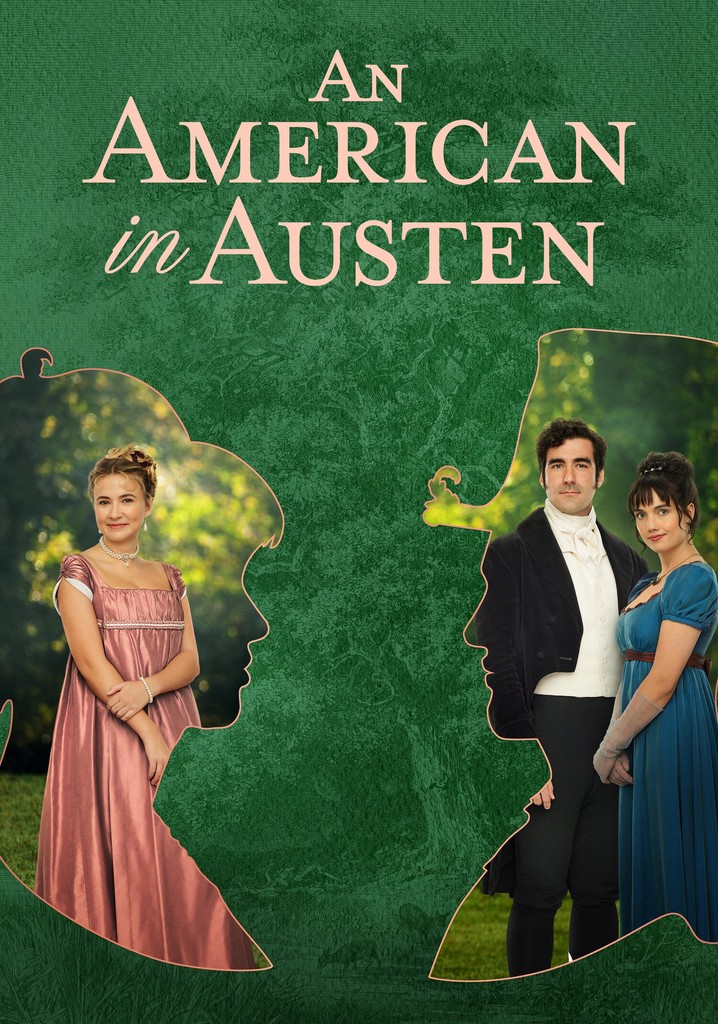
An American in Austen

There’s No Place Like Home

Spoilers

Going by the premise, the previews, and that I just rewatched Lost in Austen, this didn’t go the way I expected. And because of that, it was so much better than I expected, even though my expectations were very high indeed. Harriet is a librarian, loves Jane Austen, and is also trying to write a novel but alas, like all authors in Hallmarks, she has writer’s block.  When her boyfriend of 3 years proposes very romantically in front of her friends she responds with a resounding “Maybe.” She feels bad for breaking his heart, but, as she tells her friends, she has always dreamed of a hero (like Mr. Darcy for example) riding up on a horse taking her in his arms, and carrying her off into the sunset. Not that Mr. Darcy would ever do such a thing, and as her friends point out, she has just described a kidnapping. Because Ethan is not exactly a romantic hero. In fact, he is kind of a dorky loser. She falls asleep in the cab on the way home, and wakes up in a carriage wondering “What’s that smell?”. She has been transported into Pride and Prejudice, her favorite novel. At first, she thinks it’s an elaborate gag and plays along as best she can, exclaiming over the authenticity of the sets. But inevitably she realizes (no power lines or planes) that she really is the Bennet’s old maid (she’s over 30, horrors) cousin visiting from America. Which explains her strange ways, speech, and attitudes.

We start revisiting Pride and Prejudice. Except with Harriet there, things go a little bit awry. And first on the agenda is the assembly in Meryton (“Oh, great, more corsets”). When Mr. Darcy insults Elizabeth like in the book, Harriet marches up to him and tells him off. Not in the book. Mr. Darcy’s attention is diverted from Elizabeth to Harriet and soon becomes smitten with the “strange creature.” Mr. Collins proposes to Mary instead of Charlotte and Mary accepts. Elizabeth falls for Mr. Wickham because all of Darcy’s attention is focused on Harriet. Harriet realizes she is “destroying Jane Austen!” and, using her knowledge of the book, is determined to get things back on track. But things keep getting worse. When Darcy proposes to her (one of the things he is attracted to is her “remarkably white teeth.”), it is her wake-up call. She realizes that she has only been in love with the idea of a Romantic Hero, not a real person, and it is Ethan that she truly loves and misses terribly. “This is the moment I’ve always dreamed of but now that it is for real, this is not the feeling I have always dreamed of.” When Elizabeth elopes with Wickham it is Darcy and Harriet to the rescue. Wickham is exposed as the cad he is, and to Harriet’s relief, Darcy and Elizabeth start falling in love in the carriage on the way back home to Longbourne. “Awwwh” Harriet sighs, and then gets out of the carriage to leave them alone.

This movie was a real charmer. All of the actors made the most of the script, but the fortuitously named Eliza Bennett as Harriet really was a star. Most of the humor, even laugh-out-loud moments, are due to her delivery, especially when she comes out with her modern irreverent asides under her breath on what is happening in front of her. Trying to talk Elizabeth out of walking to Netherfield to visit sick Jane “Okay, so I can’t rewrite the walking part,” she sighs. “I adore you!” proclaims  Darcy. “Do you though?”, she responds quizzically. When Elizabeth elopes,  “Don’t worry, I got this!”

I was amazed at just how much of Pride and Prejudice they were able to get into 84 minutes. Crazy how much plot you can fit in without the usual time-sucking tentpole scenes and montages. But what makes this a 10-star Hallmark rather than a 9 or 9 1/2 are the thoughtful and serious moments. When Harriet tries to talk Mary out of marrying “that weirdo” Mr. Collins, Mary reminds her that though she doesn’t love him, she doesn’t have the luxury of a choice. But don’t worry, this is one of the things that Harriet “fixes”, though it certainly doesn’t endear her to the Bennets. In a touching tête-à-tête with Mrs. Bennet, she explains to Harriet that of course she loves her daughters and wants them to be happy. But safety and security come before love. And safety and security are inextricably intertwined with love. I loved that Harriet learns the difference between romance and real love. When Harriet gets back to her real life, the reunion with Ethan is romantic and touching because it is based on a firm foundation. One of the more romantic scenes I remember in a Hallmark, actually. Ethan really steps up to the plate. We skip forward in time, and Harriet is in a bookstore promoting her completed novel. Guess what the title is.

Rating: 10 out of 10.

Love & Jane

Clueless

There was a good movie in here somewhere but sadly I failed to find it. And I looked pretty hard. I watched it twice on DVR and it wasn’t easy. Introduced by some really lovely opening titles and a mood-setting soundtrack, I was hopeful. But the movie was not cohesive. The plots were manifold and all over the place, I didn’t like or understand the heroine, Lilly, and the figure of Jane Austen seemed gratuitous. She appears to Lilly to guide her out of her unhappy professional and personal life but never gives her any useful guidance or good advice. On camera, at least. It was peppered with talk about and references to the beloved author and her books but the character of Jane Austen didn’t seem to have a real role other than for her entertainment value for Jane Austen fans.

Lilly is the president of the local Jane Austen Society. She was born 200 years too late. We know this because of her old-fashioned hairdo, clothes, and vocabulary. Fiddlesticks! Bejabbers! And she says she hates the internet and computers. Apparently, she only likes books if they are made out of paper, although one of her society members only does audiobooks which she seems to have no problem with. She also doesn’t have a problem with using a digital assistant in her home (Play Music!). When we first meet her, she has a meltdown because a book she wants to buy is snatched off the shelf in front of her by a store clerk for an online purchaser who bought it a minute and a half ahead of her. She is mightily and loudly offended. This did not endear her to me. I order all of my books online or download them on my Kindle from the library. On occasion I do buy hardcover books, but certainly not from a new bookstore in person because they wouldn’t have them in stock. So that is bad or I’m a bad person somehow? And this customer was buying a paper book! The second strike against Miss Lillie is the way she treated her long-term boyfriend. After meeting him late for dinner she complains that the pub where she holds her Jane Austen Society meetings is closing down and they might have to disband the Society because of the difficulty of finding a comparable venue. He in turn shares the good news that he has gotten a promotion and will be moving to Chicago. He wants her to come with him as his wife and presents a ring. He points out that nothing is holding her in New York other than a job she hates. Now, he can take her on the longed-for trip to England and she can get back to her writing because she won’t have to work. She takes great umbrage at these two fantastic opportunities because she didn’t achieve them on her own, and he is somehow behaving like “Mr. Collins” which is about the worst insult imaginable. She accuses him of trying to “rescue” her. Fair enough, but other than complaining, what steps is she taking to rescue herself and achieve her goals on her own? Nada. In fact, when she gets home from her date, she throws her almost-finished manuscript in the trash. Turns out that in addition, she doesn’t love him “like that.” Then what the Dickens was she doing with him in the first place?

At work, she meets the store clerk who wouldn’t let her buy her book and it turns out he is a tech mogul and the new owner of that bookstore. The marketing company she works for is supposed to create a campaign to drive customers to his bookstore which will somehow tie people into the app company he created. It’s all very vague and convoluted. But the important thing is he gives an impassioned speech about how he wants to foster a personal human-to-human connection between people who love books and reading and get more people to shop at bookstores. Somehow Lillie curiously interprets this as him wanting to end bookstores altogether because he is a tech guy. She is very hostile towards him even though their mutual attraction is palpable and he really couldn’t have been lovelier towards her. She is resentful about working on his ad campaign even though it is practically tailor made to her own passion for bookstores and books and a huge opportunity for her. She even has a negative reaction when Trevor offers his bookstore as the new home of her Jane Austen Society. She accepts but with very bad grace. I just didn’t get how a supposedly mature woman could be so silly. She certainly was no Elizabeth Bennett.

Interwoven throughout Lilly’s shattered dreams about being an author, her thawing hostility towards Trevor the more she gets to know him, and her bewildering project for his company are her friend Alisha’s romantic problems and misunderstandings. Most of those scenes had no reason to exist other than to invite some vague comparisons to Emma. Queue matchmaking montage.

So what is the role of Jane Austen in all of this, you may ask? Well, nothing really. She comes to Lilly as a kind of imaginary friend or ghost because Lilly longs for her wise advice. She pops in and out of Lilly’s life, teaches her about having tea, gives her dancing lessons, and tells her she doesn’t know how to be happy. Very helpful. They bond over Colin Firth’s Pride and Prejudice and throw popcorn at each other. There are some amusing fish-out-of-water situations. They are united in their disdain for Trevor, who doesn’t deserve the attitude, so no help in the romance department at all. When Lilly finally finishes her manuscript supposedly with Jane’s encouragement (off-screen) Jane submits it to a publisher behind her back because she knows Lilly is too weak to do so. Strangely, Lilly does not resent Jane’s interference and help. But boy, she does get mad at Trevor because when it is accepted for publication, she finds out that he just bought the publishing company and he may have brought her manuscript to their attention. I guess she only doesn’t want to be rescued by men, but ghosts are fine. All is ironed out when Trevor quotes from Persuasion and gets a second chance with her. In the end, she is planning her second novel, though we’re not sure what ever happened to the first one. And Jane goes back to wherever she came from presumably to “help” the next Jane Austen fan-girl. So, irrational heroine, convoluted plot that never really came together, bad editing which I didn’t get into, and a waste of the Jane Austen character. I think Alison Sweeney was miscast. Ben Ayers as Trevor was fine. Acting-wise they both competently did as they were directed. There were some nice sets and a couple of amusing scenes.

Rating: 5 out of 10.

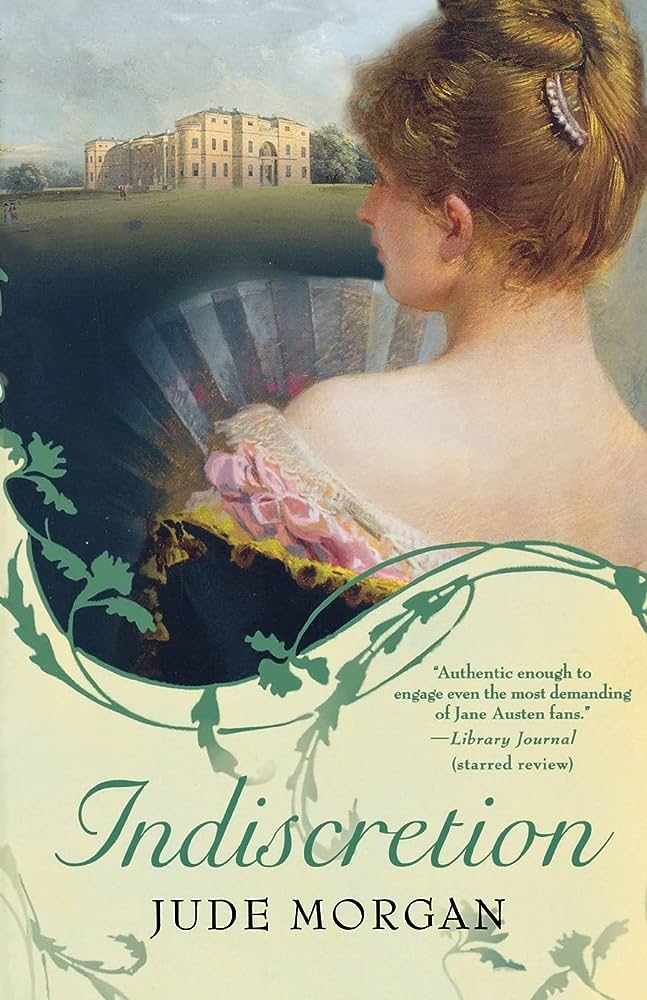
Indiscretion

by Jude Morgan

The family had long been prosperously settled in Huntingdonshire. If they were notable at all, it was for a habit of not distinguishing themselves; and as no firmer warrant for respectability could be imagined, they continued to enjoy the widespread esteem of their acquaintance, to be buried with due formality in the vault at Wythorpe church when they died, and to be absolutely forgotten straight afterwards.

Caroline did not lack for partners in the succeeding dances, and one flushed young man who had drunk too much wine repeatedly informed her, with more gallantry than exactitude, that she was a magnificent Tigress. It was partly to escape the attentions of this zoological gentleman that she withdrew to the card room.

This definitely started off slowly and it took me some time to get reconciled to the idiosyncrasies of the writing. Obviously influenced by Georgette Heyer’s incorporation of the dialect and words of the era, it seemed a little try-hard.

Mrs Catling’s personal maid— a little pinched comfit-chewer with a look of settled, not to say lifelong discontent.

It took me a bit to get used to the cadences and the wordsmithing, but once I did, I appreciated the quality of the writing, for sure.

Mr Leabrook seemed to find nothing in her silence or awkward looks to disconcert him, however; and proceeded in his soft yet precise voice, like the purposeful padding of cat’s feet.

He still tended to speak too partially of his own feelings, and to suppose that his idiosyncrasies were of necessity interesting; whereas she could not be convinced, even by ever so emphatic a manner, that a violent dislike of onion-sauce called for any special comment, still less admiration. But he was sincere and well-meaning, of that she was sure; and she felt for his difficult situation. Indeed, it was this that made Caroline his partisan.

He was one of the few men she had seen who suited the fashionable Windswept style that his thick black hair was dressed in— perhaps because he seemed always caught in a gust of emotion.

He never uses a common word when a more obscure one will do, but that didn’t bother me and my vocabulary appreciated it.

We follow in our 20-year-old heroine Caroline Fortune’s wake as she navigates through three distinct spheres of the Regency World, always doing so with grace, humor, kindness, and common sense. We first meet her as the loving but frustrated sole companion of her father and living in a seedy section of London. They are devoted to each other but are destitute thanks to her handsome father’s irresponsibility with what little income they have from his military pension. Her mother is eight years dead. She came from a respectable and well-off family but was disowned when she followed her heart and married Captain Fortune, itinerant actor, and former military man.

One step ahead of Debtor’s Prison and desperate to save his daughter, Captain Fortune secures a paid position for her as the companion to the widow of his old Colonel, Mrs. Catling, an old battleaxe if ever there was one. He escapes to Bath as Caroline settles in Brighton with her new employer. She meets and becomes friendly with Mrs. Catling’s niece and nephew who visit her frequently and are dependent on her financially to maintain their semi-fashionable lifestyle. She also becomes friendly with their friend, Mr. Leabrook, a handsome and smooth wealthy landowner who shows every indication of admiring Caroline very much. Unfortunately, he eventually proves to be not the paragon he first appears to be. Our heroine rubs along very well thanks to her composure in dealing with Mrs. Catling’s ways. Her situation changes once again about a third of the way through the book when she receives word of her father’s reconciliation with her late mother’s sister and her husband but also his unfortunate sudden demise. When Mrs. Catling refuses to allow her time off to attend her father’s funeral, she quits, and we follow her to the third and last stop on her journey: her life with her loving Aunt and Uncle in the country parish where he is the rector. It is at this point that the book really picked up for me. It was just such a relief to have the deserving Caroline find a safe haven.

She had moved amongst many circles in her life, some clever, some stupid, some moneyed, some threadbare, but all more or less sophisticated, and not inclined to expect much virtue in others, or to cultivate it in themselves. It came as a revelation, not quite commensurate with the proven existence of the fairies, but almost as charming and bewildering, that all the time there had been this other race of beings: kind, gentle, reliable, unworldly.

It is there that she meets and becomes close to the aristocratic Milner family particularly Isabella, of her own age, who becomes her good friend. Besides Isabella’s bossy and abrasive stepmother and her Navy Captain cousin, that household also includes Isabelle’s free-thinking and unconventional younger sister Fanny and her eccentric brother Stephen who would rather be exploring archaeological sites than staying home tending to his business there. To Caroline’s dismay, she also learns that Isabella’s oft-spoken-of but temporarily absent-from-home fiance is none other than the morally suspect Mr. Leabrook.

The book is dense with intrigues and subplots, but the main strength of this book is the characterizations. All of those who revolve around Caroline were extremely well drawn with many layers and complexities and amusingly described.


She was a garrulous woman who had long been listened to with rather too much indulgence, and who was a little too inclined to consider herself a Character, on no greater evidence than a continual compulsion to talk about herself, and some large rings.

Many turned out to be quite different from what they at first seemed. Mrs. Catling first came across as a prototypical curmudgeonly old dragon: tough and demanding but admirable in her own way. By the end of our time with her she has proven to be just nasty and mean.

As to why Mrs Catling should play this unpleasant game, perhaps no further reason needed to be sought than that it gave her pleasure to meddle, mar, and hurt: this human propensity not being so uncommon as ever to excite surprise when detected.

Two of the characters owe a good bit to Jane Austen’s Colonel Brandon and Lydia Bennett. But they don’t start out that way. Another character starts out to be very unsympathetic and cold but proves her mettle when the chips are down.
The character of the hero surprisingly was a problem for me. He was obviously intelligent, even intellectual, yet his conversation, particularly with Caroline was often silly and prattling with no purpose other than to amuse himself and call attention to his “wit” and famous quirkiness. But then, perhaps he was nervous around her? Even our heroine has to tell him to just shut up at one point near the end despite her love for him and their mutually enjoyable banter.

I definitely recommend this book to those who have read and re-read Jane Austen and Georgette Heyer, but crave some fresh delights. But a modicum of patience might be required and a few weaknesses overlooked. Lord, I guess a bit of Jude Morgan has rubbed off on me.

Rating: 4.5 out of 5.


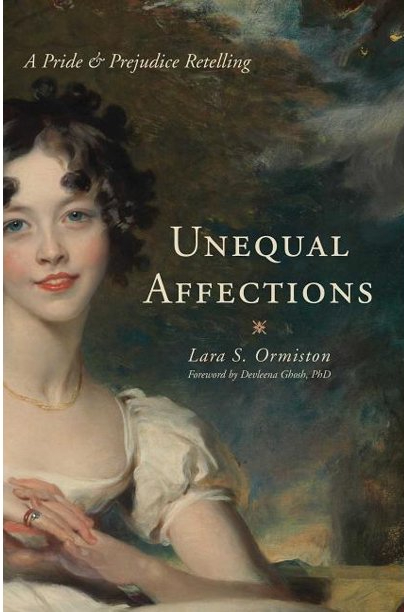
Unequal Affections

By Lara S. Ormiston

Why did he have to be so charming in some ways and so insufferable in others? She was sure she had hurt far more than just his pride. Would it always be so hard?

I admired and enjoyed this alternative imagining of Elizabeth and Darcy’s romance very much. Very. What if Elizabeth took the more practical approach of her friend Charlotte and accepted Darcy’s proposal at Hunsford?

She had been proposed to by a stranger. A very rich, very handsome stranger who was very much in love with her. She could not possibly accept him—but, suddenly, she could not possibly refuse him either, not now. This was, she knew clearly, a chance unlike any other she would ever receive. She could not turn him down for the satisfaction of it. She had to think.

You will need fear nothing as my wife, neither poverty nor loneliness, dishonor, or disloyalty, unkindness, neglect . . . you will be the most cherished wife in all of England.”

Who could resist such a declaration? She’s only human. After a week of soul-searching, she accepts Darcy. Not only for the good she can do her family, especially Jane, but because she starts to see Darcy in a new light. She thought he despised her. She was so wrong. How else has she misjudged him? Before she can truly come to love Darcy as he ardently wishes, he has to change. And changing the habits and attitudes of a lifetime is by necessity slow going. But I never found it tedious. It really felt like this is how it would have gone. In the original, Elizabeth’s words in summarily rejecting Darcy’s proposal shake him to the core, and he starts to change. Just as ”the letter” starts Elizabeth on her path. In this book, it is a much different process. How Elizabeth finally gets through to him is a great scene.

As for Darcy, he had been completely unable to speak. Elizabeth’s words had cut through him like knives, shaming him deeply, and shame was not an emotion he was accustomed to experiencing…Was it possible that he, who had studied throughout his life to improve his mind and character, had overlooked such an essential flaw?…He had not understood her then, but he did now. His refusal to talk was an active unkindness, a deliberate slight on the value of those he had thought beneath him. He had not thought their feelings even worth the effort of a few polite remarks and a smile or two. He certainly had not been willing to consider lowering his own dignity to promote theirs. Nor . . . his brows furrowed deeply in pain . . . nor to promote Elizabeth’s happiness either.

This book includes many high points of Austen’s novel. Particularly delicious is this version of Lady Catherine De Burgh and Elizabeth’s confrontation in the garden. And in this one, we have Darcy’s reaction to his aunt’s unmitigated gall and ill manners “which rather threw anything anyone in the Bennet family had ever done in the shade” when he walks into the middle of the fray. All of the characters remain true to Austen’s creations. And the more time we spend with Mr. Bennet and Lydia the more contemptible they are revealed to be. I liked how Lizzie started seeing her father more clearly and lost a lot of her respect for him. At one point, she even intervenes and protects her mother from Mr. Bennet’s mockery. There is even a dramatic rescue of Lydia and an exciting confrontation with Wickham as well, but in entirely different circumstances than the original.

I also found the dialogue, vocabulary, and narrative very authentic to Jane Austen’s style. The book is too long and repetitive but it rarely got tiresome. I admit that I found Elizabeth’s change from confusion to liking, to loving Darcy way too gradual to be believable or sympathetic. But Ormiston’s treatment of Darcy, I thought, was brilliant. His admiration, love, and passion for Elizabeth remain steadfast throughout. In this, he proves, again and again, the ardent words of his proposal in Austen’s work. Even when Elizabeth’s fearful secret is revealed to him: that not only did she not love him, but how much she actively and publicly disliked him, he doesn’t blame Elizabeth but himself. Elizabeth has to accept the fact that her actions and manners were not above reproach either and have caused great pain.

This is easily the best reimagining of or sequel to Pride and Prejudice, I have ever read. I hate to call it Fan Fiction, although it is, because it doesn’t do it justice. When I looked for more of Lara Ormiston’s books, I was so disappointed to learn she hasn’t written anything else.

Rating: 5 out of 5.

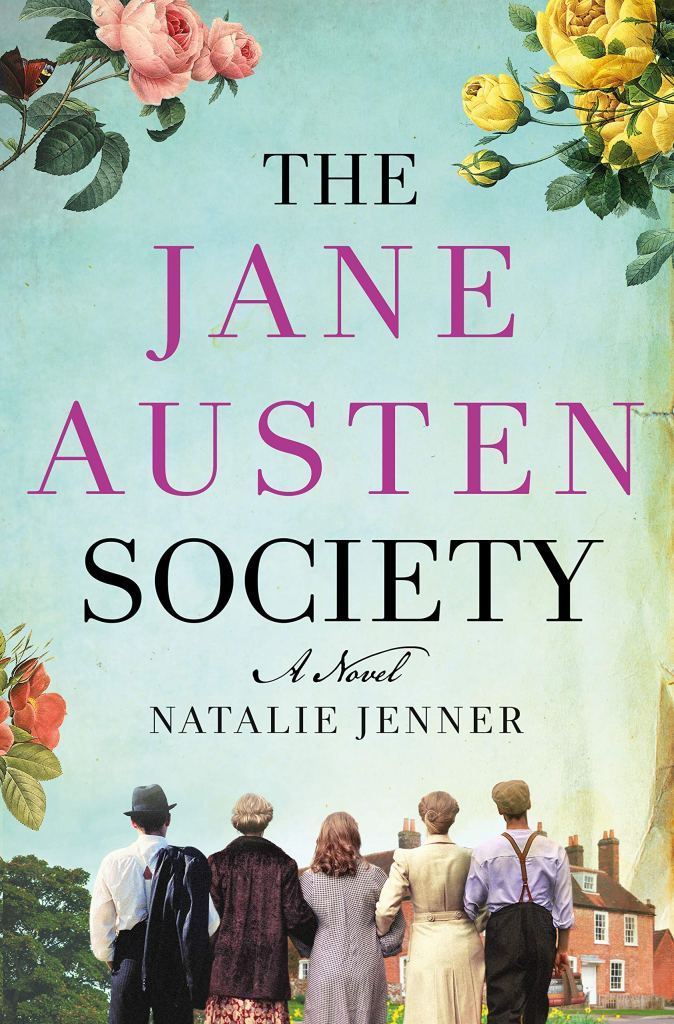
The Jane Austen Society

By Natalie Jenner

And the society itself sounded like a band of misfits with negligible expertise and no head for business: a country doctor, an old maid, a schoolmarm, a bachelor farmer, a fey auctioneer, a conflict-averse solicitor, a scullery maid, and one Hollywood movie star.

I really really like this one. I started it on Audible read by Richard Armitage and finished it on Kindle. As many have pointed out, it has a lot in common with a book that really spoke to me, The Guernsey Literary and Potato Peel Pie Society. England recovering from the devastation of WWII…an outsider welcomed into a small community of the like-minded… gentle romances…bookish conversations. It also reminded me of the work of the 20th-century English novelist, D. E. Stevenson. And this one has a Hollywood Movie Star and Jane Austen!

Winding through the story of the diverse group of society members are shades of some of the plots and characters from Jane Austen’s novels. Particularly PersuasionEmma, and a cad straight out of Sense and Sensibility. Or is it Mansfield Park? Or Pride and Prejudice? Or Northanger Abbey?)
The novel is character-driven, but the characters would probably not be all that interesting to many people. But I felt like I was drawn in and a part of their small world. I cared about them and their sufferings, secrets, and fates. I was invested in their mission to save Jane Austen’s house and the library, which was full of secret priceless treasures revealed thanks to a scholarly teenage housemaid. I was anxious and concerned because their chances of success looked pretty slim at times. Then we are given hope in a surprise twist I did not see coming.

Like many, I struggled to understand “the vote” of the society regarding how to advise one of their members. But I think it had something to do with this perspective from Mimi, the Hollywood star.

“…we are lucky if we get to live in places where so many people care—the trick is understanding why they care. Here, what I love, is that you care because you have a history together. You have known each other’s parents and grandparents…In Hollywood, it’s quite the opposite. Everyone comes there to start new and makes up a history—…Anyway, in a town where no one even knows your real name, let alone where you come from, what is tethering you to anything? What is there to keep you on the ground?

But I still didn’t like it, agree with it, or really fully understand it.

It won’t be a surprise to anyone familiar with Jane Austen that in this book, so closely aligned with that great author, it all works out in the end. And I will add that the epilogue was everything an epilogue should be. Even though this is a fictional treatment of a real Society, the Knight Family, their home, and Chawton, it was loosely tethered enough to reality that I learned a lot.
And I agree with Adeline about Emma.
**4 1/2 stars**

Rating: 4.5 out of 5.

August 19, 2022

Persuasion

It Wasn’t That Bad.

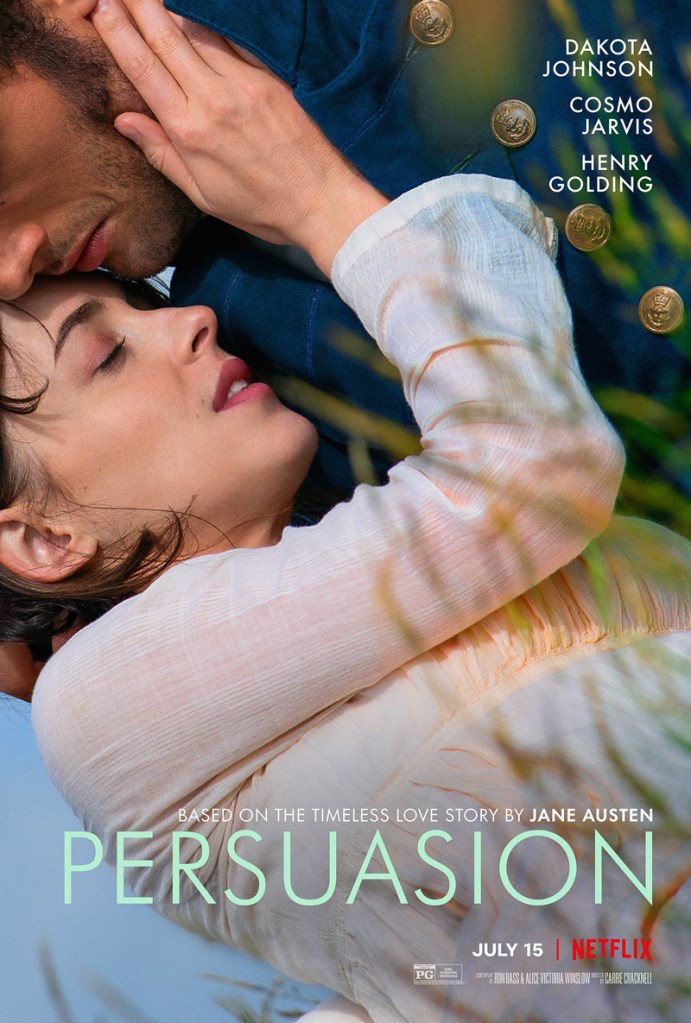
It was not my intention to review the much-criticized new adaptation of Jane Austen’s Persuasion. But such has been the vitriol and bitterness of some of the reviews, that I can’t resist. Because I didn’t hate it. I was confused by it and confounded by some of the decisions that were made particularly concerning Anne’s character, but there was much that I enjoyed. And I certainly didn’t think everyone involved should be “thrown in prison”.

It follows the plot pretty closely. All of the characters are substantially the same people as in the book and the very faithful films.  Except for Anne. Anne is not the same character at all. The mumblings and murmurings started with the miscasting of the gorgeous Dakota Johnson as the mousy beaten-down Anne. And the trailer really got people going. Since Anne Elliott is one of Austen’s most beloved characters, the sneak peak did not sit well with many. Particularly the hyper-vigilant “Janeites”. Because of all the hate, I approached this movie with an open tolerant mind and sat down to be entertained. One aspect of the movie that has incurred much criticism is Anne continually breaking the fourth wall. She makes sarcastic and witty comments to the viewer about the behavior of her family members. Her observations are dead on. “My Father. He’s never met a reflective surface he didn’t like. Vanity is the beginning and end of his character. Also the middle.” She gives the viewers sly glances when one of her fellow characters does or says something particularly absurd. It was clearly an attempt to interject Austen’s own voice into the narrative and simultaneously enliven Anne.

As Sir Walter Elliot, Richard E. Grant could not have been better. In fact, all of the actors except one were good to excellent. But things started to get weird almost immediately. Instead of keeping Anne’s outspoken and barbed observations between herself and the audience, she calls out her relatives directly to their faces. Anne is shown to be publicly full of verve and spirit. If they had kept this facet of her personality a secret between Anne and us, her confidants, they could have kept much of the integrity of her character. They missed an opportunity to show how Anne’s true feelings and opinions are at odds with the way she is forced to navigate her world. She acts out and in the process makes her character eccentric and at times, incomprehensible.  There are many examples but most jarring was Anne spouting off out of the blue and unprovoked during a dinner party to all and sundry that she herself was the first choice of Charles, her sister Mary’s husband. Needless to say, she brings the merry party to a standstill. However true, even the most socially inept meanest mean girl wouldn’t do that! It was almost Tourettes-like. I can’t think of why this was done, as well as the many many other examples of weird behavior Anne displays such as the octopus speech and drinking way too much wine right from the bottle. The director replaced Anne Eliot with Bridget Jones. Remember Bridget’s response at the dinner table full of couples that all singletons having scales? And as Bridget Jones, Dakota Johnson was charming and funny. She just wasn’t Anne Eliot in a work that is supposed to be all about the character regaining her bloom and spirit long suppressed by sorrow and regret. There is nothing to prevent This Anne from going after her heart’s desire right from the get-go.

There was little to no chemistry between Anne and Captain Wentworth, who looked decidedly grungy throughout the production. I didn’t care for him. Henry Golding’s shady and scheming William Eliot actually falls in love with the common and unattractive Mrs. Clay and marries her at the end. Just weird and nonsensical. Back to the good. The cinematography was beautiful and the scenery and fashions were both lovely. I actually liked the contemporary pop-culture parlance (“playlist,” “fashion forward,” “you’re a 10,” “we’re exes”, “I’m an empath,” etc.) I thought it was fresh, whimsical, and definitely brave. I was drawn in as I always am by Jane Austen’s regency world however askew this one was. In fact, I rather enjoyed the off-center vibe.

I was able to tolerate the strange choices by the writer and director while I was looking at it. It was only later upon reflection that my feelings started to sour. I hated that they could have made Anne a modern kick-ass heroine, while still maintaining the integrity of one of Jane Austen’s most interesting creations and her truly moving character arc. I hear that Netflix is (or was) planning to bring more of Austen’s novels to the screen. If they decide to go ahead with this despite the fact that “everyone” hates this one, I will be very curious and interested.

Rating: 5.5 out of 10.

July 20, 2022

The Emma Project

By Sonali Dev

**Spoilers**

Much of the appeal of Pride, Prejudice and Other Flavors was the clever and insightful interweaving of the characters, themes, and plotlines of the Jane Austen classic with Sonali Dev’s own take on the novel. Between this one and the original Emma the integration is spotty at best. There are major plot lines and characters in both novels that find no parallels in the other. I won’t go into a long list here, but Esha’s strange supernatural malady and her miraculous recovery and romance are one. There was enough material and backstory there for it to be its own book. It was just shoehorned into this one and it was a distraction. It had no place in a homage to Emma and didn’t make the most of Esha’s story either. But the one that really hurt my enjoyment was how the Raj family are so ugly to Naina, the Knightly character. Especially Nisha, the sister of the Emma character, Vange, and Vange’s mother. I didn’t read the middle two in the quartet, so there may be justification, but since we see everything from Naina’s eyes and with our knowledge of her struggles, it was very bothersome.

Naina has been damaged by the lifelong cruelty of her abusive father. This has affected her ability to be open and vulnerable to love. She has dedicated the last 10 years of her life to rescuing the poverty-stricken women of Nepal and she has finally secured funding from zillionaire Jiggy Mehta. Enter Vansh Raj, whose chance run-in with a person he knows that he learns is surprisingly homeless spurs him to save not only his acquaintance but all of San Francisco’s indigent. While coming from a good place, this quixotic notion has jeopardized Naina’s funding. Instead of getting his own money, he latches on to Naina’s source. Because there is more in it for him to be associated with a real Raj instead of an ex-Raj, Jiggy Mehta cools towards Naina’s project. It’s really terrible. I was enraged over this.

Vansh Raj has a passing resemblance to Emma in that he is a do-gooder who wants to make things better for those who are less fortunate than him. Actually, there are quite a few interesting parallels. But Naina has very little in common with Mr. Knightly. Both Emma and Vansh are misguided, but in very different ways. Emma almost ruins the life of Harriet with her interference. Vansh, causes Hari, the homeless computer whiz he targets, an isolated episode of pain and suffering by not listening to the good advice of Naina (Knightly). But his interference ultimately saves Hari puts him on a path to health and prosperity. Sonali Dev’s parallels between Harriet and Hari are well done. (as well done as some of the connections in the first of the Raj series) but really, that’s about it as far as The Emma Project being a modern take on Emma. Perhaps there is a parallel between Naina’s mother and Emma’s father? But it’s is a stretch. A huge stretch. Naina is 12 years older than Vansh and has been a supportive presence in his life since he was a baby. So that hearkens back to Emma, I guess.

Dev makes Vansh the kind of guy who spends hours a day on his grooming and body sculpting because he likes to look good. Even though he is already too handsome to be true. We are treated a couple of times to a description of his long tangled eyelashes. And more than a couple to his cut and flexing muscles, which he likes to show off by wearing clothes two sizes too small. I mean yuck. It’s different if a great body is the by-product of manual labor or sports. But his vanity turned me off.

Another disappointment was the lack of satisfactory resolution to two important plot threads. The author meticulously details throughout the book Dr. Kohli, Naina’s father’s, evilness and cruelty, and Jiggy Meyta’s self-serving maliciousness. Not to mention their toxic sexism. I couldn’t wait for them to get the justice they deserved. Alas. It all happens off stage. We find out that Naina’s mom found the strength to leave her husband of 40 years in the epilogue. And the final straw after years of abuse was nonsensical. And Naina told Jiggy to take his money and shove it. We are just told that she did, but we are not there for the kill. Yes, I wanted retribution to rain down upon them and I wanted a front-row seat, but nope. And I guess Jimmy, the guy who cheated and wronged Hari never did get his just deserts at all. And speaking of retribution, Naina deserved a groveling apology from the Raj family. Instead, we get “I was a Bitch” and a “Yeah you were.” But Naina is not even in the room.

At times the sentence structure and word choice were awkward and confusing. I won’t quote specifically (although I can) because to be fair it is an uncorrected proof. But I noticed the same thing with her first book as well. And that was not an uncorrected proof. Ms Dev is a wonderful writer but needs a more vigilant editor.

Despite my problems, the book kept my interest. The romance was good even though it bore no resemblance to the romance of the real Knightly and Emma. And I gotta say there was a very hot sex scene that managed to be funny at the same time. I didn’t want it to end, and that is saying something for me. Thank you for that. The exploration and growth of the characters were well done. Vansh really grew on me, despite the things I didn’t like about him. I loved the way he and Naina learned to work together and became a united front against Jiggy. I was happy Naina’s project was saved. I liked the narrative voice. But there were too many promises unfulfilled and too many disappointments.

Thank-You to Net Galley and Avon and Harper Books for providing me with an advanced copy of this book in exchange for an unbiased review.

Rating: 3 out of 5.

March 5, 2022