Wild Strawberries

by Angela Thirkell

From their earliest days the Leslie children had thought of their mother as doing or making something, handling brush, pencil, needle with equal enthusiasm, coming in late to lunch with clay in her hair, devastating the drawing-room with her far-flung painting materials, taking cumbersome pieces of embroidery on picnics, disgracing everyone by a determination to paint the village cricket pavilion with scenes from the life of St Francis for which she made the gardeners pose. What Mr Leslie thought no one actually knew, for Mr Leslie had his own ways of life and rarely interfered. Once only had he been known to make a protest. In the fever of an enamelling craze, Lady Emily had a furnace put up in the service-room, thus making it extremely difficult for Gudgeon and the footman to get past, and moreover pressing the footman as her assistant when he should have been laying lunch.”

I enjoyed this as much or more than many of Angela Thirkell’s books. It was fairly short and the world in which I found myself was fairly confined and not bursting with various characters which were hard to keep straight, nor was I roaming from one country house or family circle to another. I was most definitely helped by my trusty copy of Angela Thirkell’s World, which traces all of the characters in her Barsetshire Novels from the early 1930s, through WWII to the late 1950s.

So when Dodo Bingham and her twin daughters show up for Martin’s 17th birthday party,  learning that the carefree David actually married one of those twins in book 15 , Peace Breaks Out, it was a laugh. Wild Strawberries is book #2 in the Barsetshire universe.

We are introduced to the Leslie Family: Lady Emily, her curmudgeonly husband, and their grown children, John, Agnes, and David. Also, their grandson, Martin, whom they are raising since his father was killed in WWI. His mother is not in the picture. Apparently not in a bad way, necessarily, because according to ATW, the future children of Martin’s Uncle David stay with her in America. Visiting for the summer is Mary. A meek and mild second cousin (reminded me of Jane Austen’s Fanny Price), she is young, pretty, and very nice. The book centers around her crush on David, the Leslies’ entitled and irresponsible younger son. Her heart is destined to be broken but for David’s very responsible and very good older brother John. As the book opens, he is  a sad widower,  but when he falls for the shy and reticent Mary as she plays and sings at the piano when she thinks no one is paying attention,  the path to the happy ending becomes clear. All is straightened out, as well as some other unrelated developments,  on the night of Martin “Thanks Awfully” Leslie’s 17th birthday party.

But that bare bones of a plot, if you can call it that, is really just foundation to sketch, reveal, and affectionately skewer the personalities of the family and their friends. I grew fond of all of the Leslies but my favorite characters were Lady Emily (who reminded me of an older Laura Morland), Agnes, and Martin. I didn’t care for or approve of David much, but we aren’t meant to. He is the type who, instead of being gainfully employed like his older brother, fancies himself a novelist. Luckily for him he has an independent income “owing to the ill-judged partiality of an aunt.” He doesn’t doubt that his awful novel will be a bestseller, and although it isn’t even finished, is already confidently planning a play and a film script. Lady Emily, the benign and gentle matriarch, floats through her home, Rushwater, swathed in myriad shawls and scarves, frequently calling on her adoring family and protective servants to retrieve them and any other various accoutrements that she realizes she has mislaid. Usually they are within arm’s reach.  When she inevitably trails a scarf through her soup, she rinses it in her wine glass. Her daughter Agnes, married to the always absent Colonel Graham, is lovely and sweet-natured. She dotes on her 3 lively children, and nothing can shake her out of her calm and placid approach to life. When her children cause upset in the house, whether it is which cereal they will or will not eat or falling in the goldfish pond, her response is to laugh “Oh Wicked Ones!” with pride and affection and call for Nannie. In a bit of a side plot, she is totally oblivious to the wild passion she has inspired in the 19-year-old son of the Leslies’ new French neighbors. This is a common Thirkell trope. He’ll get over it.

Wild Strawberries is the type of book where several pages are devoted to a servant’s relationship to the dinner gong. If you’re up for that type of book, you will find yourself transported to another world of which you might certainly disapprove and even look upon with disdain. But while disapproving, you are in the hands of a very talented writer. So you might also find yourself chuckling and being charmed by the frivolity of it all. In 2024 it is a fantasy world, but it’s important to remember that less than 100 years ago it was an authentic slice of life.
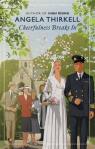
Rating: 4 out of 5.

Cheerfulness Breaks In

by Angela Thirkell

**spoilers**

I enjoyed this Angela Thirkell very much more than some of her other books. This was mostly thanks to my copy of Angela Thirkell’s World: A Complete Guide to The People and Places of Barsetshire by Barbara Burrell. Since this concludes (I think) the saga of the difficult Rose Birkett, I wish I had read the book before this, Summer Half, first though.

‘Rose is a very good girl, but I don’t think you quite understand what you’re undertaking. I’m afraid my wife and I have spoilt her rather.’ ‘Take it from me, sir, you have,’ said the Lieutenant. ‘But this is where the Navy puts its foot down. Do you mind if I smoke, sir?’… ‘You know I’m awfully fond of Rose,’ said Lieutenant Fairweather, sitting down again, ‘and you needn’t be anxious about her, sir.’ ‘No, I don’t think I am,’ said the Headmaster. ‘Nor about me, sir, if it comes to that,’ said the Lieutenant, looking his future father-in-law straight in the face with an immovable countenance. 

It also sees the marriage of “swashbuckling” Lydia Keith to the great and good Noel Merton whose unlikely romance has been brewing through several books.

‘Gosh!’ she said. ‘If I loved anyone I’d marry them at once.’ Then to Noel’s intense surprise, her face went bright pink and she looked at him as if imploring forgiveness. ‘You couldn’t think of me in that light, I suppose,’ said Noel. ‘Because if you did I would be more than willing. Much more.’ For the first time since he had known his Lydia her gaze dropped before his. … ‘Of course I will,’ said Lydia…We couldn’t get married to-day, could we?’

And, besides Lydia, another favorite, her great friend, clever Geraldine Birkett, gets matched up as well.

‘I don’t think it would be a bad plan if Geraldine and I got married. I just thought I’d break it to you.’ As his future parents-in-law appeared to be struck all of a heap, he continued, standing over them with a pleasant impression of self-reliance and kindness, ‘She needs someone to look after her…The Birketts were so taken aback by this totally unexpected development that they were bereft of speech, till Mrs. Birkett recovered herself enough to ask weakly if Geraldine knew. ‘She knows all right,’ said Captain Fairweather. ‘I gave her the idea and it’ll soak in all right….
“I’m sure Geraldine will be very happy with you and I can really think of nothing nicer.’ ‘Well, it surprised me as much as it surprised you,’ said Captain Fairweather with great candour… Anyway I’ve known her since I was a kid—and she was a pretty ghastly kid herself,’ said the gallant Captain meditatively, ‘so we ought to make a do of it.”

In between getting the various couples sorted out, we meet old friends and new friends as we share life in the English Countryside during the beginning of WWII. Most of the interesting and amusing developments and the new friends (and enemies) in this novel are due to the evacuations of children and a school from London to Barsetshire. Fair warning: If you are a communist, a refugee, or from an underprivileged urban background, you might be offended by some of the passages in this book.

Angela Thirkell isn’t as accessible as, say, D.E. Stevenson. I really had to concentrate and sometimes, re-read, to fully grasp the meaning of some of the language and subtle humor and satire. And also just to bask. But it is well worth the effort. I will continue to visit Barsetshire from time to time and already know the next three I will read or listen to.

But Oh, that ending! So glad I had my trusty ATW: ACGTTPAPOB to set my mind at rest.

Rating: 4 out of 5.

August 26, 2021

Before Lunch

By Angela Thirkell

FINALLY finished Before Lunch by Angela Thirkell. There were many reasons it took me so long. First was that I was listening to it on a platform (Hoopla) that made it difficult to just turn on whenever I wanted. Usually, this would be on my walks (weather’s been too cold) and in the car on my way to and from work. Secondly, the book did not keep my interest most of the way through. It is a little disconcerting to me how similar all 4 of the books I have read by her have been. The characters have all been very much the same, and also the plot points. Young callow man, in love with a considerably older married woman and young and old partnered with the wrong people that eventually get sorted out by the end. The end of this one was a little bittersweet and a tad melancholy for one couple.


Before Lunch features many mentions and brief appearances of several characters from the other 2 novels I have read by her. This would normally charm and interest me, but I couldn’t remember the revisited characters well enough to care much. I probably could have stayed engaged better if this has not been an audiobook. For me, it really didn’t pick up until about halfway through. I still had some chuckles over Thirkell’s wry observations and witty turns of phrase, but I think I am going to take a little break from her for a while. Too many books, so little time, and all that. Also, I would have to pay for anymore I read: I think I’ve exhausted all of the titles my library has available. 

Rating: 2 out of 5.

January 19, 2018

August Folly

By Angela Thirkell

I didn’t like this as well as the first 2 AT books I have read. It was way too similar in terms of character and plot. This is the 3rd book that a callow rather silly young man has fallen for a much older woman. Only in this one, the young man was pretty unpleasant. There were really not any lovable characters in this one, in my view, to rescue the not very interesting bones that the plot is hung on. Two families, one with scholarly parents and struggling financially and one fairly well off interact and find romance successfully and unsuccessfully. Also, there is a community play. It resulted in losing my attention from time to time while listening. I was happy to finish it.

Rating: 2.5 out of 5.

December 1, 2017

The Brandons

By Angela Thirkell

Angela gently and affectionately portrays English country village life. In this one, Mrs. Brandon, an attractive widow, who is too kind for her own good, is featured. Everyone falls in love with her, to the amusement of her two grown children. The foibles and eccentricities of the family and their friends are amusingly skewered, but only in the kindest way. The principals in the book await the demise of old Miss Brandon, whose vast fortune and crumbling old estate no one really wants. They are perfectly happy the way they are. I listened to this one from the library on Hoopla, and it was a treat. We meet Laura Morland and her incorrigible son Tony again, and I hope I will meet The Brandons again.

Rating: 4 out of 5.

November 7, 2017

High Rising

By Angela Thirkell

So I finally read an Angela Thirkell Book. And what better place to start than the first in her Barsetshire series? It was a pleasant read: the kind of book you read with a faint smile and a gentle chuckle every so often. Laura, our heroine, “a delightfully vague widow with four sons” on her late unlamented husband:

“You see my husband was nothing but an expense to me while he was alive, and naturally he is no help to me now he’s dead, though, of course, less expensive…

She knows how to sketch a character in a few strokes and turn a humorous phrase. On her annoying but beloved and oh so talkative 11-year-old son:

She had sent him to school at an earlier age than his brothers…partly, as she remarked, to break his spirit. She fondly hoped that after a term or two at school he would find his own level, and be clouted over the head by his unappreciative contemporaries. But not at all. He returned more self-centred than before, talking even more, and, if possible, less interestingly. Why the other boys hadn’t killed him, his doting mother couldn’t conceive.

Mrs. Stoker, Laura’s no-nonsense, grouchy, but loyal housekeeper, on our villain, the encroaching neurotic secretary to a neighbor and good friend: “Miss Una Grey she calls herself, said Stoker, as if the secretary were indulging in a sinful alias.”
She mines the comic out of the most unlikely circumstances. Her description of Laura haplessly trying to change a typewriter ribbon is priceless.
As a mother of two sons, this description of a Valentine terrible Tony sends to his mother from school, really hit the spot:

The letter was written with much care and a shocking calligraphy in red and blue ink, and copiously decorated with hearts, pierced by arrows, dripping blood…[A an original valentine poem, too long to quote] “It’s lovely Valentine,” said Adrian, while Laura’s eyes shone with pride.

I’ll be reading more of the Barsetshire series in a bit. I hope to meet Laura, and especially her son Tony again. 

Rating: 3 out of 5.

May 23, 2017