“Happy endings are of little comfort,” Logan told me, very sure, “to characters who die afore the tale is done.”
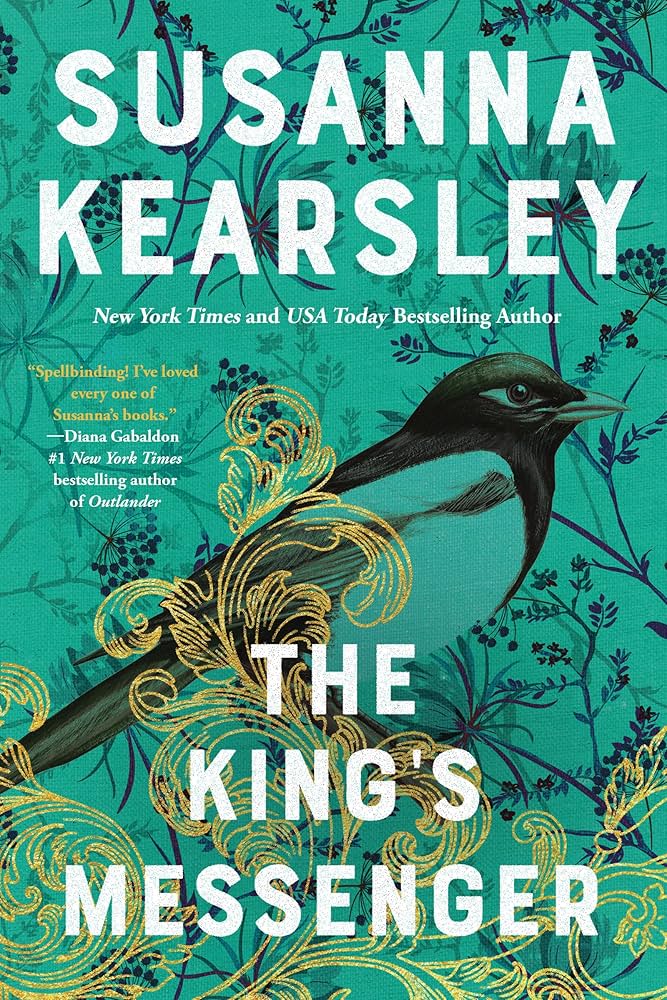
I wasn’t crazy about this one. It was very romance-forward for a Susanna Kearsley novel which I was happy about at first. But it seemed much lighter than the other books by her I’ve read. To be fair, that perception might be influenced by the book I read right before this one. She picked a good bit of history to provide the foundation for her novel, but ultimately the history part, which was confined and personal as opposed to overarching and epic, was depressing to think about. Since many of the characters were based on real historical figures, it limited her on what she could do with them. The fiction part was a bit plodding and I was not emotionally engaged in the predictable romance. That’s true of most of her books, but usually there’s enough “other stuff” to make up for it. Kearsley almost always includes a supernatural element which has always been well integrated into the story. In fact, it has been the key factor and those books as written would not exist without it. There was a supernatural element in this one but it could have been left out and would have changed nothing to plot or character. In this one, one of our main characters has second sight and gets random brief visions of the future, which are mostly always deceiving. Also he sees dead people. Neither of these “gifts” have any major influence on anything that happens. They’re just kind of tacked on seemingly to make Andrew more interesting, or just because it’s Susanna Kearsley’s “thing” to have a paranormal element to her novels.
It is set in 1613 shortly after the sudden and suspicious death of Henry, King James I of England’s promising teenage son and heir to the throne. Rumors are starting to spread that he was poisoned and suspicion is starting to fall on King James, his own father. King James was a nasty piece of work and was jealous of his talented, intelligent, and principled son. In order to quell the rumors, he sends for David Moray a.k.a. Murray (real person), Henry’s trusted courtier and companion with the intention of pinning Henry’s murder on him. Andrew Logan, our hero, is the King’s Messenger sent to Scotland to arrest and bring David Moray to London for the inquiry and trial. Because there will be a trial: David Moray is being framed by the King himself. With him on the journey goes a Scrivener who is assigned to write down everything that David says and does with hopes of gathering actual evidence against him, and his daughter Phoebe who insists on coming with to watch over her father who is in poor health. Phoebe and Andrew’s families have been neighbors for a long time, but due to a misunderstanding and some lies told to her, Phoebe has always disliked Andrew. On the journey to London, there are some not very thrilling adventures, and we get to know the characters in depth. As Andrew proves his worth time and again, Phoebe’s dislike turns to love. David Moray is a wise and good man, and still suffering the lingering pain of Henry’s death whom he loved like a son. Of course we care what happens to him but the fact that Wikipedia (and other sources-Ha ha-not really) tells us that David Moray was never brought to trial and lived a long and productive life for years after the events in this book kinda put a kibosh on any suspense regarding his fate. However, “the how” was neatly and cleverly done. Can Andrew remain loyal and dutiful to King James but not be a party to turning over an innocent man to certain death?
There are some interesting little nuggets in this book. For one, We meet and learn about real person Esther Inglis, who, despite her gender, was a well respected calligrapher of the day. Susanna Kearsley does her research, so I found all of the real historical details regarding the royal personages, King’s Messengers, scriveners, etc. pretty fascinating. Speaking of research, Kearsley is a firm believer in the theory that Prince Henry was poisoned, and poisoned at the instigation of his father the King. This flies in the face of most historians’ long held view that he died of Typhus. She makes a strong case, and I believe her. But it is so depressing to think what a great English King Henry would have made as opposed to his brother Charles I whose beliefs sparked the English Civil War and led to his execution. It was very neat how Kearsley used an incident that really happened to fashion Queen Anna’s revenge on her husband for her son’s death. Spoiler Alert! My second book in a row that a dog dies. I hope this is not a trend.
“I think the secret is that it belongs to all of us – to us of the West. We’ve learned to think in its terms, and to live in its laws. It’s given us almost everything that our world has that is worthwhile. Truth, straight thinking, freedom, beauty. It’s our second language, our second line of thought, our second country. We all have our own country — and Greece.”
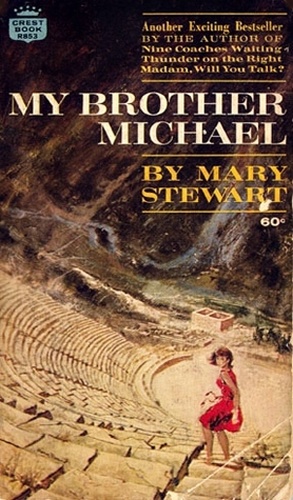
I remember this book as not being a favorite, not coming near the high bar set by all of her other titles. Except for The Ivy Tree another of Mary Stewart’s books I wasn’t too fond of. It is precisely because of that, and because consequently, I had only read this novel twice before, that I decided to give it another chance and listen to it on Audible. Hopes were high, but I’m sorry to say that it lived down to my memories.
Of course, Mary Stewart’s prose and her descriptions of the countryside and attractions of the Greek precinct of Delphi were as masterful as ever. But I found the plot and mystery to be rather boring and uninvolving. Our heroine and our hero, the same. They share a lot of character similarities with her other creations, but there is nothing that sets them apart or makes them particularly engaging or interesting. Most of her other lead characters, especially the women, had something about them that stood out and made them uniquely likable or admirable. One of the problems may have been that Stewart’s usual teenage boy sidekick with whom our heroine can banter and look after is missing in this one. She is basically on her own, except for Simon, the hero, whom she barely comes to know. With no one to bounce off of, so to speak, Camilla remains rather one-dimensional. We learn hardly anything of her backstory other than she has recently broken off an engagement. The romance is so slight as to be almost non-existent. We only assume that they have growing feelings for each other. Nothing beneath the surface is shared with the reader. On a more shallow note, I found it distracting that Camilla was tramping and fleeing over the rough and rocky Greek countryside in a dress and presumably heels. I mean, it’s 1959 girl. Put on some trousers, Not to mention all of the cigarettes consumed.
One scene in this book that has always remained with me, did not disappoint. Camilla is being stalked by the ruthless murderer. She is hiding in plain sight but knows he will soon be able to see her and he is coming up the steep hillside after her. Instead of waiting for the inevitable she steps out, brushes herself off, and meets him instead of cowering in hiding without hope of escape. I could feel her terror and inability to deal with the suspense. Indeed, the last 20% or so of the book contains some of the most harrowing and tense action in a Mary Stewart book, culminating in a to-the-death fight between Simon and the villain.
I hate to give a Mary Stewart book any less than 3 stars, but the ending lacked closure regarding Simon and Camilla’s relationship, and how they were going to deal with a wondrous discovery that they found hidden deep in a cave.
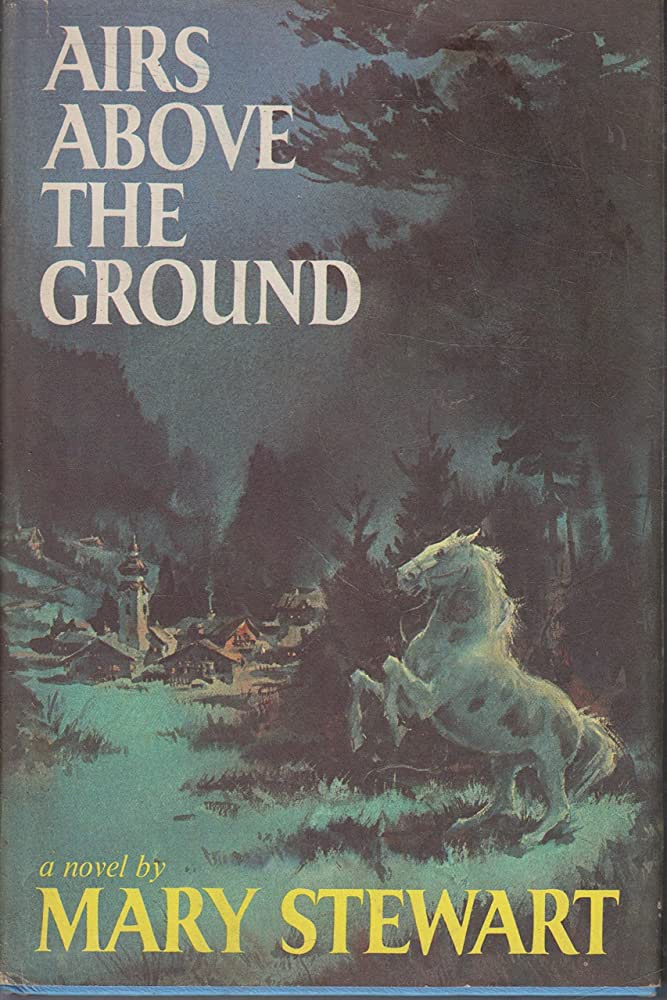
This one takes the typical Mary Stewart heroine(nice, sensible, spirited, smart, and attractive) to Austria. I think this is the only one of her books where the heroine is already married. Vanessa and her husband had been planning a second honeymoon to Italy when he puts everything on hold because his company is supposedly sending him to Sweden. Vanessa is not pleased, to say the least, and they part in anger. But then she sees her husband in a newsreel about a tragic circus fire in a small village in Austria! And, he has a protective arm around a pretty young woman! Despite her angry parting words, Vanessa and Lewis are happily married and her upstanding husband has never given her a reason not to trust him. What is going on? Coincidentally, A friend of her mother’s has asked her to chaperone her 17-year-old son, Tim, to visit his estranged father in Vienna not far from where the newsreel was filmed. What is a concerned and suspicious wife to do? Need you ask?
If I had to name a favorite Mary Stewart novel, this would be it. Tim and Vanessa become the best of friends despite their age difference, and their relationship is charming. When Lewis is tracked down, he has a very good if rather astounding reason for his deceptive actions and his many “business trips” to Europe. It turns out that there is a lot more to her husband than Vanessa was aware of. In most of Mary Stewart’s novels, the romance is tinged with darkness and suspicion with little room for humor. I loved that this one was happy and even lighthearted. The rapport and banter between Vanessa and Tim and Vanessa and Lewis and eventually Tim and Lewis was a highlight.
Of course, there is intrigue and danger involved, including a thrilling chase over the rooftops of a fairy tale castle and a terror-filled race by car and train to rescue Tim from an unthinkable fate. Yikes! Poor Tim. PTSD is definitely part of his future. And intertwined throughout is the small family-owned circus which proudly features a Lipizzan stallion. When Vanessa, a qualified veterinarian by the way, is called on to treat an old broken-down horse who was injured in the fire, it leads to two of the most touching and triumphant scenes in a Mary Stewart novel that I can recall.
The crime part is a bit pedestrian. I liked the romanticism and drama of what turned out to be the red herring much better. But that is just a quibble. There is another mystery that crops up in this one that is much more intriguing and involving than the mere breaking of international laws. I’ve never forgotten what I learned about the Lipizzan horses and their history when I read this for the first time. I listened to this one on audible, and as usual, this added even more enjoyment to this story that I last read many many years ago.
I enjoy books that have spooky or paranormal elements in them but keep you wondering if, after all, there might be a logical explanation for at least some of it. Sometimes what seems to be paranormal activity is actually quite earthly activity. Sometimes there really are ghosties and ghoulies or all manner of supernatural happenings. And sometimes it is a combination of both. The late great Barbara Michaels was a master of gothic and contemporary romantic suspense novels that were firmly rooted in the metaphysical. Susanna Kearsley is often compared to Mary Stewart, but I find her more closely aligned with Barbara Michaels. Susanna (may I call her Susanna?) loves to use the dual timeline where the heroine travels in some way between two worlds, present times and times of centuries past. She is known for her impeccable research and authenticity in bringing forth past worlds.
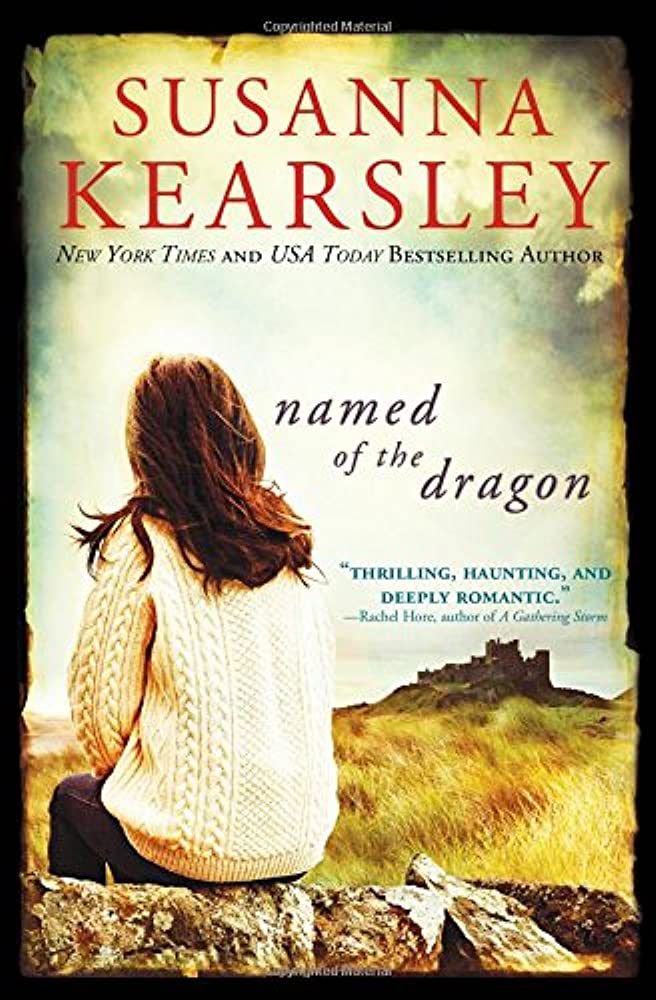
Lynette is a literary agent spending the Christmas holidays in Wales with one of her authors and good friend, Bridget, Bridget’s boyfriend, a critically acclaimed author, and his brother. Nearby is a near-legendary reclusive grouchy playwright as well as the caretaker of Castle Farm (a real place) and his wife. Also living in an apartment attached to the main house is Elen, a young widow with a baby, whom, shall we say, has her feet firmly planted in the clouds. Or as it is put, “She’s just inherited her mother’s way of seeing things, the Celtic way, that sees the past and future worlds all blended in with ours. That isn’t mad, it’s Welsh.” She is convinced that a dragon is after her baby, like in an ancient Welsh tale, and that Lynette has been sent to protect him. Sadly, 5 years earlier Lynette’s own baby died in childbirth, and Lynette, continually haunted by nightmares, has not healed from the tragic loss. Interwoven throughout the book are elements of the Arthurian myths and legends and actual British history alike including Henry VII, his remarkable mother Margaret, and the baby who would someday become Henry VIII. As is usual while reading Kearsly’s books I was driven to Wikipedia and Google Maps to get a grounding in the historical background and the actual historical sites that come into play. Margaret and Merlin come to both Lynette and Ellen in dreams, and we are meant to see parallels and influences between the present and the past. Is history repeating itself? Is Elin’s baby really in danger? And what is Lynette meant to do about it?
For me, Susanna did not adequately bring the fantastical together with the real in a coherent way. To my mind, this intertwining should have been the heart and soul of the book. I loved learning about Queen Margaret, legendary and historical Welsh figures, and the Arthurian legends as told by Tennyson and other accounts. I was awaiting with curiosity and interest for all to be revealed and past and present, and reality and fantasy to come together in true Susanna Kearsley fashion, but it just didn’t. I don’t mind if mysterious things remain mysterious or not fully explained, but I at least want these things addressed and acknowledged. For example, At one point, while sightseeing, Lynette sees an old man, “tall and thin with stooped shoulders and with wispy white hair that blew wild in the wind” emerge from a cave. He is wearing a woolen wrap that trails behind him. He approaches Lynette with eyes as “sharp as chips of gray granite” and in a melodious voice intones, “ Take you care of the boy.” Her two companions saw and talked to him earlier so he is not a figment of Lyn’s imagination. Lynette makes no connection with Merlin come to life, or Elin’s oft-stated belief that Lynette is her baby son’s protector because Merlin told her so. She wonders about it for about five minutes but strangely concludes the old guy was referring to her adult male companion whom he must have taken to be her boyfriend. And then she just forgets all about it. She is unfazed, while I was all “WHY ISN’T SHE FREAKING OUT RIGHT NOW!!??” That she might have just had an encounter with Merlin does not even cross her mind after all that she has been exposed to. It’s where the book lost me.
As always, Susanna Kearsley’s prose is beautifully written, her characters are interesting, the dialogue sophisticated, and the descriptions evocative. There is an exciting climax and satisfying resolution to Lynette’s road to her personal recovery and romantic happy ending. The clues to the source of the danger and mystery, when we find out there is real danger and mystery, are fairly placed along with some very plausible red herrings. I think she tried to tackle too much in this fairly short (for her) novel and just fell too in love with all of the trappings. Interesting trappings, but in the end, just trappings.
This started out pretty well. I was in the mood for a good gothic and this one came to my attention as a likely prospect. I liked the heroine who seemed to have a lot of gumption and an interesting background. I loved the 1970s New York City vibe the book started off with. It reminded me of T.E. Huff’s contemporary Gothics. Unfortunately, the male writer of this one (under a female pseudonym) didn’t measure up to my expectations. This was disappointing and surprising because Hillary Waugh was a very respected and pioneering writer of the police procedural subcategory of mysteries and was named a Grand Master by the Mystery Writers of America. Surprisingly, the mystery part was one of the disappointments in this. In the end, it seemed pretty slapdash and not well thought out or constructed.
Andrea, our heroine, is in a dead-end boring job with a scientific journal and answers an employment ad looking for a young, personable, single female who is adventurous and able to travel. After a somewhat unusual interview, she is selected to be the pretend girlfriend of Charles Carteret, the attractive young head of a very wealthy and prominent family. Her mission is to become friends with Regina, his mentally disturbed sister who is suffering from a devastating disappointment in love which has caused her to become a recluse, depressed, and completely closed down. Hopefully, Andrea, spending the summer with Charles, Regina, and their family on their private island, can penetrate the wall she has put up and start the healing process. This seemed a pretty questionable plan to both me and Andrea. But she is talked into it.
The writing was engaging with a good setup for intrigue, danger, and mystery. It was cooking along pretty well until about the halfway point when smarmy Daniel, Regina and Charles’s stepbrother and the supposed object of Regina’s unrequited love, arrives on the scene. A handsome and charming ladies’ man, he and Andrea start flirting with each other although she is careful not to be inappropriate. Daniel whines about how unfairly he has been treated inheritance-wise and has a “slightly soft body.” Gothic good guys don’t whine and their bodies are not soft unless they are elderly, so I discounted Daniel immediately and soon viewed him with suspicion and distaste. But not so Andrea. Despite the attractions of Charles, she likes him, trusts him, and is even attracted to him. Which, in turn, makes her look stupid and a person of no judgment or sense. After some admittedly suspicious behavior on Charles’ part when a stable worker is killed, she jumps to the conclusion that Charles is a murderer without a thought as to why he would murder that person. It’s not that he had no motive, but that the thought of “what is his motive?” and puzzling over what it might be never enters her mind. This was the point I lost interest in the novel. After a few more chapters, I started skipping through to the end. The death is ruled an accident even though proof that it is not is in plain sight. And on and on. Questionable motivations, unnecessary lies, “proof” that is not proof of anything, and ludicrous actions abound. Not to mention a jarring change of literary point of view near the end. The main thing though was having to see everything through the eyes of a heroine that was just so clueless. I got very antsy and impatient which was not helped by the fact that I was forced to read this book in hardback (interlibrary loan) as it was not available on Kindle. And I had another book with lots of potential waiting in the wings. Even the romance was a bust.
I listened to this on audio, read by Ellie Haydon, who makes Christy and Charles, the two leads, posh but likable. Strangely, Christy’s Lebanese driver, Habib, is read as an English cockney. Christabel Mansel is on a guided bus tour of the Mideast. She semi-coincidentally meets her older cousin Charles. “I met him on a street called Straight” is the attention-grabbing first sentence in the book. They were raised together in England and are first cousins, both the children of twin brothers. I’ll let that sink in though I have no comment. My understanding is that in later, possibly in the U.S. editions, the editors changed this to second cousins. Because by the end of the novel, they are well on the way to marriage and presumably children. Christy is the first to admit that both she and Charles are spoiled and entitled, but it doesn’t really come through in their words and actions. They are likable and nice. Christy in particular has a lot of gumption and is not afraid of confronting the bad guys later in the book with her tart sarcastic tongue.
Charles reminds Christy that their eccentric Great Aunt Harriet lives near Damascus in a Castle called Der Ibrahim. She fancies herself as a latter-day Lady Hester Stanhope. Christy doesn’t really remember her too well, but Charles was always a favorite and he plans to go visit her. Meanwhile, Charles has to go meet someone on business, and Christy decides to steal a march on him. Because that is how she rolls. She is successful in getting into the decaying castle and meeting her elderly sick Aunt’s caretakers, who seem OK at first but may or may not be shady, and finally her reclusive and anti-social Aunt, who is really odd and creepy. Before she leaves two days later she notices that the local girl servant is wearing her great aunt’s ruby ring, a family heirloom. Something is not right.
When Christy and Charles meet up again Christy tells him the whole story. The easy and sometimes amusing banter between the two cousins is a strong point in the book. On her way to meet Charles in Beirut (or Damascus?), she is kidnapped and taken back to Aunt Harriet’s castle by a man who looks strangely familiar. From there, Christy and the Reader are confronted with being drugged, smuggling, poison, dungeons, murder, a raging fire, and the truth about Aunt Harriet.
Most of the book is, fair to say, heavy on the description and travelogue aspects and light on the plot. As exotic, romantic, and nostalgic as the 1960s Middle East is, it does slow the book up a bit. The last quarter of the book is full of action and excitement and of course, Romance. It even has a heart-touching scene. Christy and Charles make a great team and have a great relationship. Reading about the 1960s in the 2020s is nostalgia gone wild. With a touch of melancholy. Not that I ever was in Syria or Lebanon, of course. But Mary Stewart is so great at conjuring up that world and the sights and experiences that a beautiful, rich, spirited, and smart girl might have had there, (even without all the excitement) it reminds me of why I love to read. Calgon, Take me Away.
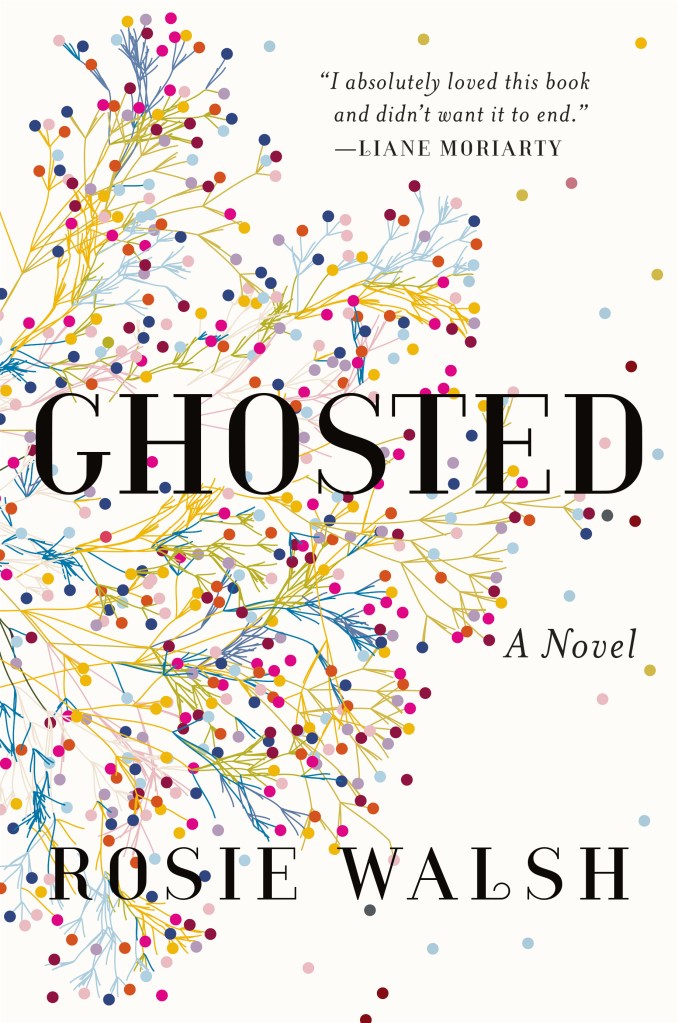
“The letters, Tommy, all those letters I sent him via Facebook. Calling his workshop, writing to his friend Alan. What was I thinking?” “A silent phone brings out the very worst in us,” he said. “All of us.”
As I was reading this, I found it to be a real page-turner. I went into it thinking it was going to be a romantic suspense-type novel: a story about a woman whose lover has disappeared and her search for him leading to danger and intrigue. The down-to-earth guy she fell in love with not being what he seemed on the surface. Perhaps involved with organized crime, witness protection, or being a secret agent who disappeared because he was killed or kidnapped? Or perhaps deliberately going out of her life without a trace to protect her from harm? I did not see the twist around the middle coming at all and was blown away by the real story.
But no. Ultimately, I had too many problems and frustrations, particularly with Eddie (did she have to name him Eddie?). I bought the love story and the soulmate connection that happened in a week. I understood Sarah’s obsession with finding him, her terror, and then her pain and bewilderment. I was as bewildered as she was, and I really felt for her. Despite her emotional somewhat unhinged behavior, I didn’t blame her. I wanted her to keep going and find Eddie.
**Spoiler**
What I didn’t get was the hatred and hostility directed at 17-year-old Sarah for the accident. It. Wasn’t. Her. Fault. I didn’t understand her sister Hannah hating and not speaking to her for 19 years for choosing to save Hannah’s life at the expense of another. And it wasn’t even a choice. It was an involuntary instinct. A reflex in the horror and panic of the moment. If anything, it was Hannah’s own fault for running off and getting in scumbag Bradley’s car to begin with! It was just so unjust and I couldn’t understand. What added to that frustration was she was never blamed for her stupidity and blindness in letting lowlife Bradley into her life at all. In that way, yes, she was indirectly responsible for the tragedy. A more immature, half-witted, and blinder than usual teenager could not be imagined. But she was still only a kid. And Eddie. I lost all patience with him and his cruel ghosting of Sarah when it became obvious that it was a choice, not something forced on him. After the twist, I was initially sympathetic, but ultimately there was no excuse for his cowardly irrational behavior. I just couldn’t forgive him even at the end when he went through so much pain and remorse. He got off way too easy. I felt like his obsession with his sister was a little over the top and, shall we say, off-putting. **end spoiler**
The second twist, I felt, was clever and well done.
**spoiler**especially given the title of the book . **end spoiler**
It kept me turning the pages, let me tell you! Despite my problems with one of the protagonists and the core motivations, I really liked how it all turned out. So overall, I would recommend this to most people, especially to romantics at heart. But you gotta like melodrama too. I hovered between a 3 and a 4, but the problems I had nagged at me all the way through. So my annoyance rounds it down from a 4.
If there is one word to describe this book, it would be “fun.” Right off the bat, I loved the authorial voice: It flowed easily and drew me right in with the funny remarks and quick immersion into the plot. The idea of the story was intriguing and unusual. It set up a lot of anticipation as to who, how, and what was going down. Because make no mistake, our heroine was going to see that the bad guys (her family) were, indeed, going down.
We meet Jillian, fresh from 39 months in prison, ready to literally and spectacularly descend upon her unsuspecting family who put her there. She debarks from her helicopter on the family mansion’s spacious grounds in the midst of a party where they are laying the groundwork to swindle and con their latest victims. They are not happy. But Jillian is less so. They had promised to go straight in return for Jillian taking the fall for them with the FBI. Now she’s back, she has their number, she holds all of the cards, and she’s had 39 months to contemplate her revenge. And maybe, just maybe, set them on the straight and narrow. Nah. Not happening.
It turns out that her family are not only professional grifters and con artists, but that in an emergency they will not stop at murder. And Jillian’s arrival is definitely an emergency. If some may balk at murdering a family member (that would be against the family rules) they won’t hesitate to send her back to prison. Enter Beck, a very grumpy, sexy, and intimidating bodyguard, hired by one of her loyal allies.
Although the romance is nice and provides a topper to the satisfying ending, the main focus is the battle of wits between Jillian and her family. In the process, we also get the occasional point of view of one of her half-sisters. There are, of course, some twists and turns and surprises. Some of her family are revealed to be truly perfidious, others not so bad in spite of themselves. The book did seem to lose a little steam about halfway through as we learn that Jillian is not quite so “together” as she first appeared. Having Jillian gaining insight and having to work on her own issues provided some depth and layers to her character. But it did seem to stall the narrative a bit. I missed the implacable focus of her mission to teach her family the lesson they so richly deserved to learn.
Fortunately, the sensational set-up was matched by a strong conclusion and the book regained most of the momentum it had lost towards the end. All in all, it was light and entertaining and I enjoyed it.
Thank-You to Net Galley and Avon Books for providing me with an advanced copy of this book in exchange for an unbiased review.
Amnesia or no, Lock, you’ve got to admit she’s got spunk!
This one had a lot in common withWherever Lynn Goes. A girl in swinging ‘70s London with a wacky roommate gets drawn into mystery and danger at an isolated old mansion. In both of the books, the loyal gal-pals almost steal the show from the heroines. They insist on schlepping along with them (Lynn and Emmalynn) out of loyalty or love of adventure and take an equal role with the heroine in investigating the mystery. In several instances, they take the lead. Mandy and Billie are both gorgeous party-lovers who are used to having men worshiping at their feet as opposed to our beautiful but sensible heroines. But while they come across as flighty, they are both keenly intelligent. And they both are can-opener challenged:
As I set the table, Mandy tried to open a tin—for her a highly dangerous process which might well result in a surprise appendectomy.
I wondered how long it would take Billie to cook dinner. I privately doubted if she could even open a can without performing a surprise appendectomy…”
But enough about the sidekicks. Our likable heroine witnessed the murder of her former employer in the lonely old mansion, but she has amnesia. The eccentric old woman has left Emmalynn the house, and of course, she must go there. Part of the fun in a T.E. Huff is trying to guess who the romantic interest of our leading lady might be vs. The Killer. In this one, we have three men and a possible long shot. Two of them ruled themselves out pretty quickly as the love interest. One because…
He’s smooth and polished and—I suppose you’d think him handsome. He never did a day’s work in his life, although he piddles with stocks and investments and always managed to run through all the money Henrietta let him get hold of.
Romantic heroes never “piddle” are always responsible with money. The other because…
The pants were a bit too tight, the shirt showed a little too much bronzed muscle, his hair was just a bit too shaggy and sun-streaked. He was a stunningly handsome man, but his good looks were too calculated for my taste.
Plus, they are never conventionally handsome. Once you know who the hero is, you then know who the killer is, because it always is the other one. In this case, we know that neither of these dudes is the hero, so one of them must be the ax murderer. According to the playbook. And yes, Henrietta was decapitated with an ax.
The third guy seemed promising from what we hear about him. He’s a socially conscious doctor who is trying to prove his Dad is not guilty of the crime. And he’s a dog owner. But Emmalynn has almost no interaction with him. We meet him briefly about a third of the way through, and they have a hostile public interaction about halfway through, but then he all but disappears. I admit I was stumped. There has to be a romantic interest in a gothic…doesn’t there? Admittedly T.E. Huff keeps the romance in his novels pretty uneventful, but this was ridiculous.
At a little over halfway through the book an alert reader becomes aware that Emmalynn is keeping something from us. COULD IT BE SHE DOESN’T REALLY HAVE AMNESIA??!!!
This was a solid “3 out of 5”: Not the best Thomas Elmer Huff but very enjoyable with an engaging writing style as always. But the last chapter was so delightful that I am bumping this up to 4 stars (for what it is-a quick, light and entertaining read).
I had just seen the Disney movie The Moon-Spinners for about the millionth time motivated by reading Hayley Mills’s autobiography. I had forgotten how different it was from the book. In both, Nicola Ferris our 22-year-old young heroine runs across Mark in Crete while on vacation with her forty-something cousin Frances. In the book, Mark is already wounded and in hiding with his Greek friend, Lambis. In the movie, they are both guests at a small family hotel. They meet at a party the first night but the next morning, he is mysteriously missing. Of course, the book has Colin, Mark’s kidnapped little brother instead of the friendly Greek youth of the movie. That was a plus. Mark’s and Nicky’s anguish and our suspense over whether the bad guys had killed Colin or taken him hostage added a lot to the novel. The scenes where Nicky and Colin find a buried body that appears to be Mark’s and the discovery of the truth later make gripping reading.
There is one main thing, though, that I feel the movie improves upon and that is Mark’s motivation for his conflict and danger from Stavros and company. In the book, Mark and Colin are threatened because they witnessed a murder among thieves. But in the movie, Mark was accused of stealing some jewels in London and the only way he can clear his name is to follow Stavros to Crete, recover them, and prove Stavros was the real thief. This brings in the iconic Pola Negri to play the part of Madame Habib to whom Stavros is bringing the jewels to sell. Those scenes, and also the scenes at the diplomat’s house that they take refuge in only to find out he is one of the gang are really suspenseful and add a lot more adventure to the plot of the movie.
I did enjoy the Moonspinners very much despite the sub-par narration of Daphne Kouma. Her enunciation was not the clearest and she often whispered to convey tension or suspense in the story which also made her difficult to understand sometimes. The romance between Mark and Nicky was very slight and rather subtle, but it was sweeter than in the movie. The characters of Colin and Lambis added some humor and depth. Nicky’s successful Cat and Mouse with Sophia, Tony, and Stratos until she makes a fatal mistake keeps you on the edge. And of course, Mary Stewart’s description of the land and the character of the people and their ways were very evocative as always. The book is lighter than some of her books in which the lead characters are a little more mature, but none beat this one for charm.




 Rebekah's Readings and Watchings