“Happy endings are of little comfort,” Logan told me, very sure, “to characters who die afore the tale is done.”
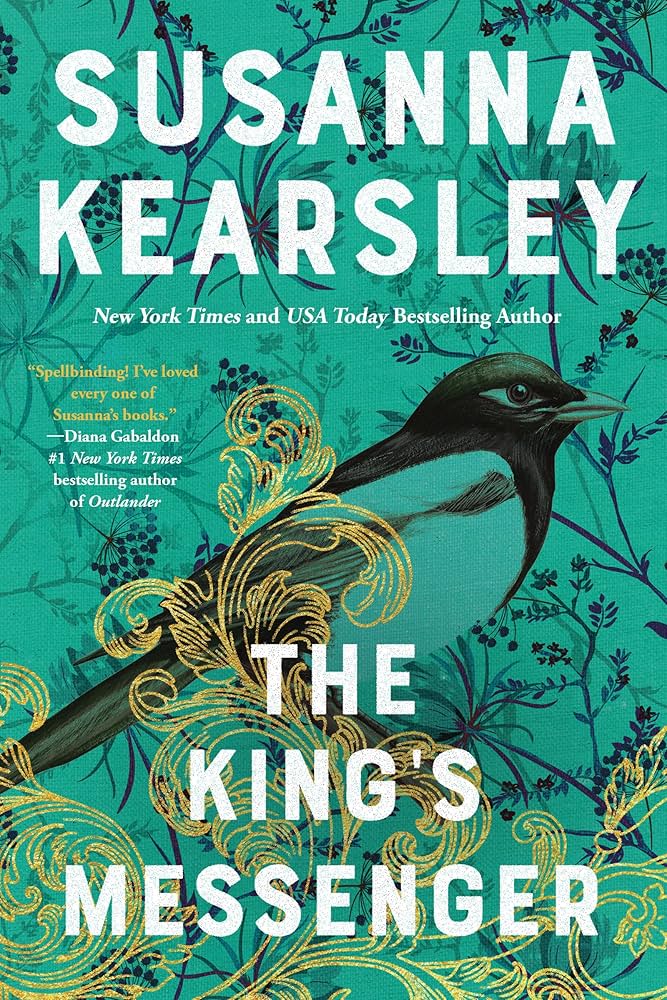
I wasn’t crazy about this one. It was very romance-forward for a Susanna Kearsley novel which I was happy about at first. But it seemed much lighter than the other books by her I’ve read. To be fair, that perception might be influenced by the book I read right before this one. She picked a good bit of history to provide the foundation for her novel, but ultimately the history part, which was confined and personal as opposed to overarching and epic, was depressing to think about. Since many of the characters were based on real historical figures, it limited her on what she could do with them. The fiction part was a bit plodding and I was not emotionally engaged in the predictable romance. That’s true of most of her books, but usually there’s enough “other stuff” to make up for it. Kearsley almost always includes a supernatural element which has always been well integrated into the story. In fact, it has been the key factor and those books as written would not exist without it. There was a supernatural element in this one but it could have been left out and would have changed nothing to plot or character. In this one, one of our main characters has second sight and gets random brief visions of the future, which are mostly always deceiving. Also he sees dead people. Neither of these “gifts” have any major influence on anything that happens. They’re just kind of tacked on seemingly to make Andrew more interesting, or just because it’s Susanna Kearsley’s “thing” to have a paranormal element to her novels.
It is set in 1613 shortly after the sudden and suspicious death of Henry, King James I of England’s promising teenage son and heir to the throne. Rumors are starting to spread that he was poisoned and suspicion is starting to fall on King James, his own father. King James was a nasty piece of work and was jealous of his talented, intelligent, and principled son. In order to quell the rumors, he sends for David Moray a.k.a. Murray (real person), Henry’s trusted courtier and companion with the intention of pinning Henry’s murder on him. Andrew Logan, our hero, is the King’s Messenger sent to Scotland to arrest and bring David Moray to London for the inquiry and trial. Because there will be a trial: David Moray is being framed by the King himself. With him on the journey goes a Scrivener who is assigned to write down everything that David says and does with hopes of gathering actual evidence against him, and his daughter Phoebe who insists on coming with to watch over her father who is in poor health. Phoebe and Andrew’s families have been neighbors for a long time, but due to a misunderstanding and some lies told to her, Phoebe has always disliked Andrew. On the journey to London, there are some not very thrilling adventures, and we get to know the characters in depth. As Andrew proves his worth time and again, Phoebe’s dislike turns to love. David Moray is a wise and good man, and still suffering the lingering pain of Henry’s death whom he loved like a son. Of course we care what happens to him but the fact that Wikipedia (and other sources-Ha ha-not really) tells us that David Moray was never brought to trial and lived a long and productive life for years after the events in this book kinda put a kibosh on any suspense regarding his fate. However, “the how” was neatly and cleverly done. Can Andrew remain loyal and dutiful to King James but not be a party to turning over an innocent man to certain death?
There are some interesting little nuggets in this book. For one, We meet and learn about real person Esther Inglis, who, despite her gender, was a well respected calligrapher of the day. Susanna Kearsley does her research, so I found all of the real historical details regarding the royal personages, King’s Messengers, scriveners, etc. pretty fascinating. Speaking of research, Kearsley is a firm believer in the theory that Prince Henry was poisoned, and poisoned at the instigation of his father the King. This flies in the face of most historians’ long held view that he died of Typhus. She makes a strong case, and I believe her. But it is so depressing to think what a great English King Henry would have made as opposed to his brother Charles I whose beliefs sparked the English Civil War and led to his execution. It was very neat how Kearsley used an incident that really happened to fashion Queen Anna’s revenge on her husband for her son’s death. Spoiler Alert! My second book in a row that a dog dies. I hope this is not a trend.
Very short review (for me, anyway). A quick take, if you will.
Fantastic Book. Poignant, Funny, Scary, A love story, Mysterious, Astonishing. Very very very satisfying ending. All loose ends tied up with a little happy twist during the wrap up. Loved all of the characters. The female ones in particular were strong and admirable. The stars of the show to my mind. This could be a homage to Stephen King (who loved it. Of course.) I was really drawn in to the fictional world, and I looked forward to coming back to it every time I put it down. That is rare for me.
To add to the personal connection I found in this book, it is set in 1999 when my oldest son was the same age as Marshall, the narrator and main character.
But if snakes freak you out, maybe give it a pass.
“Not kill you, sir, never kill you!” said Dobby, shocked. “Dobby wants to save Harry Potter’s life! Better sent home, grievously injured, than remain here, sir! Dobby only wanted Harry Potter hurt enough to be sent home!”
**Original thoughts, 2018, on the American Audible version**
Going through all of the HPs, listening on Audible. I have listened to the Stephen Fry Philosopher’s Stone, but all the rest I have are the Jim Dale versions. I much prefer the Stephen Fry, as Jim Dale has some odd intonations and I don’t like his pronunciation of Voldemort and other words. Sometimes Dale sounds really whiny and wheedling, especially with the children’s voices.
**re-read on kindle 06/2025**
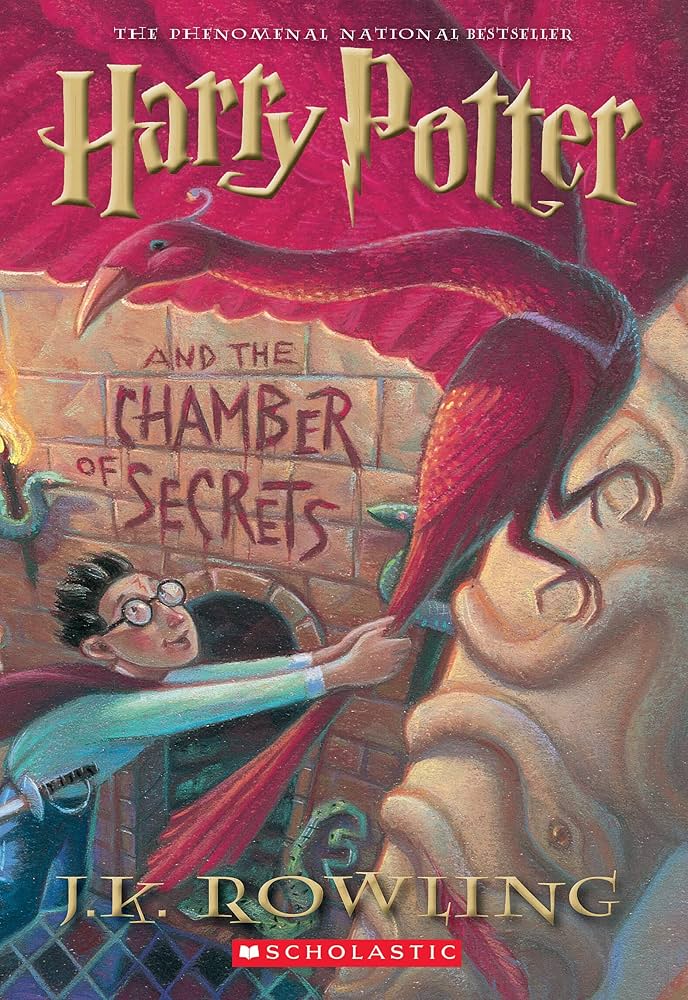
Even though this remains a Harry Potter that is not a favorite of mine, it cannot be skipped. It is the introduction of Dobby, Lucious Malfoy, Tom Riddle, Ginny Weasley, Arthur Weasley, the first Horcrux, The Burrow, Polyjuice Potion, the Sword of Gryffindor, Borgin and Burkes, Aragog, Moaning Myrtle, and Fawkes. And probably some others I don’t remember. It gives so much context to many momentous events to come. So many aspects which have far reaching influence on our key players’ final outcomes and fates start here. Nevertheless, it still comes across as a children’s’ book (which it is, of course) but, for me, minus much of the wonder, and, though there were some funny lines, humor, of its predecessor. I almost think the movie surpassed the book in many areas particularly in its portrayal of Dobby. It brilliantly captured the amazing, almost impossible, mix of annoying and adorable, funny and tragic, victim and victor.
And a few things took me out of the book. I couldn’t get over why Harry was shunned and suspected of being the Heir of Slytherin when Draco Malfoy should have been the obvious suspect of everyone from the start.
Then someone shouted through the quiet. “Enemies of the Heir, beware! You’ll be next, Mudbloods!” It was Draco Malfoy. He had pushed to the front of the crowd, his cold eyes alive, his usually bloodless face flushed, as he grinned at the sight of the hanging, immobile cat.
But there is no reaction to this outburst! Where is the outrage? It is a harbinger of Harry being celebrated one minute and vilified the next that repeats itself throughout the series.
Also the whole Polyjuice Potion scheme was a very high risk, low reward plan. It could only succeed in possibly satisfying the trio’s suspicion of Draco’s guilt or innocence, but would prove nothing to anyone else and could never accomplish anything.
Hermione’s infatuation with the nincompoop Lockhart seemed very out of character.
Of course Chamber of Secrets is part of Harry Potter so I liked it a lot. I am enjoying noticing things I didn’t notice before. Listening to books on Audible holds many joys, but you miss some detail and subtleties. This is my second time reading Harry Potter in “print” on Kindle and it’s been quite a few years. I am enjoying all of the re-discoveries. One of these worth noting is the part where Harry first hears the name “Riddle”. He thought it sounded vaguely familiar. He knew he had never heard it before but it “still seemed to mean something to him almost as though Riddle was a friend he’d had when he was very small and had half forgotten.” Chilling. It’s a clue and dark foreshadowing as to what is going on with the connection between Harry and Voldemort that will gradually be revealed in the coming books.
Despite many frustrations with the male half of the couple who are the two narrators of their story, I really enjoyed this folk horror/thriller. A young couple leave their urban lives behind and fulfill their dream of buying a large property in the country at the foot of the Teton mountains. With them, is their dog, Dash, who I have to count as the third main character in the novel. Their nearest neighbors are an older couple, Dan and Lucy, and Joe, the rather mysterious Native American patriarch of the family who has owned the largest ranch in the area for generations. Soon after moving in, Harry and Sasha are visited by the older couple who shock them by telling them that their valley is haunted by a malevolent spirit that manifests itself 3 different ways depending on the season. Winter is a reprieve when the spirit is at rest. They talk to them about the rules they must follow to keep themselves safe and the spirit at bay. And though the whole process is disturbing, it is not that hard. At first, though they like and value Dan and Lucy, how can they believe such craziness? Harry especially is resistant to anything dealing with the supernatural, while Sasha, as things begin to transpire exactly as Dan and Lucy foretold, understands that she must believe the evidence of her own senses.
Harry and Sasha’s love and support for each other throughout the ordeals which are to come is never in doubt. It is established early on that Sasha is wise and strong, while Harry, though a former marine and tough and strong on the surface, is ruled by his emotions. This leads to bouts of rage and actions that not only fly in the face of logic and sense, but put the safety of himself and his beloved Sasha (and Dash) at risk. This happens over and over despite his recognition of his own foolhardiness and the remorse which follows. Harry’s frustrating behavior is caused to some degree by his injuries and experiences in Afghanistan. Until near the end of the book when Joe, often talked about but never seen, finally makes his entrance, I counted Harry’s weaknesses as a flaw in the book. I was driven to distraction by him and his mess when I felt the rest of the story was so strong that it was an unnecessary distraction. After a disastrous encounter with the Autumn manifestations of the spirit, Joe finally comes to the rescue and his encounter with Harry is so satisfying that it almost made all of my distress and disgust with the essentially good man and co-hero of the book worth it. I saw what the authors did there.
I was engaged and engrossed throughout. The concept and source of the horror and terror were fascinating and unusual. Secrets are revealed that increase the threat and danger to Harry and Sasha. Sasha’s focus changes to living with the spirit by following the rules to vanquishing it permanently. When winter comes, the season in which the spirit is supposed to hibernate, we learn that it only hibernates for those who have not killed another human. And of course, Harry, a war veteran, has killed as many as 5 people in Afghanistan. It is with the Winter manifestations that the story breaks down. The main problem is voiced by Harry himself:
I dunno…a divine omnipotence that’s damn near indiscernible from how most monotheists describe God. All that power over the souls of the dead just to play ventriloquist for a few weeks a year? All that power just to put on some spooky theater for a nobody asshole like me in this little mountain valley? Nah. Even applying the bizarre, fucked-up metrics that exist in this strange place, that’s just too much of a stretch.
Exactly. At the end of the book we are left with the hope that this infinity-year-old omnipotent spirit has perhaps been permanently put to rest by Harry and Sasha. But how they did that when generations of Native Americans could not crack the code is very unclear. And smacks of white saviorism. The secret was too simplistic bordering on inane. So much so that I thought I missed something. There were plot holes and questionable aspects throughout the book which I could and did overlook, the story was so compelling. I loved all of the characters except for Harry. But since Sasha and Dash the dog (and Dan and Lucy) loved him despite his flaws, I didn’t want any permanent harm to come to him. It was a good read but the epilogue was facile with an attempt to bolster it by a tangle of meaningless gobbledygook. Also, unanswered questions! A bête noire of mine. No pun intended.
“Doris Crockford, Mr. Potter, can’t believe I’m meeting you at last.” “So proud, Mr. Potter, I’m just so proud.” “Always wanted to shake your hand — I’m all of a flutter.” “Delighted, Mr. Potter, just can’t tell you, Diggle’s the name, Dedalus Diggle.” “I’ve seen you before!” said Harry, as Dedalus Diggle’s top hat fell off in his excitement. “You bowed to me once in a shop.” “He remembers!” cried Dedalus Diggle, looking around at everyone. “Did you hear that? He remembers me!” Harry shook hands again and again — Doris Crockford kept coming back for more.
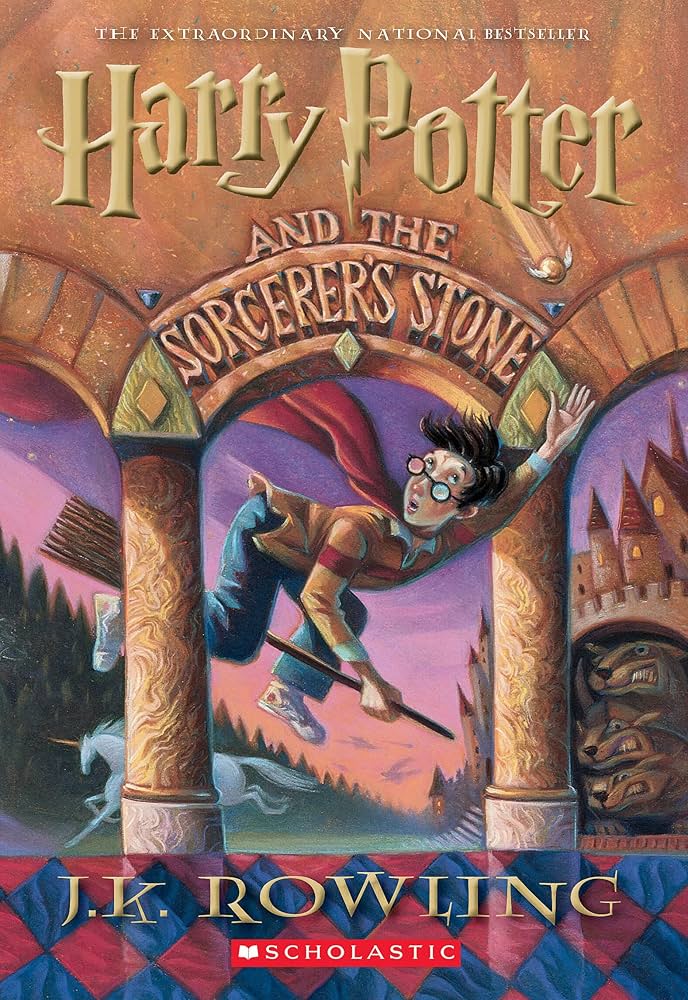
What can I say that hasn’t already been said about this book? And by far smarter and more insightful people than me. All I can say is I enjoyed it very much and was very entertained by Rowling’s playful sense of humor. I am amazed at the funny names she gave her characters. The humor is geared for children in this book, but there is much for adults to enjoy as well. She seems like she was having a heck of a good time writing it and sometimes I imagined that she was just cracking herself up. And I appreciated that reading the book instead of listening to it or watching the movies gave me the opportunity to pause and reflect. Knowing the series backwards and forwards, I enjoyed the foreshadowing of things yet to be and happen. Or was it foreshadowing? How far down the road did she plan out the story and details? It is said she spent 5 years planning out the series before she started writing Sorcerer’s Stone. I wonder what she would have changed if she knew then what she knew by the time she wrote the words “All was Well”? She mapped out everything before she even knew this first in the series would be written, or if written, if it would ever find a publisher. Amazing. A truly amazing woman and writer.
The only quibble I have ever had with this book was the way Gryffindor won the House Cup at the end. As a fair-minded Hufflepuff, it really bothers me. If I was a Slytherin, I can’t even imagine my reaction.
I was expecting more from this, especially after I started reading it. The premise, in which our main character keeps going back in time until she get things right, had a lot of promise. But the two main characters turned out to be disappointments, and a disappointment together. The very large and crowded secondary cast had no one entertaining enough to carry a secondary storyline to fall back on.
Andrew, our heroine’s love interest, was too much of a paragon. Perfect face, perfect body, and perfect personality. There was no room for growth, or change for the better, possible for him.
He smiles, and Lord, if the sun doesn’t come out from behind the clouds. Dimples so deep I could lose all my hopes and dreams inside them. I swear his teeth sparkle. As if on cue, a perfect brown curl falls over his forehead. You have got to be kidding me.
You’ve got to be kidding me too. The description reminded me of those old comic book representations of Superman. And that can be fine if he is the knight in shining armor character who has to rescue a victimized or seriously flawed heroine from a heinous antagonist. But this heroine had just failed to launch and needed to grow up. Besides, no disrespect to Superman, but I prefer Clark Kent. The love story seemed jejune and more of school girl crush. Our heroine, called variously Maelyn, Maisie, Mae, or Noodle, is 26. She had decided she was in love with “Mandrew” at 13 and has since only saw him for one week a year. Hardly a strong foundation for an enduring love story. Honestly, it had all the makings of “Girl thinks she is in love with the guy who checks all the boxes, but her real connection is with the less obvious underdog.” I would have preferred it if the love story started with perfect Andrew but ended with his flawed brother Theo, minus the gross face licking incident.
I glare across the table at him, but he doesn’t look up. He tucks into his Lucky Charms like a hungover frat boy. Theo is a dick.
Lots of room for growth and change there! A slow realization that Theo had been misunderstood and had hidden depths would have been much more interesting and romantic. But unfortunately the author(s) saddled him with some serious no-nos that eliminated that possibility and any suspense of who she would wind up with, despite my hoping for a miracle.
The second big thing that didn’t track with me was the time travel/Groundhog day thing. It didn’t make any sense, and I’m not even talking about “why this particular girl?” Although that would have been nice to know! By the way, our heroine had never heard of this modern classic Romantic Comedy, which did nothing to endear her to me. I was ok with her having 3 trips only which stopped at the halfway point. She was always whisked back in time right before she was about to be killed or maimed (or seriously injured.) At first I thought the universe was trying to save her life. The first time, an out of control truck is spinning towards her and feet from crashing into her car. The second time she is about to fall down the stairs. The third time, a heavy tree branch is about to fall on her head. But when the fourth time a life threatening incident occurred, nothing happened. She assumes the universe is trying to warn her she did something wrong (why?), which she didn’t. In fact, it occurred right after she decided to do something very right and be honest with Theo about Andrew. And throughout the book, it never seems to hit her that the first incident that triggered “Groundhog day” could also have killed her and her whole family. This possible tragedy waiting to happen (again) is never acknowledged.
Fairly early on, after the 3rd reliving of her cabin vacation, She actually learns the lessons she presumably is meant to learn, the secret to her being happy. She emails her boss and quits the job she hates, and is honest about her feelings for Andrew. But the penny doesn’t drop until almost the 80% mark.
I’ve spent years not trusting my ability to make decisions and quietly letting life just happen to me. It can’t be a coincidence that the moment I stopped being passive and followed my instincts, everything seemed to fall into place. I know what makes me happy—trusting myself. What a gift, right? I found happiness… The only person whose expectations you have to live up to is yourself. When I thought it didn’t matter and no one would remember, I finally started living authentically. I quit my job. I was honest about my feelings. I went after what I wanted without fear.
I don’t know, it was all very confusing. But I won’t pile on about other things that bothered me. The upshot is, that the premise could have been the foundation of a really good book with some depth and all sorts of interesting things going on, but the authors wasted it on what is only a light and frothy holiday (and pretty insipid) romance. It was like Christina Lauren purposely steered away from anything that could have made it substantial or really special.
Oh god. I think…I think this is actually it? My grand finale. My expiration date. The End. Here lies Delphie Denise Bookham. She died just as she lived: alone, perplexed, wearing something a bit shit.
I really really liked this one. It was charming and very light, with an intriguing premise. And really funny. There were no flies in the ointment to detract from my enjoyment except that the heroine started out unlikable and flawed. She dislikes being around other people and is prickly, passive, and rude. She has chosen to isolate herself from the world as a response to a lot of childhood trauma, and her mother’s continuing neglect and disinterest in her. Once a talented artist, her art supplies are covered in dust. But since the overriding theme of this book is how and why Delphie learns and grows into a better, happier person, and starts connecting to other people, how can I complain? That wouldn’t be fair. And we know she is a good person at heart because of her only human contact (I hesitate to call him a friend), Mr. Yoon, her downstairs neighbor. He is an elderly mute Asian man, whom Delphie has taken upon herself to look after and keep safe.
At the beginning of the book, Delphie chokes on a hamburger and dies. She ends up in the “Evermore” waiting room with her afterlife counselor named Merritt. She is just getting acclimated to the situation when another recently dead man shows up. His name is Jonah and they have an instant connection. In fact, he is one of her 5 earthly soulmates. Delphie is thinking being dead might not be so bad after all when, Oopsie!, he is sent back to Earth. A mistake has been made. But Merritt, a lover and expert in romantic comedies has a deal for Delphie. She will bend the rules and let Delphie return to Earth for 10 days. If she can get Jonah to kiss her within that time, she can stay alive and kicking. Of course, it is easier said than done. Jonah will have no memory of Delphie and she does not even know his last name, only that he lives in London.
To her disgust, Delphie quickly finds out that she can not do this on her own. She needs the help of her workmates and neighbors whom she has been successfully and unapologetically alienating for years. Number one on the list is her downstairs nemesis, the attractive but surly Cooper, who has the necessary computer skills to track down Jonah. Readers familiar with romantic comedy know right away that it is Cooper who is “the one” for Delphie, not Jonah. Confident ladies man Cooper, it turns out, is as ornery and unhappy as Delphie. He’s not enthusiastic about helping her, but he needs a favor. As they search London for Jonah, Delphie slowly sheds her antisocial ways and finds friends. Cooper and Delphie fall in love.
Just yesterday my life involved interacting with as few people as I could get away with….How am I supposed to leave this? This…life. Because what I was living ten days ago wasn’t a life at all. But this? This noise and laughter and mess and fear and…people. Friends. Possible love. I can’t lose this. There are people in this room who wouldn’t want to lose me either. I make a difference to them. I can’t leave. Evermore is too far away. I don’t want to die. Fuck. I want to live.
But to live, she must still get Jonah to kiss her. And that blasted Merritt sometimes seems to be working against her. She must also ensure that Mr. Yoon is not left on his own in case her quest ends in failure. Cooper and Delphie’s journey to their happy ending is both hilarious and touching. As the already quick pace of the book picks up as Delphie’s 10 days comes to an end, it really kept me guessing. And then there is a surprise development that throws a whole new light on many things.
I’ve had another of Kirsty Greenwood’s novels on my TBR list for years. Now that I’ve read this one, I finally have a new author to be excited about. It’s a great feeling.
I like a good thriller and welcome paranormal elements in a few types of books. But I didn’t quite expect how all of this played out. I knew something was up when the bowl of nacho sauce exploded in the face of a guy who was being a jerk to our heroine. I’ve read Harry Potter and the Sorcerer’s Stone, binged Stranger Things, and have seen Carrie. And any reader knows that, despite appearances, if dogs love you, you are a good person at heart, but if they don’t, there is something seriously wrong with you. But I didn’t expect it to be so full-on. I don’t know why it came as such a surprise (not shock-there is a difference) because the clues were there barely 10% into the book
The dog…went on yapping, clawing, baring its teeth, trying to get to me. Eventually, the girl got up and moved, eyeing me as she did. “He’s never like this,” she muttered to herself as she passed by.
Vesper is smart, funny, and beautiful. Too smart and beautiful to be waitressing in a chain restaurant in New Jersey. We learn that she has been on her own for 5 years because shortly before she reached her 18th birthday, she escaped from a strict and fanatical religious cult. While growing up, she had always been indulged and treated as if she was special despite her indifferent and sometimes cruel mother. The loving father she adored had left her and the community when she was 11 and she still yearns for him. She never believed in “The Lord” and felt like an outsider. Yet, outside and free from the cult, she still is an outsider. She does not play well with others. She is lonely and unloved. So when she receives an invitation to attend the wedding of her childhood best friend who is marrying “the only boy she had ever loved”, she can’t resist returning and attending. She is welcomed back with open arms except by her mother (who is a retired “scream queen” movie star). The reader is introduced to Rosie and Brody, the bride and groom-to-be, who are like a Disney princess and her handsome prince come to life.
I wondered what had caught [Rosie’s] attention. She was peach sweet, would stop to admire a rainbow, marvel at a praying mantis.
Wait, what? A praying mantis?
Anyway, early in the book we learn that the cult that has all the hallmarks of fanatical fundamentalist Christianity is not what we have been led to believe.
“Praise to Him.” “Praise to Him.” Their god. Not mine. Never mine. “Hail Satan!” “Hail Satan!” “Hail Satan,” I muttered, infusing my tone with sarcasm to curb my nerves.
Even though I was not surprised, it was shocking to see it in print. And she learns that her father was not like herself: a rebel who left because he didn’t “believe” like the rest of them, but the head honcho himself whom the rest of the community worships. Satan.
It was him. My father. “Look at you,” he said. “My girl.” “What are you doing here?” “I’m here to see you,” he said. Then he gestured around the room. “And my friends. To join the party.” “Praise be!” someone shouted. “Hail Satan!” “Uh . . .” I looked over my shoulder to my mother, who blinked rapidly, fake lashes aflutter. “Everyone,” he said. “Please, rise. It is so good to see you all. It’s been too long. I . . . have been busy. Very, very, very busy.”
After this big reveal halfway through the novel, I was hoping, like Vesper, that her father and his followers were delusional. The clues in the beginning that she has “powers” she is not aware of and an alien or strange nature that repels dogs (and probably cats if there were any in this book) were “just one of those things.”
I was eager to dismiss it all—I didn’t believe in powers or magic or gods or any of that pixie-dust bullshit. I never had, and I refused to start because of my delusional father. I understood that belief was a slippery slope. If you wanted to believe in something, opened yourself up, suddenly you were seeing signs, assigning meaning, taking coincidences as proof. I wouldn’t. I couldn’t.
But finally, the truth is revealed and is impossible to deny. She is not just in a big drug-induced hallucination. She is Satan’s Spawn. “Lucifer Junior”, “The Harbinger”, The Princess of Hell. The Antichrist. A Reluctant Antichrist, but The Antichrist nonetheless. And her role is to be a sacrificial lamb to initiate the Apocalypse and destroy the world the non-Satanists have ruined (Climate change and inflation, it is clarified) leaving no survivors except Satan’s true followers. But Vesper, with a little help from someone unexpected, fights back.
This book did live up to the hype. It was horrific, irreverent, sharp, and funny. “The Princess Diaries meets Dante’s Inferno”* I loved Vesper and her voice. But the book did not address the elephant in the room. And that is, if Satan really does exist, then so does God. If the book had gone deeper and Vesper had had that revelation and dealt with it, the book could have gotten a higher rating from me.
I enjoy books that have spooky or paranormal elements in them but keep you wondering if, after all, there might be a logical explanation for at least some of it. Sometimes what seems to be paranormal activity is actually quite earthly activity. Sometimes there really are ghosties and ghoulies or all manner of supernatural happenings. And sometimes it is a combination of both. The late great Barbara Michaels was a master of gothic and contemporary romantic suspense novels that were firmly rooted in the metaphysical. Susanna Kearsley is often compared to Mary Stewart, but I find her more closely aligned with Barbara Michaels. Susanna (may I call her Susanna?) loves to use the dual timeline where the heroine travels in some way between two worlds, present times and times of centuries past. She is known for her impeccable research and authenticity in bringing forth past worlds.
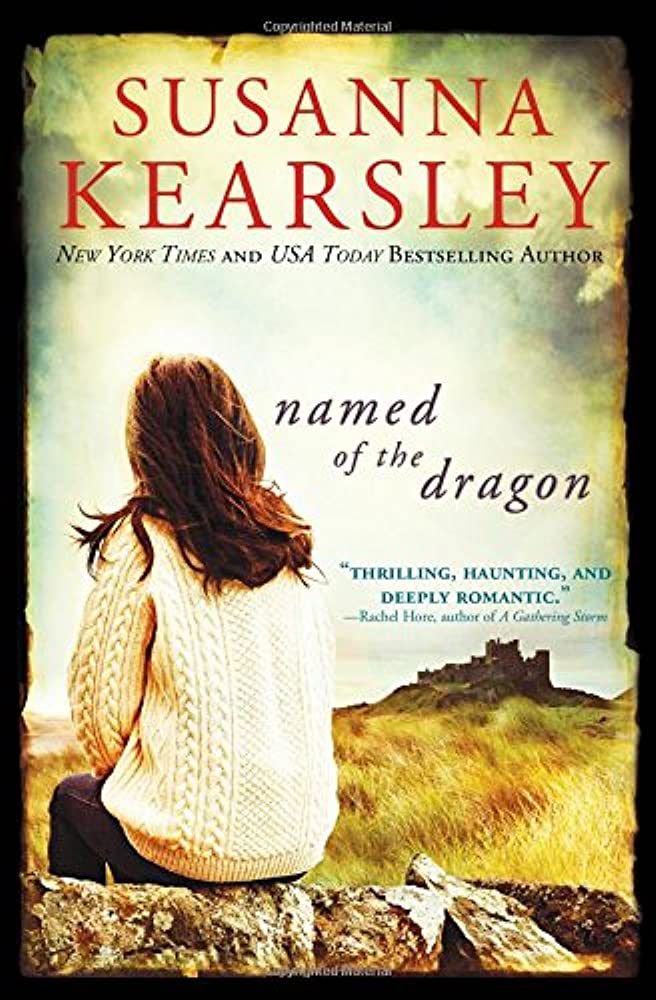
Lynette is a literary agent spending the Christmas holidays in Wales with one of her authors and good friend, Bridget, Bridget’s boyfriend, a critically acclaimed author, and his brother. Nearby is a near-legendary reclusive grouchy playwright as well as the caretaker of Castle Farm (a real place) and his wife. Also living in an apartment attached to the main house is Elen, a young widow with a baby, whom, shall we say, has her feet firmly planted in the clouds. Or as it is put, “She’s just inherited her mother’s way of seeing things, the Celtic way, that sees the past and future worlds all blended in with ours. That isn’t mad, it’s Welsh.” She is convinced that a dragon is after her baby, like in an ancient Welsh tale, and that Lynette has been sent to protect him. Sadly, 5 years earlier Lynette’s own baby died in childbirth, and Lynette, continually haunted by nightmares, has not healed from the tragic loss. Interwoven throughout the book are elements of the Arthurian myths and legends and actual British history alike including Henry VII, his remarkable mother Margaret, and the baby who would someday become Henry VIII. As is usual while reading Kearsly’s books I was driven to Wikipedia and Google Maps to get a grounding in the historical background and the actual historical sites that come into play. Margaret and Merlin come to both Lynette and Ellen in dreams, and we are meant to see parallels and influences between the present and the past. Is history repeating itself? Is Elin’s baby really in danger? And what is Lynette meant to do about it?
For me, Susanna did not adequately bring the fantastical together with the real in a coherent way. To my mind, this intertwining should have been the heart and soul of the book. I loved learning about Queen Margaret, legendary and historical Welsh figures, and the Arthurian legends as told by Tennyson and other accounts. I was awaiting with curiosity and interest for all to be revealed and past and present, and reality and fantasy to come together in true Susanna Kearsley fashion, but it just didn’t. I don’t mind if mysterious things remain mysterious or not fully explained, but I at least want these things addressed and acknowledged. For example, At one point, while sightseeing, Lynette sees an old man, “tall and thin with stooped shoulders and with wispy white hair that blew wild in the wind” emerge from a cave. He is wearing a woolen wrap that trails behind him. He approaches Lynette with eyes as “sharp as chips of gray granite” and in a melodious voice intones, “ Take you care of the boy.” Her two companions saw and talked to him earlier so he is not a figment of Lyn’s imagination. Lynette makes no connection with Merlin come to life, or Elin’s oft-stated belief that Lynette is her baby son’s protector because Merlin told her so. She wonders about it for about five minutes but strangely concludes the old guy was referring to her adult male companion whom he must have taken to be her boyfriend. And then she just forgets all about it. She is unfazed, while I was all “WHY ISN’T SHE FREAKING OUT RIGHT NOW!!??” That she might have just had an encounter with Merlin does not even cross her mind after all that she has been exposed to. It’s where the book lost me.
As always, Susanna Kearsley’s prose is beautifully written, her characters are interesting, the dialogue sophisticated, and the descriptions evocative. There is an exciting climax and satisfying resolution to Lynette’s road to her personal recovery and romantic happy ending. The clues to the source of the danger and mystery, when we find out there is real danger and mystery, are fairly placed along with some very plausible red herrings. I think she tried to tackle too much in this fairly short (for her) novel and just fell too in love with all of the trappings. Interesting trappings, but in the end, just trappings.
I listened to this on audio read by the great Barbara Rosenblat. I had read the story many years ago and may have read it more than once. It was Barbara Michaels’s last novel under this pseudonym. I would give the story a 3, but Barbara R.’s reading a 5. I loved the heroine, but in the end, the plot was kind of all over the place. Although Heather, our funny, caustic, and indomitable heroine ends up with the guy I wanted her to, I’m not sure how it happened exactly. She seemed to be going in another surprising direction, and it wasn’t until the end that that attraction was explained, and it kind of made sense. I was happy and even relieved at the pivot.
American school teacher Heather Tradescant is touring the gardens of England in honor of her gentle scholarly father. They had planned the pilgrimage together, but he has since died in an automobile accident. She arrives at what was to be the highlight of their tour, the estate of Troyton House, the site of a famous 17th-century garden long since grown over and all but vanished. When she is locked out of the grounds, Heather being Heather forges through a thick overgrown hedge which mysteriously seems almost alive and malevolent. She bursts through, scratched and bloody, and lands at the feet of the famous and fabulously wealthy Mr. Karim, the current owner. To her surprise and incredulity, he enlists her amateur aid in restoring the important garden. He learned her last name, Tradescant, is coincidentally (?) the same as the original designer. Also, he likes her because, unlike everyone else in the world, she refuses to be bossed or bullied and gives as good as she gets. She is a breath of fresh air.
Unfortunately not much restoration is accomplished because Heather is too busy dealing with local witches, mysterious fogs, trying to rediscover how she got through the impenetrable hedge in the first place, the jealous wife of the former owner of the estate, and her spoiled little boy who has all of the makings of a future serial killer with a history of pyromania to boot. Not to mention being the romantic target of two attractive men despite the fact that she is just average looking with an overweight though athletic build. The third man in the picture is Mr. Karim’s sarcastic grouchy son who is a university professor working on a book and doesn’t seem to like her at all.
There is really not much of a plot and not even a mystery to solve unless you count why Mr. Karim is so hateful to his son. Bobby, the future serial killer, disappears and is feared dead but that is a matter for the police and his unhappy parents and is not any of Heather’s business. Not that anyone misses the horrid child anyway. Heather is poisoned and has two other exciting escapes at the end. The story ends with a shocking development but the reasons behind it all didn’t really make a lot of sense.
This is the last of a long line of Barbara Michaels novels, and she might have been a little tired. She was also keeping up with her yearly and very popular Amelia Peabody adventures under “Elizabeth Peters,” and an occasional Jacqueline Kirby or Vicky Bliss thrown in. Most of her earlier “Barbara Michaels” books were true Gothics which featured haunted houses, witchcraft, and other paranormal activities: Werewolves, fairies, timeslips, and possession included. The latter novels are immersed in fascinating and arcane aspects of various professional and hobbyist pursuits. This one is steeped in the lore of formal gardens and mazes with a healthy dose of witchcraft and ancient curses. Previous books have also tackled vintage fashion, quilting folklore, antique jewelry, old rose cultivation, deciphering damaged manuscripts, and archeology. Barbara Michaels’s scholarly and feminist approach shines throughout all of them. To qualify as “Romantic suspense” each has a sometimes perfunctory sometimes charming romance thrown into the mix. I always loved her Barbara Michaels novels having grown a little weary of Amelia Peabody over the years. I have learned a lot from her books and this one was no exception.





 Rebekah's Readings and Watchings