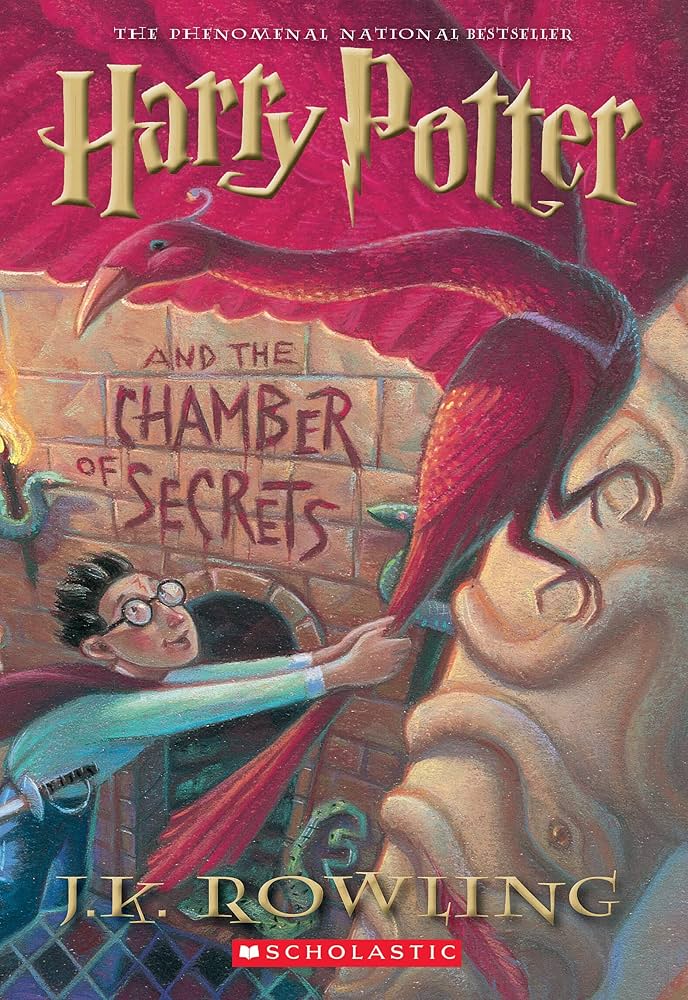
“Not kill you, sir, never kill you!” said Dobby, shocked. “Dobby wants to save Harry Potter’s life! Better sent home, grievously injured, than remain here, sir! Dobby only wanted Harry Potter hurt enough to be sent home!”
**Original thoughts, 2018, on the American Audible version**
Going through all of the HPs, listening on Audible. I have listened to the Stephen Fry Philosopher’s Stone, but all the rest I have are the Jim Dale versions. I much prefer the Stephen Fry, as Jim Dale has some odd intonations and I don’t like his pronunciation of Voldemort and other words. Sometimes Dale sounds really whiny and wheedling, especially with the children’s voices.
**re-read on kindle 06/2025**
Even though this remains a Harry Potter that is not a favorite of mine, it cannot be skipped. It is the introduction of Dobby, Lucious Malfoy, Tom Riddle, Ginny Weasley, Arthur Weasley, the first Horcrux, The Burrow, Polyjuice Potion, the Sword of Gryffindor, Borgin and Burkes, Aragog, Moaning Myrtle, and Fawkes. And probably some others I don’t remember. It gives so much context to many momentous events to come. So many aspects which have far reaching influence on our key players’ final outcomes and fates start here. Nevertheless, it still comes across as a children’s’ book (which it is, of course) but, for me, minus much of the wonder, and, though there were some funny lines, humor, of its predecessor. I almost think the movie surpassed the book in many areas particularly in its portrayal of Dobby. It brilliantly captured the amazing, almost impossible, mix of annoying and adorable, funny and tragic, victim and victor.
And a few things took me out of the book. I couldn’t get over why Harry was shunned and suspected of being the Heir of Slytherin when Draco Malfoy should have been the obvious suspect of everyone from the start.
Then someone shouted through the quiet. “Enemies of the Heir, beware! You’ll be next, Mudbloods!” It was Draco Malfoy. He had pushed to the front of the crowd, his cold eyes alive, his usually bloodless face flushed, as he grinned at the sight of the hanging, immobile cat.
But there is no reaction to this outburst! Where is the outrage? It is a harbinger of Harry being celebrated one minute and vilified the next that repeats itself throughout the series.
Also the whole Polyjuice Potion scheme was a very high risk, low reward plan. It could only succeed in possibly satisfying the trio’s suspicion of Draco’s guilt or innocence, but would prove nothing to anyone else and could never accomplish anything.
Hermione’s infatuation with the nincompoop Lockhart seemed very out of character.
Of course Chamber of Secrets is part of Harry Potter so I liked it a lot. I am enjoying noticing things I didn’t notice before. Listening to books on Audible holds many joys, but you miss some detail and subtleties. This is my second time reading Harry Potter in “print” on Kindle and it’s been quite a few years. I am enjoying all of the re-discoveries. One of these worth noting is the part where Harry first hears the name “Riddle”. He thought it sounded vaguely familiar. He knew he had never heard it before but it “still seemed to mean something to him almost as though Riddle was a friend he’d had when he was very small and had half forgotten.” Chilling. It’s a clue and dark foreshadowing as to what is going on with the connection between Harry and Voldemort that will gradually be revealed in the coming books.
“Doris Crockford, Mr. Potter, can’t believe I’m meeting you at last.” “So proud, Mr. Potter, I’m just so proud.” “Always wanted to shake your hand — I’m all of a flutter.” “Delighted, Mr. Potter, just can’t tell you, Diggle’s the name, Dedalus Diggle.” “I’ve seen you before!” said Harry, as Dedalus Diggle’s top hat fell off in his excitement. “You bowed to me once in a shop.” “He remembers!” cried Dedalus Diggle, looking around at everyone. “Did you hear that? He remembers me!” Harry shook hands again and again — Doris Crockford kept coming back for more.
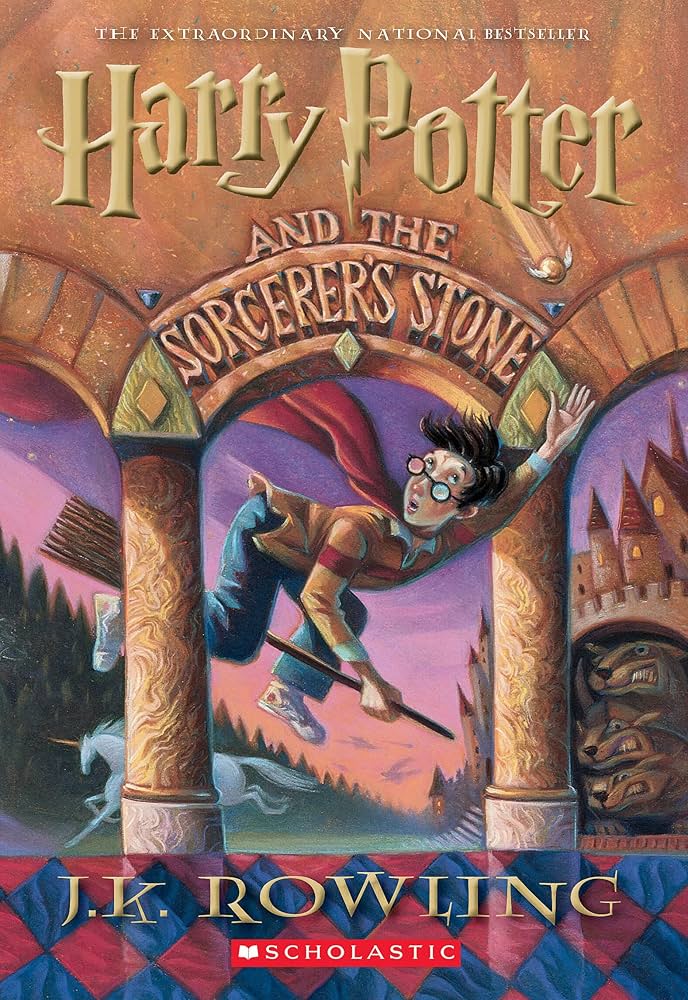
What can I say that hasn’t already been said about this book? And by far smarter and more insightful people than me. All I can say is I enjoyed it very much and was very entertained by Rowling’s playful sense of humor. I am amazed at the funny names she gave her characters. The humor is geared for children in this book, but there is much for adults to enjoy as well. She seems like she was having a heck of a good time writing it and sometimes I imagined that she was just cracking herself up. And I appreciated that reading the book instead of listening to it or watching the movies gave me the opportunity to pause and reflect. Knowing the series backwards and forwards, I enjoyed the foreshadowing of things yet to be and happen. Or was it foreshadowing? How far down the road did she plan out the story and details? It is said she spent 5 years planning out the series before she started writing Sorcerer’s Stone. I wonder what she would have changed if she knew then what she knew by the time she wrote the words “All was Well”? She mapped out everything before she even knew this first in the series would be written, or if written, if it would ever find a publisher. Amazing. A truly amazing woman and writer.
The only quibble I have ever had with this book was the way Gryffindor won the House Cup at the end. As a fair-minded Hufflepuff, it really bothers me. If I was a Slytherin, I can’t even imagine my reaction.
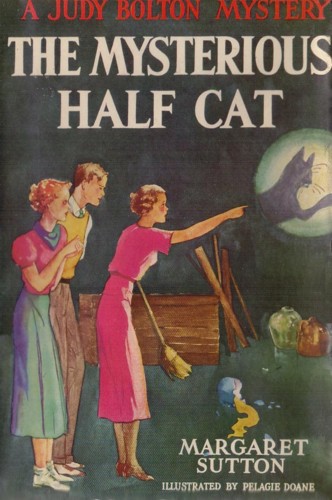
“Holy Christmas!” Horace exclaimed way down in his throat. “What do you call that?” “The Half Cat!” gasped Scottie, one had to her heart. Even Judy found herself clutching Arthur’s coat sleeve in that moment of frozen terror… Let’s get out of here,” Horace whispered hoarsely and began helping Scottie through the window…..“Wait a minute!” Judy detained him “I have an idea.”
I had decidedly mixed feelings about this one. At the beginning of the book, Judy is awakened from a horrible nightmare in which Blackberry, her beloved cat, is hit by a car and cut in half! Peter and Arthur appear and Blackberry, still cut in two, gets up and follows them. The top half follows Arthur and the bottom half follows Peter as they head in opposite directions. Although obviously symbolic of Judy’s feelings being torn between the two young men, this image was very disturbing to me and it is one of the recurring themes in the book. An old beggar approaches the front porch where Judy is telling Honey about her dream and Honey buys the old man’s dream book to interpret it. The old man warns her against dreaming of cats, a coincidence which startles Judy. Peter comes by and shows the girls a mysterious coded note which he found in front of Wing Lee’s Chinese laundry. Judy is intrigued.
When the mail comes, Judy is surprised and pleased to receive a letter from an old playmate, Dora ”Scottie” Scott, who had moved to Alaska before the Roulsville flood. Scottie is coming back home with her little sister Carol. She is all alone in the world now and hopes to stay with the Boltons while she searches for lost relatives. Judy is very excited and of course the Bolton family starts making preparations to welcome Scottie and Carol into their home. Remembering that Scottie was always one for adventure and excitement, Judy thinks that maybe the mysterious note might be a good mystery for them to solve together. Judy goes to talk with Wing Lee about the note and he tells her that “spooks” come to his laundry every Wednesday. This is right up Judy’s alley and she hides out in his basement overnight (on a school night no less!) to investigate. She gets locked in and hears strange sounds and someone talking about splitting a cat in half! What?! How can Judy’s dream be connected to an old beggar, and nefarious doings in Wing Lee’s cellar? I, for one, was baffled. Surely Judy does not have psychic dreams?!
In addition to the mystery of the coded note and the “Half Cat”, Scottie and Carol’s troubles take center stage. When Scottie arrives, she is nothing like the girl Judy remembers. She is unpleasant, ungrateful and unappreciative of Judy’s efforts to make her welcome and involve her in adventure. She is also exhausted because she can not let Carol out of her sight. There is something wrong with Carol’s brain which causes her to go into trances or fly into destructive rages. She also seems to be hearing impaired. Poor Scottie has a lot on her plate, but sometimes the interested, curious, and fun-loving Scottie peeks through. Judy powers through Scottie’s sometimes nasty behaviour and sets to work to help her and Carol and solve the mystery of the “half-cat” into the bargain.
One has to appreciate the unusual step of incorporating a child who, these days, would be considered “on the spectrum” or having serious brain damage into a children’s mystery series. But it was disturbing and painful. Margaret never shied away, even in her early books, from addressing controversial topics to her young readers. In fact, Carol’s problems reflect a tragic circumstance in Margaret Sutton’s own life. How Carol’s behavior affects Scottie emotionally is very layered and authentic. The portrayal of the old beggar is also complex with paranoia, guilt, hoarding, the corruption of wealth, and repentance coming into the mix.
How Judy’s dream seemed to be repeated in real life is neatly explained at the end, to my satisfaction and relief. And Judy’s efforts, with the help of the whole gang, result in tying a kind of “half-cat”, the old beggar, and Scottie and Carol together into a hopeful happy ending. The end of the book sees Judy graduating from high school and and anxiously looking towards an uncertain future.
“Maybe he’s just drunk,” she said…”I just want to shake him to see.”
“Don’t you dare!”
“Why not? If he’s dead he can’t hurt us and if he’s only drunk it may rouse him up….”
“I don’t want to rouse him up,” cried Honey in a panic…If you touch him I’ll scream!
“That might rouse him too.”
So, this was the first Judy Bolton I ever read. It got my attention to say the least. It starts off pretty tamely with Judy and Honey at a school picnic discussing a recent burglary of the Hamilton house. They are at a state park and the kids encounter some bums begging for food. Remember this was written during the depression. Judy is intrigued to hear what sounds like a voice coming from one of their suitcases. Due to a misunderstanding, the school bus leaves without them and they start to walk home (40 miles!). On the way, they encounter one of the bums seemingly dead or drunk in a ditch with his suitcase. Luckily, because a girl named “Tagalong”, of the prominent Hamilton family, alerted Peter and Horace that Judy and Honey had been left behind, they show up in the car to pick them up. They give the man a ride, but on the way he asks to be let off at a lonely house in the middle of the boonies. The name on the mailbox is “Brady.”
Back at home, Judy’s young friend Tagalong introduces her to the poor but proud Brady family. Tagalong’s BFF is Selma Brady, a friendship she keeps secret from her socially prominent and snobby family. Tagalong is a little rebel. The Brady father’s parents, who live at the old house that “the bum” asked to be dropped off at, are celebrating their golden wedding anniversary on Thanksgiving weekend. Selma has been dragooned into visiting them to help them prepare for the big party and Judy volunteers to go in Tag’s place to help her. Also, Selma is afraid to go their house alone. Of course, Judy’s main interest is to further investigate the talking suitcase which she believes is still at the Brady home. To add to the excitement, we also learn that Selma’s father, Walter Brady, has been arrested for the burglary of the Hamilton home, one of a series of recent burglaries in Farringdon.
What really stood out about this, my first Judy Bolton, was how many times I thought to myself when reading, “This would never happen to Nancy Drew!” Selma’s grandmother is a hateful old witch who claims to have psychic powers. She threatens to shoot her granddaughter (and Judy) and resents all of their hard work trying to clean the house and prepare for the family reunion/anniversary party. Their house is absolutely filthy and every inch is covered in trash and dirt except for some paths through the dirty clothes and litter. Margaret description of the house and its inhabitants is priceless. For dinner, they have dry bread dunked in milk, which the Grandfather eats with “a sucking sound.” That night, Judy and Selma sleep in dirty beds, and are awakened by scurrying sounds and chains rattling. That morning, when Judy looks in a mirror, she sees animal tracks across her face, which Judy surmises are rat tracks. Judy’s Thanksgiving was shaping up to be one to remember, and it is just the beginning.
By the end of the story, The Brady’s house is clean, the party is a great success, The old couple have mellowed (a bit), and a falsely accused man has been proven innocent. And the voice in the suitcase has been revealed. No spoilers but the clues are all there for the alert reader
As Judy stepped upon the stage she lifted her chin proudly and looked straight into Madame Wanda’s cat-like eyes….she walked cautiously over and peered down into the mystic ball….Madame Wanda burst out explosively.”Tell me! Tell the audience! Tell the whole world what you see!” Was the woman crazy?…But to her great disappointment, there was nothing there. …“What’s the matter with it? I don’t see a thing.” “Ah clever weren’t you?” she mocked. ”But not clever enough to see your own future! Why? Because you haven’t any future.” Gasp went up from the audience. “Don’t you know what it means…? “Have you never heard the word–Death?”
This book has some of Judy’s best sleuthing as well as plenty of personal drama regarding one of Margaret’s most interesting character creations, Judy’s friend, Irene. I would call Irene a divisive character, but I doubt that there is any serious Judy Bolton fan who would not admit the girl is flipping crazy (as much as they might defend her and try to explain her.) Thankfully, she does get better as the books go on. And her fiance Dale is another piece of work. Irene and Dale met and got engaged in the previous book, The Yellow Phantom. In this one, they are almost torn apart thanks to Irene’s stubborn belief in a fortune teller.
The adventure begins with Judy and all of her Farringdon friends going to the theatre to watch a movie and a show featuring Wanda the Wonderful. While passing by the theatre, Judy notices a lot of electronic equipment being carted into the theatre. Now these days, anyone would know that electronic equipment + a psychic predicting the future = Fraud and Skulduggery. But remember this book was written in the 1930s when the X-ray machine was considered the latest in medical innovations and a source of amazement. Wanda singles out Irene and tells her a disastrous fortune with enough details from her past life to win her trust. The most alarming part is that she tells her that her father will die and Dale doesn’t really love her and is after her money. Like several other victims, she is given a card and sent to a special room in the back for “the remedy” to the horrific fortunes.
Judy is suspicious but as convinced as she is that Wanda is a crackpot and a con woman, she cannot convince superstitious Irene to believe in Dale’s love rather than a creepy stranger and her crystal ball. And how was Wanda so accurate about Irene’s music, her engagement to Dale and the Tower House? Irene seems to be almost under a spell by the menacing fortuneteller and insists on going back to the theatre to give her a sealed envelope. Knowing that doing so would be the last straw as far as Irene’s nerves are concerned, the girls decide they will change places with each other with Judy delivering the envelope to the theatre and Irene going back to Dry Brook Hollow to stay with Grandma and Grandpa Smeed. Irene insists that when she gets Dale’s next love letter, Judy read it and answer back in her place. I’ll let that sit a minute. I told you she was crazy. When Judy does exactly that, it results in Dale almost breaking the engagement and Irene angrily repudiating Judy as a friend. It’s quite a letter, but poor Judy meant well.
By the end of the book, Judy meets a new friend, Sylvia, gets on stage and challenges Madame Wanda, is trampled during a fake fire alarm, is hospitalized, exposes the crystal-gazer and sees her convicted of grand larceny, wins back Irene’s friendship and re-unites the two lovers. Also, the differences between Judy’s two potential swains, Peter and Arthur, are highlighted. As always with Margaret Sutton’s series, we will meet young Sylvia again in future books and will even see the Crystal Ball again which was given to Judy as a reward for her outstanding sleuthing which resulted in getting a cruel and dangerous fraudster off the streets.
This is one of Margaret’s most entertaining books, in my opinion. Irene and Dale never disappoint.
“Irene, nothing!” she fumed. “That girl’s Johanna Holiday, the wench who made away with her mother’s poetry. I know you!” She pointed a shaking finger at the trembling Irene.
Judy, standing near the old lady, caught a whiff of her breath and guessed that she had taken an overdose from the bottle that she called her tonic. She had noticed how frequently her employer resorted to the stimulant.
Margaret Sutton originally wrote this book as a stand-alone unrelated to the Judy Bolton series. When it didn’t sell, she revamped it into a Judy Bolton book. In many ways, it falls very seamlessly into the series, but it does incorporate some elements that seem a little unusual for a girl’s series book. Judy’s friend, Irene, who is barely 17 and still in high school has a serious romance with and becomes engaged to a man who is well into his 20s. One of the characters is an eccentric literary agent with a drinking problem and some of the situations in which Judy and her girlfriends find themselves seem more appropriate or realistic for older girls.
At the end ofThe Ghost Parade, Judy’s friend Pauline, the daughter of Dr. Faulkner who made an appearance in The Invisible Chimes, invites Judy and Irene to her home in New York City to finish out their extended summer vacation while Farringdon’s new high school is being built. Dr. Faulkner really gets around. Apparently, every crazy person in New York City was or is a patient of his. Lots of coincidences in this one. On the bus to Pauline’s luxurious home in Gramercy Park, the girls’ attention is caught by a handsome young(ish) man. Irene declares him her “ideal” and the girls hope to meet him in New York. It seems unlikely but Judy discovers he is an author of murder mysteries. She has no trouble getting a job with his agent, the eccentric and gruff Emily Grimshaw, in an effort to pursue their acquaintance. And, indeed, it isn’t long before Dale Meredith shows up. When Judy brings Irene along to the office, the formidable tough-as-nails editor takes one look at her, goes into hysterics, and insists she is someone named “Joy” who we find out is the dead daughter of one of her clients, the poet and recluse, Sarah Glenn. Dale and the 3 girls become friendly but it isn’t long before Dale’s preference for Irene becomes obvious (much to Pauline’s irritation). In fact, it is love at first sight. Meanwhile, some valuable manuscripts of the poet mysteriously disappear and Irene also mysteriously and alarmingly disappears soon after. Is there a connection between Sarah Glenn, her dead daughter, Joy, whom Irene so strongly resembles, Irene, and the stolen manuscripts?
Judy has her work cut out for her in this one. In her desperation to find Irene while fearing the worst, she is also trying to protect her from being suspected of stealing the manuscripts. She is at her wit’s end when Peter, Arthur, and her brother Horace show up to help her with the search, ably supported by New York’s finest.
The Yellow Phantom makes good use of its New York City setting. the girls have a night out on the town, and later, Judy ventures alone into the wilds of Brooklyn following clues to Irene’s whereabouts. In addition to the baffling mystery of what happened to Irene and how the manuscripts disappeared from Ms. Grimshaw’s secure office in broad daylight, we have a bonafide serious romance, attempted murder, evil villain, fear of insanity, and a sad tale of a tragic romance, bad poetry, and a yellow phantom in a tower window. Peter and Judy’s relationship is moved forward, and the hapless Irene seems to have fallen into a secure future with an inheritance and Dale. Lord knows she needs someone willing and able to take charge of her. The only quibble I have is the solution to how the manuscripts disappeared is pretty preposterous and somewhat of a letdown.
We can only hope that it will be nothing but smooth sailing ahead for Dale and Irene’s romance. I guess we will find out in The Mystic Ball. Wink, wink.
“No wonder she’s afraid.” Judy said aloud. ” I told you the box was empty. Someone stole those heads and tried to scare us. You know they couldn’t have walked out of the box alone. See! It’s empty!” She lifted back the cover! Lorraine screamed! Then she fell back into Arthur’s arms and began sobbing hysterically. That head with horns had popped out at her for all the world as if it had been alive.
Just when a mystery is heating up near Farringdon, Judy is about to leave for a month’s vacation at a girl’s camp at The Thousand Islands near the Canadian border. She is not a happy camper. On assignment from the paper, Horace takes her along to the scene where Chief Kelly has just busted up a counterfeiters’ ring. Some of the criminals are still at large, and Judy is sure the police could use her help. On top of that, Arthur Farringdon-Pett has just bought an airplane. Oh well, I guess Judy will have to endure a boring month of swimming, boating and other camp activities with her friends instead of chasing criminals and joy-riding in airplanes.
Fear Not. Before they even arrive at the camp, Judy has acquired a huge crate full of horrific-looking Indian Masks at an auction and will be keeping them with her at the camp along with her two cats Blackberry and Ghostie. On top of that, she meets a strange old crone called “the Cat Woman” who is headed to the same area. The suspicious old woman tells the friends that the masks are cursed and will bring “sickness, trouble, and death” to all in their vicinity. Hopefully the strict matron will not raise any objections to Judy’s unexpected accoutrements.
Besides dealing with the less-than-thrilled Mrs. Dinwiddie, Judy has plenty else on her plate. First the scary Masks seem to have taken on a life of their own, mysteriously disappearing out of the trunk, then spotted parading through the camp. Have the “Ghosts of Dead Warriors” come to life? Next Blackberry and Ghostie have violent fits and Blackberry scratches Judy’s vain sometime frenemy, Lorraine Lee, on the face. Judy along with Pauline, Honey, and Irene take the beloved pets to the Cat Woman who owns an island nearby. She cures them and takes care of them since they have been banned from the camp. On the way back the girls almost drown during a violent storm on the River, and then Mrs. Dinwiddie gets deathly ill herself. Judy saves her life using the same treatment that The Cat Woman used on the cats (don’t ask, it’s gross) and things are just getting started. Lorraine disappears just as Arthur shows up in his new plane and then the plane disappears! Judy tracks Lorraine to Cat Island looking for a cure for the scar on her face. And who should show up but Slippery McGuirk, the head of the Counterfeit Ring! And weirder still, he is married to the Cat Woman, who is old enough to be his mother!
This is a Judy Bolton that is very action-packed with some character exploration as well. Lorraine Lee shows her bad side as well as a good side, as does Arthur Farringdon-Pett. We get the first clear hints that Judy’s destiny lies not with rich sophisticated Arthur, but with her longtime friend Peter Dobbs. Pauline, Judy’s New York City friend, who is my favorite character besides Judy, played a strong role in this book. In the teaser for the next book, The Yellow Phantom, we are told that talented but poor Irene’s life will be changed forever. Pauline is in that one too.
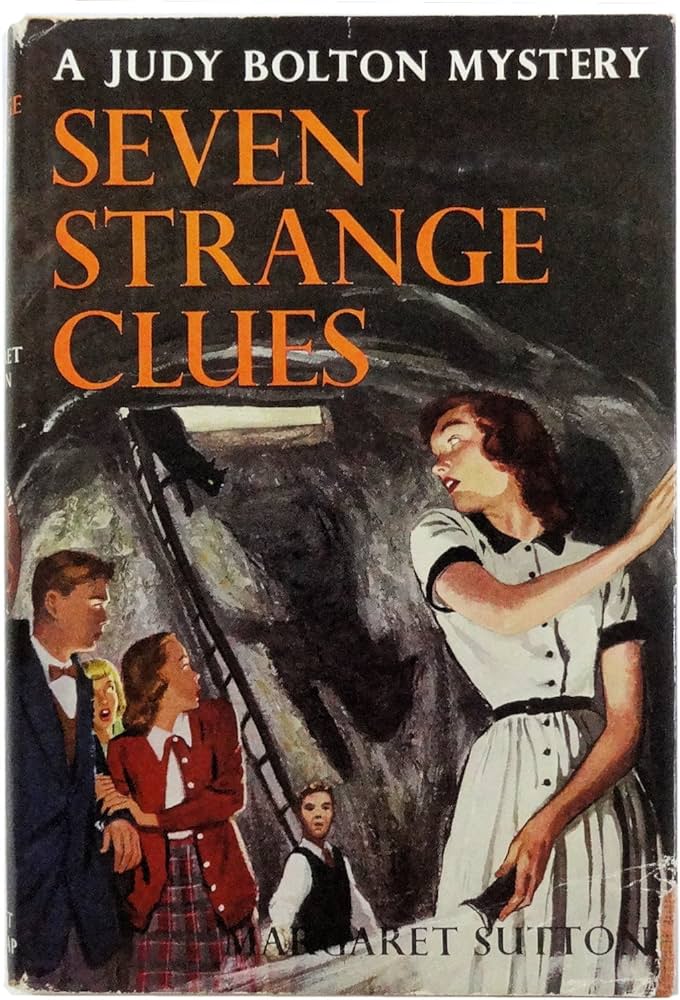
“All kinds of ghastly things may have happened in this tunnel. What’s that?”
The others turned as he said it and when they saw what had frightened Horace he looked a little sheepish. Blackberry was climbing down the ladder. But the cat certainly made an eerie picture as his agile body descended noiselessly….Irene shivered and clutched Horace’s arm.
“There’s something about cats that I don’t quite like,” she said “….not black ones in cellars.”
The shadow of the murdered Vine Thompson still lingers over Judy’s house on Grove Street and once again, her evil doings continue to provide Judy with mysteries to solve and adventures to be had. There is more than one mystery in this fourth book in the series. It starts out innocently enough with Judy and her school friends planning to enter a poster contest to celebrate “Health Week”. Meanwhile, Dr. Bolton has rented out his garage to two strangers who board at Irene’s house. They offer to build a workbench in the Bolton’s cellar with some lumber in the garage. Judy, and Honey will work on their posters there.
Despite her distinct lack of artistic talent, Judy decides to paint a bowl of fruit for her poster.
Golly! It’s bright [Horace] exclaimed “What is it? The sun?”
“Of course not, Silly. Can’t you see it’s in a blue dish?”…
I thought that was the sky.”
“You had the picture upside down.”
“So I did. Hmm! I see now. It’s an orange. Looks as if it’s beginning to go bad. But Judy, seriously, orange leaves aren’t yellow and they aren’t as long as this”…If you just put a little more green in those leaves——
“But they’re not leaves. They’re bananas!”
When Judy wins first prize, everyone is in shock. Sweet Mrs. Bolton wonders if Judy’s poster was taken “for one of those modernistic paintings.” When they go to the exhibit at Brandt’s department store where the posters are being displayed, they see that someone has put Judy’s name on someone else’s beautifully done poster. Why? What are the strange sounds coming from the cellar, and why are papers missing and who ate the apple out of Judy’s bowl of fruit? Why has snobby, mean, and hateful Kay Vincent suddenly befriended poor Irene? Why is Honey behaving so strangely? Why does Kay’s poster have a missing corner and a smudge on it? And most importantly of all, who burned down the High School?
All eyes turn to Judy and she is persona non grata when it is suspected that she took someone else’s poster and claimed it as her own. To make matters worse, it is Honey’s poster that someone has put Judy’s name on, and Honey is not happy. Rumors are spreading that, incredibly, Judy or Honey is the one who burned down the school! And why are the shades always drawn on the car that Irene’s boarders are keeping in Judy’s garage? It all comes to a head when Judy discovers a secret room underneath the Bolton’s cellar complete with a tunnel leading to their garage. I will say no more except to point out that this book was written in 1932, 1 year before Prohibition ended.
This one excelled in tying all of the diverse mysteries into a neatly packaged whole. Both the personal dramas and the genuine criminality that Judy uncovers make for one of the better books in the series. Judy single-handedly extracts a confession from the culprit who started the school fire, and her detective work leads to the disgrace of a prominent citizen of Farringdon. At least we hope so. She even is responsible for getting Irene out of the drudgery of her life as a mill worker. This book advances the relationships between Judy and her friends, and justice is served on all fronts. But have we seen the last of Kay Vincent? Time will tell.
Judy’s hands trembled and her gray eyes were dark with apprehension as she lifted the loose floorboards and looked. “Good Heavens!” The two boards fell back across the open space with a crash as Judy uttered this startled exclamation. She simply sat back on her heels and refused to think until her mind had been prepared for this appalling thing she had discovered.
In the last book, we learned that Peter is the son of Grace Thompson who was rejected by her parents, Peter’s grandparents, The Dobbses, after she ran off with the oldest son of Vine Thompson, a criminal gang leader. When Grace died, after having another baby, who apparently also died, The Dobbses adopted her 3-year-old son, Peter, and raised him.
This book opens with Arthur driving Judy and her friends out to the country to visit an antique store and tea room. After admiring the antiques, they go into the tea room for a snack. Horace asks a pretty girl who is playing the piano to dance. But they soon suspect that her loud piano playing was to distract the owners and guests from the antique store being robbed. The thieves and the piano player make their getaway by stealing Arthur’s beloved car. After the police come, Judy and her friends chase them down and end up almost getting run over by the gang when they get out of their car and try to block the road. At the last minute, the young girl turns the wheel from the driver and saves their lives. She is injured and the grateful Boltons take her home to recover where they learn she has amnesia.
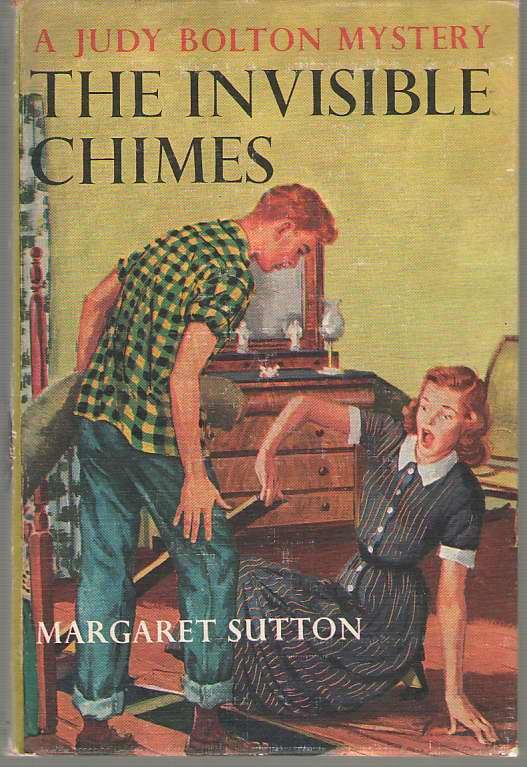
The heart of this book is uncovering the mystery of the girl’s background. Judy calls her “Honey” as they don’t know her name and she has honey-colored hair. She is sweet, eager to please, and grateful to the Boltons for taking her in. But is she a thief and part of a criminal family? Or was she kidnapped? Judy uncovers some lies Honey has told but doesn’t want to believe that Honey is anything other than the good and lovely person she appears to be. But whom was Honey meeting in secret in the dead of night and what was in the package that the stranger gave her? And what are those chimes Judy keeps hearing in her home seemingly out of nowhere? To uncover the truth Dr. Bolton invites a psychiatrist friend from New York City to observe Honey. Thus, we meet Pauline Faulkner, his daughter, who becomes a good friend of Judy and plays a part in this and several other of her mysteries down the road. Judy starts keeping a notebook to record clues and observations and discovers many inconsistencies that make Honey suspicious (to the reader, at least). She wants to catch the thieves that almost killed her and her friends as well as recover the stolen antiques and discover what the connection is between the gang and Honey. When Mrs. Dobbs, Peter’s grandmother, has a stroke she becomes strangely attached to Honey and starts calling her “Grace,” the name of her dead daughter.
While Honey is caring for Mrs. Dobbs, Judy discovers a musical vase that was stolen from the antique store hidden under the floorboards in Honey’s bedroom. That solves the mystery of the chimes but things are looking very dark indeed for the Boltons’ young house guest. Judy feels angry and betrayed. Can Honey really be the sneaky and criminal liar that all the evidence seems to indicate? Judy thinks so and wants her arrested immediately. The cooler heads of her parents and Peter persuade Judy to not judge until they hear Honey’s explanation.
When Judy gets a letter from Pauline who has been doing some detective work for her in New York City, she thinks she has all of the answers and confronts Honey with her disturbing discoveries. But she is not prepared for the story that Honey has to tell. By the end of the book, there are tears aplenty but they are tears of happiness and Honey will start her life anew with a “clean slate.”
Judy sighed. I can’t decide if this mystery is interfering with Christmas or if Christmas is interfering with the mystery.
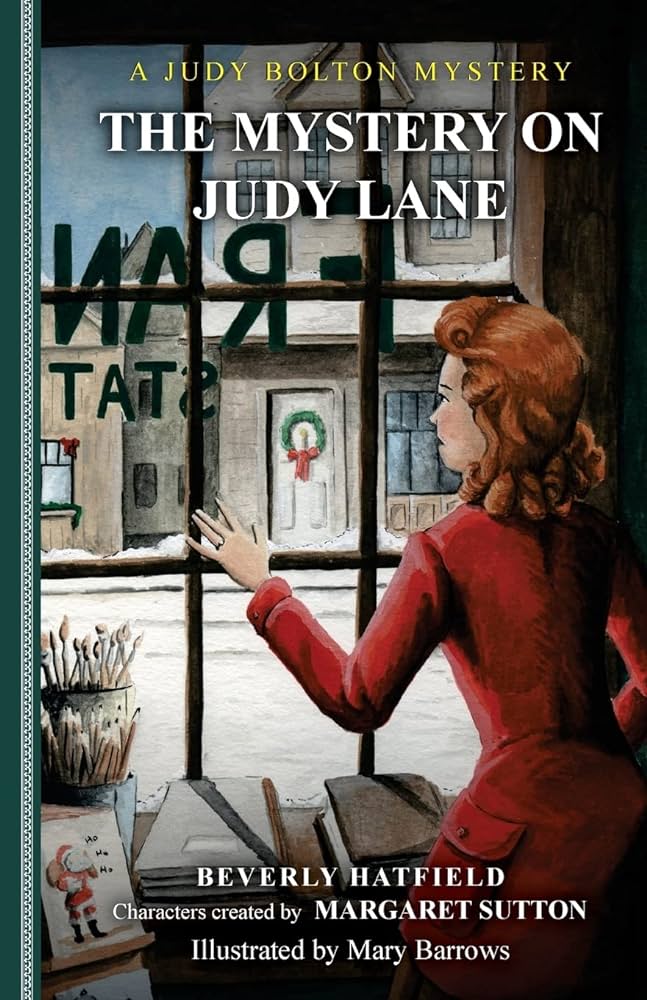
Before going to the third book in the Judy Bolton series, we take a short detour to celebrate the season, with The Mystery on Judy Lane, which is set during Christmas time. This book is a later addition to the series and was written by Beverly Hatfield who co-authored book # 39, The Strange Likeness (A Judy Bolton Mystery, #39).. It is set in 1940 between The Name on the Bracelet, in which Judy and Peter become officially engaged, and The Clue in the Patchwork Quilt, which sees the death of both of Judy’s grandparents, The Smeeds. Of natural causes, I hasten to add. So this one gives us an opportunity to see Judy and Peter as a newly engaged couple and their working relationship in Peter’s Roulsville office as attorney and secretary. It is also a fond farewell to kind hard-working Grandpa Smeed and loving but moody and somewhat intimidating Grandma Smeed.
The mystery involves the Pipers of The Unfinished House and Ruth Piper’s mother-in-law, Ella. Mrs. Ella Piper comes to visit Peter to sign her will, which seems to have some complications and mysteries attached to it. Earlier, while Judy was shopping for Peter’s Christmas present, she senses she is being spied on by a strange woman. What follows is a mystery involving the Roulsville Paper Mill, a land dispute, threats against Peter’s law practice, and finally criminal mischief in the form of rocks through windows. Why are Judy and Peter being targeted? Both Mrs. Piper and George the owner of the stationary store where Judy bought Peter’s present fall under suspicion, as well as Ruth’s cousins-in-law who are possible claimants to an inheritance. Interspersed with the sinister goings-on are the Christmas secrets and plans of Judy and her friends and family. We get to spend valuable time with the Smeeds when Horace and Judy are stranded there overnight during a snowstorm. Finally, with the help of Horace’s investigative reporting skills, Arthur’s inside information, Honey’s spying from George’s store, and Judy’s derring- do (and female intuition), all is solved satisfactorily for all just in time for Christmas. And of course, Peter helps too.
Though not written by or based on any input from Margaret Sutton, this book fits right into the series perfectly. Past mysteries are referred to and future mysteries and occurrences are foreshadowed, and sometimes quite poignantly. The writing style perfectly mirrors the original author’s and all of the characters’ personalities are faithful to her original creations. One can tell a lot of knowledge, love, and respect went into this one. Like Margaret, Beverly incorporated true events in her own life into this story. After reading this, Margaret Sutton’s daughter gave her blessing to its publication and asked Beverly to co-author The Strange Likeness which so successfully brought closure to the Judy Bolton series.


 Rebekah's Readings and Watchings