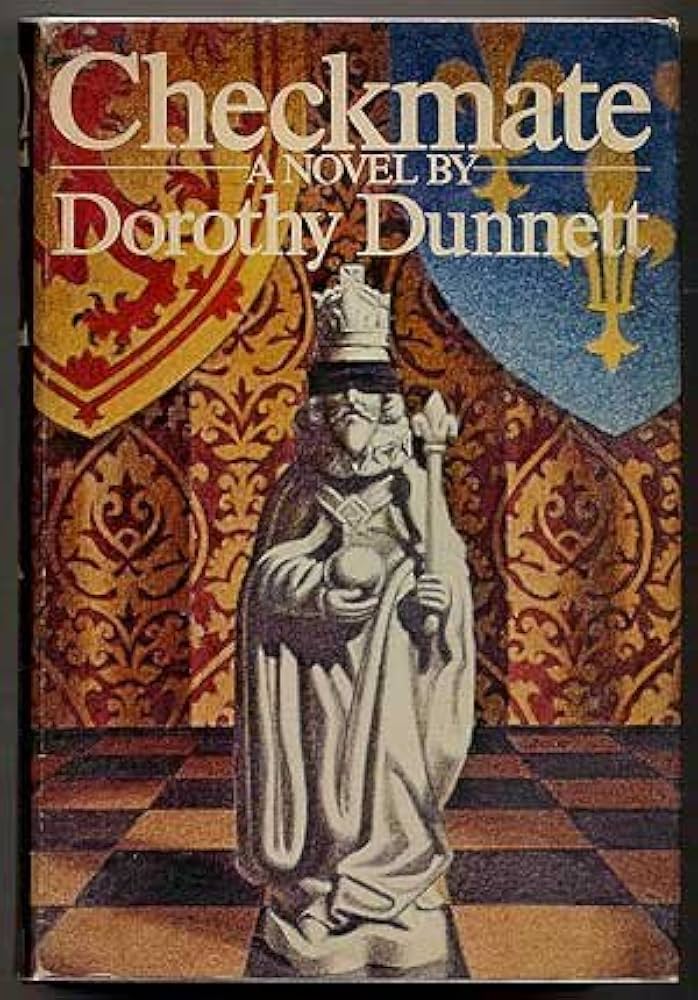
Checkmate (#6 in the Lymond Chronicles)

By Dorothy Dunnett

The current image has no alternative text. The file name is: checkmate.jpg

At the moment, I am tired of journeys. It is time I arrived somewhere.

He wondered why his lordship had claimed to be unable to identify the boy on the bridge. Then he recalled something he had heard rumoured. Once, Lymond had questioned a child and lived to regret it.

“You may give me a brooch. A sapphire one.”
“Ah,” he said. “But will you take care of it?”

It’s been about 3 weeks since I finished this last book in The Lymond Chronicles. And this review has been hanging over my head. Between finishing the book and seriously tackling this review I have had a ball reading other peoples thoughts and insights into the series which I was unable to do while I was reading it because of fear of running into spoilers. More on that later. In short, I have been, off and on, just immersing myself even further in the series.. I have a lot more exploring yet to do down the Lymond/Dorothy Dunnett rabbit hole.

As I look back on this book, Checkmate, I am amazed at how much happened action-wise, the character arcs, and the seamless involvement of our fictional characters with the military actions, politics, and religion of the time. In the course of the series, Dorothy Dunnett has shown herself to be ready, willing, and able to kill off important characters as well as animals. So while I was happy at the return of those whom we kind of left by the wayside during Pawn in Frankincense and/or The Ringed Castle, I feared for them. These included Kate, Philippa’s mother, Jerrott “I don’t understand” Blythe, Marthe, his difficult and troubled wife, and Archie Abernathy, the rock. Of course Lymond’s mother, Sybilla, so beloved and admired by me in previous books was certainly under threat of ye old chopping block given her advanced age (at least for those times) alone. And what of his estranged brother Richard? It would be just like DD to kill him off before he and Lymond could be reconciled. Though frankly, Richard was such a dumbass throughout most of this one, I can’t say I cared much about his ultimate fate.

What we went through in this book, along with Lymond and Philippa, our daring duo! We begin the book, right where The Ringed Castle left off, picking up with Lymond shortly after he has landed back in France after being kidnapped by Philippa and his friends, for his own good. They successfully conspired to prevent him from returning to what he saw as his mission in Russia where he would face certain death. Which was OK with him, but not with anyone else. I know I sure didn’t want him to go back there. Although at the end of TRC, he loves Philippa “in every way known to man” he is determined to divorce her for her own protection and because of his own self-loathing. Philippa is as yet unaware of the nature of her attachment to “Mr. Crawford.” He enters into an agreement to serve embattled France in his capacity as a military leader without peer. In return, the powers that be will see that the divorce is granted. Along with placing Lymond in the middle of real historical military battles and political machinations, we experience all manner of…stuff. High spirited swashbuckling adventure, a love story for the ages (which for me, had its earliest beginnings in The Disorderly Knights), deep dark mystery, family drama, mental and physical anguish of all sorts, sacrifice, evil, goodness, triumph and…well, just name it. And that’s just Philippa. Kidding. But Philippa and Lymond are equal or almost equal partners in all that transpires in this book.

Before I bought the books many moons ago, I vetted the series enough to know it ended in a rewarding and satisfying way. But as the books went on, I didn’t see how the ending could possibly be completely happy due to Lymond’s physical and mental health challenges. But Dorothy accomplished it. At least I chose to buy it. As much as I loved the book, it wasn’t perfect. I struggled with getting my head around the motivations, mindsets, and decisions of Philippa, Lymond, and Sybilla. So much harm and suffering for, what I felt, were weak and not very well supported reasons. I asked the DD in my head, at too many points, “Because why now?” “Huh? But.…” Also, I feel like the title of the book is a little misleading and I felt a bit cheated by part of the conclusion. Because the book is called “Checkmate” I expected a battle of the titans between Lymond and his nemesis throughout most of the series, Margaret Lennox. With, of course, Lymond outmaneuvering, tricking, and finally conquering the wily Margaret in an exciting showdown for the ages. Of course it would exceed in guile and excitement the climaxes we were treated to in 4 of the 5 preceding volumes. The word “Checkmate” comes with certain expectations. The confrontation between the two had its rewards, but in the end that part was anticlimactic. But, thanks to the gorgeous and fulfilling conclusion to Francis’ and Philippa’s love story, It is a fairly minor quibble. In the end there is peace and joy at long last, and that is enough. But still so many questions! I learned from reading this series that sometimes that’s not a bad thing.

So many lovers of this series have read it many times. They comment how much they missed the first time. I had a different experience, thanks to helpful websites and Youtube chapter by chapter discussions posted years ago which leant valuable insights, and conscientiously avoided spoilers. They added historical political and religious context, explained obscure literary allusions, translated foreign language passages, and a whole lot more. Many personal opinions and speculations over countless plot and character points were offered and explored. Not to mention, “What did Dorothy Dunnett really mean by that?” Some hearty souls read this massive work while it was still being written and had to wait years between books. I can’t pretend to imagine what that experience was like. Many forged ahead while up in the air as to whether all would end tragically with Lymond’s death (or worse!). Given his death wish, it seemed more than likely. I had the advantage of knowing the end would be a happy one, though I took great care to avoid any other spoilers. But a funny thing happened. I went through Checkmate and part of The Ringed Castle, under a misapprehension. In looking up an innocuous factoid, I ran across what I thought was a huge spoiler. I caught a glimpse of the answer to one of the big running mysteries we had been teased with throughout the series: Lymond’s true parentage. But since I shut down what I was reading immediately, I got it wrong. It would have been quite juicy, had it been true, so I was a little disappointed when I finally realized that all of the clues that pointed in another direction were not, as I thought, red herrings. Also I read that one very important character died, and he/she didn’t. Where that came from I’ll probably never know. But I was sure happy about it.

So there you have it: A small part of my experience with this scholarly, flamboyant, and, yes, sometimes preposterous series which is influencing writers to this day. But I am certainly not done with Dunnett. I now have the audio books in my library and another series to look forward to: Niccolo Rising. Which from what I gather should be almost as profound a reading experience as was The Lymond Chronicles. We’ll see.
Rating: 5 out of 5.

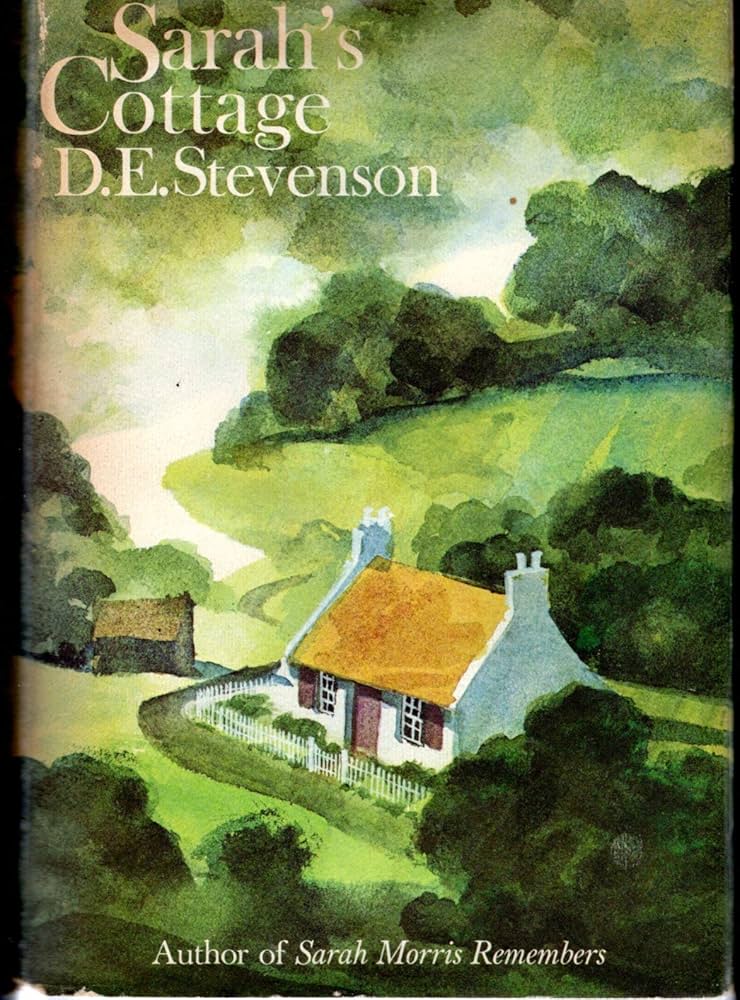
Sarah’s Cottage

By D. E. Stevenson

The current image has no alternative text. The file name is: sarahsc.jpg

This was a perfectly enjoyable DES which pretty much picks up where Sarah Morris Remembers leaves off. Sarah and Charles are married and have built a cottage near Sarah’s grandparents on some land that they gifted to them.  I listened to this on Audible and the new narrator made the choice of losing Charles’ Austrian accent which was so much a part of his personality in “Remembers.” Sarah’s father who was so important in the preceding book stays in London and is very much on the back burner which was A-OK with me. At the end of Sarah Morris Remembers, the good vicar made me very angry by discounting Sarah’s frantic and confused insistence that she had seen her beloved Charles whom she feared dead. No matter how passionately she tried to convince him, he refused to believe her, which added to her pain and confusion. After Charles and Sarah are reunited at her grandparents house in Scotland (where she was sent to basically recover her sanity), I thought it was pretty significant that her father was not included in the joy of their reunion, nor even told, at least on the page, of Charles’ miraculous return.

A lot happens in this book, which spans, as near as I can make out, around 13 years. But there are two main plot threads. Sarah and Charles take Lottie and Clive’s neglected child, Freddy, under their wing. Lottie never wanted her (in SMR she wanted an abortion!) and treats her accordingly–only concerned with her own pleasure-seeking. Her father is not a bad man but  a non-entity in his daughters’ life whose only concern is running his business. Sarah and Charles only see Freddy  on some holiday breaks from her boarding school (Saint Elizabeth’s of Charlotte Fairlie!), but it is enough to guide her, give her safety, security, and what she most needs, love. A lot happens with Freddy, including her transformation from an ugly duckling to a swan and her almost falling victim to a cad and a fortune hunter.

The second is Charles becoming obsessed with writing a fictionalized account of his life. It totally takes over his life for about 6 months  and frankly he behaves like an asshole, neglecting and ignoring Sarah. To my relief, although she is vexed and frustrated, Sarah makes the best of it by developing friendships and having an adventure or two on her own. One of the friendships that she develops is with Deb and Mark of Celia’s House. And Celia herself to a lesser extent. Their children becomes Freddy’s playmates when she can come to them at Craignethan. (Although the title of this book is Sarah’s Cottage, The final almost half of the book is set at her grandparents’ large home, the cottage largely forgotten). Once his manuscript is finished, Charles gets back to normal (the book was basically therapy for his difficult life in Austria). But once he got everything out on the page, he refuses to have anything to do with it, giving it to Sarah. “ Do what you like with the wretched thing—burn it if you like!” What she does with it forms another satisfying story line.

Sarah didn’t always do or act the way I wanted her to. At times she came across as a little, as the British say, “wet.” She often excuses Lottie’s destructive and manipulative behavior and the harm she is doing to Freddy. There was a lack of insight and urgency to act. After 18 year old Freddy finally lays all of Lottie’s cruelties over the years on the line, and explains to Sarah why she wants nothing more to do with her mother, it’s “Oh Freddie, she does love you! I know she seems neglectful but that’s just her way. She cares for you, darling.” Uh No, Sarah, she does not. Honestly, I wanted to throttle her.  Freddy recounts even more horror stories, and finally Sarah gets it. I wanted a more dramatic and cathartic resolution, but in the end Sarah and Charles acted with wisdom and restraint in regards to Freddy. 

All in all this was almost equal to Sarah Morris Remembers. Sarah and Charles rarely disappointed me. I often feared how they would react to certain challenges, but if they let me down, it was only briefly and they always did the right thing in the end. It was quite episodic and I was often confused as far as the timeline. Sarah’s never having any dearly wanted children was never addressed sufficiently.

Rating: 4 out of 5.

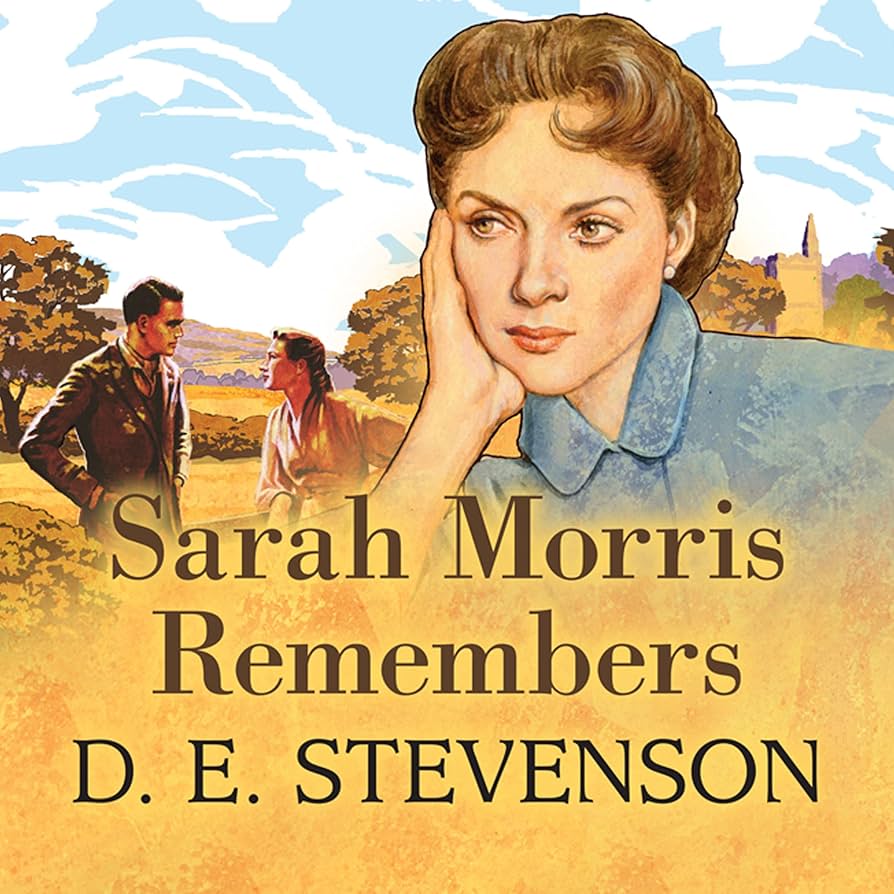
Sarah Morris Remembers

By D. E. Stevenson

The current image has no alternative text. The file name is: sarahm.jpg

Although I did anticipate enjoying this very much, the real reason why I chose this one, in the still many Stevenson titles I have left to read, is that it leads up to Sarah’s Cottage, one I have reason to believe might be a favorite. Fingers crossed.

Sarah Morris Remembers traces our heroine’s life as a child growing up with her loving parents, her two brothers, and a younger sister in their country vicarage home. It starts some years prior to WWII and takes us through the end of the war and Sarah’s reunion, after their separation, with the love of her life. We see her family and the world through her eyes as she is writing down her memories with help from her diaries.

When I started this story of my life I unpacked the diaries which I had kept in a large tin box and, as I turned over the pages, all sorts of things came back to me – things I had forgotten – and I realised I had plenty of material for a family chronicle. I had intended to write the story to amuse the family but I hadn’t got very far before I saw that I was faced with a difficult choice: either I could write a story about the family, suitable for the family to read, or else I could write a true story about everything that had happened to us all.…I saw quite clearly that the story would be no good unless it was true in every detail. I would write it for myself, for my own satisfaction; no eye but mine should ever see it and perhaps when I had finished it I should be able to see some sort of pattern in my life.

Although not a beauty like her kind and gentle mother and her little sister, Sarah is smart and spirited. And, nurtured by her parents, she has a very highly developed sense of morality. She is a very good girl. Sometimes a little too good to my liking, to be honest. But that is true of all DES heroes and heroines. It’s part of their charm and the comfort and joy of the books. Sarah, at least, is spunky and sensible to the last page. She and her siblings have an idyllic childhood: Lewis, the oldest, is handsome, smart, and their parents’ fair haired boy. Willie, like Sarah, is a bit of a rebel, and her little sister Lottie is pretty like a little doll and cossetted as the baby of the family. As the children grow up, Lottie becomes friends with a wealthy schoolmate whose family has her for weekends and vacations and she ends up more influenced by them than her own family. Although Lewis has a hankering to choose a military career, he complies with his mother and father’s wishes (especially his mother) and goes to Oxford. Willie and Sarah stand up against their well-meaning parents and fight for and follow their own dreams. One day, when Sarah is a young teen, Lewis brings home a good friend, Charles, who is Austrian. Although nothing untoward happens or is even hinted at, Sarah is drawn to him and, though he is 5 years older (possibly more), it is mutual. WWII is still a few years away, but Hitler is on the rise. We follow Sarah as she makes her way through her teens, while keeping tabs on the rest of her family and their highs and lows.

Sarah and Charles’ connection eventually leads to an engagement, but before they can be married Charles must come to the rescue of his noble and wealthy Austrian family who are threatened by the Nazis. He mysteriously and alarmingly disappears. Sarah bravely carries on with her father in war torn London, doing their bit, while waiting for her beloved Charles to return to her (hopefully).

This Stevenson is very romance-forward even though Charles and Sarah are separated throughout much of the book. Their love and passion (yes, passion in a D.E Stevenson!) are consummated before Charles leaves for Austria albeit with the belief he will return in a few weeks in time for their wedding. That has got to be a first for DES, and I thought it was worth mentioning. True to her original intent, Sarah tells the truth regardless of the foibles and weaknesses of herself, her parents, her brothers, and especially Lottie (Hoo Boy!). Even Charles comes across as a bit of an ass in one part, even though Sarah worships the ground he walks on. And Sarah rarely let me down.

Of course, because this is D.E.S., we spend some time in Scotland where her grandparents live near good ol’ Ryddelton. And yes, a certain ghostly carriage can sometimes be heard by certain people on certain nights. I’m hovering between 4 and 5 stars, so I’ll go with 4 1/2, leaving some room in case I like Sarah’s Cottage even more.

Rating: 4.5 out of 5.

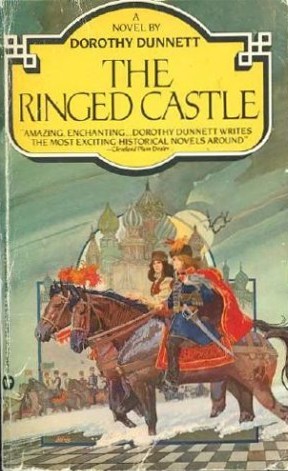
The Ringed Castle (#5 in The Lymond Chronicles)

By Dorothy Dunnett

The current image has no alternative text. The file name is: ringed.jpg

‘I lost three ships,’ Chancellor said. ‘And eighty- five souls.’ ‘I stopped counting,’ Lymond said, ‘after I had seen the first hundred or so of my soldiers dispatched to their earthly rest through me. You lead, therefore you kill.’

‘Your son will be John Dee’s next pupil. You cannot face marriage again?’ Richard Chancellor drew in a short breath, and let it carefully out, without stirring the candle. He said, ‘I have only met one girl to match Eleanor. And you are married to her.’
Lymond slid his hands off the table. On his shadowless face rested, openly, an astonishment so unexpected, so vivid that Chancellor himself was taken aback and said quickly, almost in anger, ‘I’m sorry. But she is a remarkable girl.’ ‘She is a remarkable girl,’ Lymond repeated. He looked startled still. ‘She must be Christopher’s age.’

I was trying to explain to a non-fiction reading loved one the other day why reading fiction was an enriching and important part of my life. Particularly when you find something so involved and complex and written so brilliantly and beautifully as the Lymond Chronicles. I tried to explain how it was like entering another world which doesn’t really fully go away even when you are not reading the words but going about your day to day business. Even when you are not actively contemplating the book, you go through your day knowing there is an alternate reality waiting for you when you choose to go back to it. You live safely through fear, tragedy, and grief. But also through triumph, wonder, joy, and love. People who don’t read stories don’t know about this, I guess. Not every reading experience does this for me. I’ve enjoyed and even loved other books without having this feeling of it being part of my life. For me, It’s mostly been series or at least connected books where there is world building involved. Like Harry Potter. And a sadly somewhat forgotten writer of historical and swashbuckling adventure and romance named Patricia Veryan.

The Ringed Castle, I was thrilled to discover, begins not with Lymond on the way to Russia from The Levant, as the previous book ended, but with Philippa coming home to her mother, Kate.

Not to every young girl is it given to enter the harem of the Sultan of Turkey and return to her homeland a virgin….The most prosaic schoolgirl in England, Philippa Somerville arrived home from Stamboul in the summer….

Kate, nor Lady Culter, cannot reconcile the “The Queen of Sheba”-like stylish young woman with the formerly bedraggled Philippa,

“the undersized fifteen- year- old who had left her uncle’s home in London two winters ago, to plant herself willy nilly in the unsuitable company of Lady Culter’s younger son Francis… Francis Crawford of Lymond, the hard- living leader of mercenaries whose by- blow Kuzúm had been snatched and used in a game by his enemies.”

But it’s her all right. Not being sure what her reception would be, her face is “green with fright.” But after an exchange of quips with her Mom, she slides giggling into Kate’s waiting arms.

From there, Lady Dunnett alternates between Lymond’s adventures accumulating power while navigating the insanities of Russia and the terrifying court of Ivan the Terrible, and Philippa’s continuing maturation in the home of real historical figure Henry Sidney and his family and friends. Lymond is the hated and feared Voevoda Borshoia, The Supreme Commander of the Tsar’s army, and Philippa is a very popular lady-in-waiting in the court of another troubled ruler, Mary I.

As a highly qualified Turkish-trained concubine from the harem of Suleiman the Magnificent, Philippa Somerville settled into English court life as a kite among chickens, and as a kite among kites into the Spanish court of the new King-consort Philip.

She has lots of suitors, except she’s married and her divorce from the Voevoda of all Russia is being held up. As much as I hated sporadically leaving Philippa and the English Court (which includes Mary’s dearest confidant and Lymond’s worst enemy, now that Gabriel is dead, Margaret Lennox. Also an important historical figure), I was always quickly immersed in Lymond’s exploits in Russia. Dorothy Dunnett knows how to keep things interesting no matter what. The husband and wife (in name only) are re-united around a year later when Lymond is forced, through political machinations of his enemies, to leave Russia to accompany the English Muscovy Company back to England to promote trade between the two countries.

Now I, your Tsar, beg it of you. Sail to London, the home of this strange, married Queen, and speak to her in her own tongue, but with the heart of a Russian. Bring me what I want.’ There was no escape. No loophole; no answer, no argument; no excuse. ‘Then of course, Lord, I shall go,’ Lymond said.

With him goes Richard Chancellor another real historical figure much admired by DD. who has become Lymond’s true friend and match in intellect and spirit.

“The Ringed Castle” refers to Moscow and the Kremlin, but it is also a metaphor for Lymond. Since the horrific occurrences in Istanbul he has coped by shutting down all emotion and putting up a virtually impenetrable wall between himself, his comrades and his family. “He can make you want to knock him down, if he feels like it, by simply saying “good morning”. Those who still care for him fear for his humanity: He has become a machine. The alert reader sees that is not entirely true. Further isolating Francis is the knowledge that his parentage is not what he thought it was, and a prophecy that he thinks will doom his brother if he returns home. He wants nothing to do with his formerly beloved and formidable, now heartbroken and fragile, mother. And, as usual, someone is trying to kill him. It is in England, thanks largely to Philippa, that chinks start to appear in his armor. But he is determined to return to Russia where certain death surely awaits.

As always some of the plot elements border on the preposterous, despite the erudition of the writing. And Lymond is surely one of the most maddening heroes in popular fiction. If you don’t like flawed (really flawed), you might want to give this series a pass. But if you gird your loins and proceed, there is always Philippa, who starts to become a major player after the second book. And Archie. And Sybilla. And Richard. And Kate. And Adam. And Danny. Not to mention a growing number of late lamenteds, and not so lamented.
And despite the often grim happenings (don’t get attached to any domesticated animals), there is humor. One of my favorite “running jokes” is Philippa’s and Lymond’s perception of each others ages. Lymond still thinks of her as a schoolgirl, and Philippa believes (and she is not alone) that Lymond is her mother’s age. They are only 10 years apart, and usually only the reader seems to realize it. Also banter, sophisticated wit, and comedy.

On to the last book in the series, Checkmate. I expect to be awestruck, amused, frustrated and saddened, but from what I gather, not disappointed.

Rating: 5 out of 5.

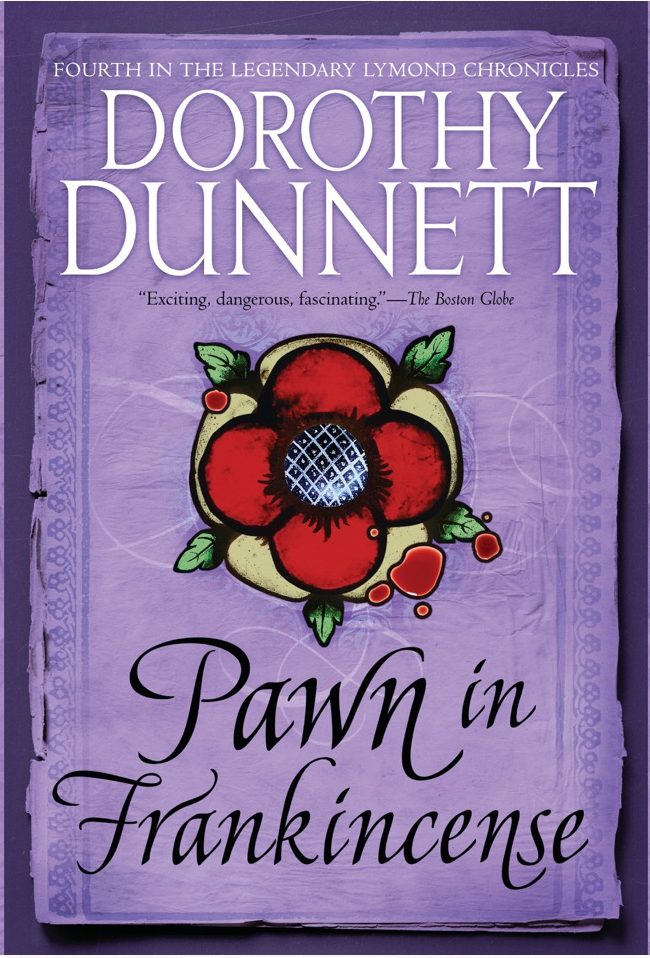
Pawn in Frankincense (#4 in the Lymond Chronicles)

The current image has no alternative text. The file name is: pawn-e1758880080116.jpg

By Dorothy Dunnett

Evil matters. So does love. So does pity. My pilgrim,’ said the Dame de Doubtance gently, ‘you have still three bitter lessons to learn.’

The penultimate scene of The Disorderly Knights foreshadows the age-old ethical dilemma that one is devastatingly confronted with in this, Pawn in Frankincense: When does the greater good outweigh the good of the individual? When it is a matter of life or death, how does one choose the sacrifice, and how will one live with the consequences of the decision?
Francis Crawford of Lymond’s hand is stayed by the redoubtable Philippa Somerville just as he is about to execute the malevolent and malignant Graham Reid Malett a.k.a. Gabriel. In the devastating scene Malett has shockingly revealed that Francis has a baby son who is under his power and if he dies, his son dies. Nevertheless, Francis, knowing the depth of threat Malett represents to the world is determined to carry through killing him after besting him in mortal combat. He is willing to sacrifice one child (Is GRM even telling the truth?) to save thousands.

And a child’s voice, echoing his in turn said, “No!”… No, Mr. Crawford!” cried Philippa forbiddingly, and ducking under the snatching arms that tried to prevent her, she ran forward…..sinking on her knees she shook, in her vehemence, Lymond’s bloodstained arm…There is a baby. You can’t abandon your son!” …Philippa Somerville, who believed in action when words were not enough, had leaned over and snatched the knife from Lymond’s left hand.

It is enough. Gabriel escapes back to the Ottoman Empire as, thanks to Lymond, he is persona non grata anywhere in Europe. There, in this book, he will betray his brothers, the Knights of St. John, and abandon all pretense of Christianity. He will successfully consolidate the power he craves under Suleiman the Magnificent while planning the entrapment and downfall of Lymond using his son as a pawn in the game.

The final scene in the preceding book has Lymond in front of a church altar vowing to find and save his lost son while somehow destroying Gabriel. Pawn in Frankincense is his quest.

We start out in Baden, in the Swiss Confederation, where Philippa, accompanied by Lymond’s sidekick, the usually very confused Jerott Blythe, has snuck away from her mother Kate and tracked Lymond down. She has come, she says, to look after the baby once he is found. One may ask, how could Lymond agree to take a 15 year old schoolgirl, the daughter his one of his closest friends, on such a treacherous journey?

As I have said before, and am now saying for the last time, I cannot tell you with what awe my family and friends, not to mention yours, would receive the idea that I should ship a twelve- year- old girl along the Barbary coast——’

Not surprisingly (if one has gotten to know her) Philippa prevails. And thank God for it. She provides the only safe haven and flashes of light in a book full of tension, fear and horror. Somehow, we know that she will always be all right. She is a master of “the feat of keeping her head, her reason and her sense of the ridiculous amid conditions of civilized lunacy.” Not that she doesn’t have a difficult journey. At one point, Lymond decides he must place killing Gabriel over finding his son and sends Philippa back home. He thinks. Philippa decides to continue the hunt virtually on her own and ends up entering the Sultan’s harem to protect the young toddler (because of course she finds him) from the cruel tentacles of Gabriel. As she writes to her mother, Lymond’s good friend,

Dear Kate. As you will see from the address, I am staying as a concubine in the harem of Sultan Suleiman the Magnificent, son of Sultan Setim Khan, son of Sultan Bayezid Khan, King of Kings, Sovereign of Sovereigns; Commander of All that can be Commanded, Sultan of Babylon, Lord of the White Sea and the Black Sea, most high Emperor of Byzantium and Trebizond, most mighty King of Persia and Arabia, Syria and Egypt, Supreme Lord of Europe and Asia, Prince of Mecca and Aleppo, Possessor of Jerusalem and Lord of the Universal Sea….There are two hundred and ninety- nine other girls here: but no one else from Northumberland. Tell Betty I have the dearest little black page.

We meet and continue our acquaintance with many intriguing characters, some fictional, some not. Some lovable, some not. They include Marthe, a young woman who could be Lymond’s twin. Sybilla’s child? But that’s impossible. Isn’t it? We learn there are two supposedly indistinguishable babies in peril, the other one being Gabriel’s own son from an unspeakable union. At times it seems we are in a retelling of the Odyssey, at others, Raiders of the Lost Ark, Ladyhawke, or an Errol Flynn pirate movie situation. Even once, a very strange romantic comedy fake marriage, one bed trope. At one point, horribly, Sophie’s Choice came to mind.

Dunnett’s books are very cinematic thanks to the lush realism of her descriptions. She is merciless with what she puts Lymond and those he cares for through and they will not emerge triumphant unscathed. In one of the last chapters, I was physically trembling as I read. I love Dorothy Dunnett, but thanks to this at times painful book, I kind of hate her too.

Rating: 5 out of 5.

Sylvester, or The Wicked Uncle

The current image has no alternative text. The file name is: sylvesteror.jpg

By Georgette Heyer

“Do you mean that I am redoubtable? Oh, you are quite mistaken!” “Am I? Then let us say intrepid!” She sighed. “I wish I were! The case is that I am a wretched coward.” “Your father gives you quite another character.” “I don’t fear fences.” “What, then?” “People – some people! To – to be slain by unkindness.” He looked at her with a slight frown…

Sylvester, or The Wicked Uncle has always been right on up there with my favorite Heyers. I think it’s because of the unusual heroine and the complex hero. Most of her heroines have charm to spare and are, if not extremely beautiful, at least attractive with some outstanding feature or another. Phoebe is a drab little “sparrow” who is only at home and comfortable in a stable. She has been bullied and dominated her whole life by a rigid and cold stepmother whose mission in life seems to be to beat every spark of Phoebe’s own unconventional personality out of her and into a model of perfect but insipid behavior. As for our hero, although a large percentage of Heyer heroes are formidable and proud, very few, like Sylvester, have to undergo growth and change in order to find their happy endings. Of course as in all romances, Heyer included, one or both individuals must change towards each other, but not their actual mentalities. In this novel, although Phoebe comes into her own to a certain extent, It is Sylvester’s journey to self awareness that is the significant one.

The Duke of Salford has decided it is time for him to do his duty, get married, and perpetuate the House of Rayne. He has prepared a list of five candidates for the honor of his hand each more well born, well behaved, charming, and beautiful than the next. It makes no difference to him, so he takes his list to his beloved mother to see if she has any input as to which of the fortunate ladies to favor with a proposal of marriage. His wise and gentle mother’s suspicions are confirmed: Although always open, loving, and warm with her, (and his 6 year old nephew and current heir, Edmund) to all others he has closed himself off from any emotional attachment. He is considerate and well-mannered to his servants and his peers and is popular with all. But his exemplary behavior to others is not out of any empathy or warm feeling but because it is what is due to his proud family name and station. He says and does the right things always, but beneath this surface he is cold and aloof. Encouraged by his mother and godmother, on a whim he decides to meet one other candidate for the position of the Duchess of Rayne: Phoebe, the daughter of his mother’s long-deceased best friend and his godmother’s granddaughter. He is not impressed. And neither is Phoebe. To add to her discomfort, she has secretly written a novel which is about to be published and she has based the villain of the bloodthirsty gothic tale on Sylvester. She had met him at a ball once and she noticed his distinctive satanic-looking eyebrows and was hurt by his haughtiness and boredom with her. Of course Sylvester doesn’t remember her at all. Due to a misunderstanding, she has been told that he has travelled to her family’s country home with the intent of actually proposing marriage to her and she better accept him, or else. Horrified and panic-stricken by the prospect, she decides to run away to her grandmother in London (yes, that same one) escorted by her loyal friend Tom. Sylvester is considerably peeved, as well as incredulous, that such a plain and vapid chit of a girl would hold the idea of a proposal of marriage from him in such abhorrence that she would flee from home in a snowstorm. He leaves as well, and inevitably the 3 fugitives meet in a small inn and are marooned together for several days. As they get to know each other, Phoebe learns that Sylvester is actually a pretty good guy beneath the arrogant facade, and Sylvester learns that out from under her stepmother’s thumb, Phoebe is a clever, funny, and forthright original. She is mortified and guilt- stricken that she has made Sylvester her villain in a novel that will potentially hold him up to ridicule and suspicion. And Sylvester is embarrassed to realize that Phoebe’s initial poor opinion of him may be justified.

Adventures, escapades, and misunderstandings ensue. Despite its romp of a plot, there is a serious undertone to this book. Sylvester’s aloofness is self protection and is due to a terrible tragedy in his past. Before he is shaken off his high horse by Phoebe (and the down to earth Tom) he is on his way to a loveless marriage and, except for his care for his invalid mother and his little nephew, an emotionless half-life. The emotional abuse Phoebe has had to endure her whole life is the source of her hypersensitivity and fearfulness in society. Other than her writing, her future is bleak and lonely.

The book contains Heyer’s usual humor and comedy and the light tone is there. But although some of her comic set pieces involving Edmund’s flighty, shallow, and selfish mother and her silly fop of a husband are amusing, there is a potentially a very sad side to even them. When the couple actually kidnap Edmund from the guardianship of his Wicked Uncle (inspired by the plot of Phoebe’s unexpectedly successful novel) Edmund’s life is actually in danger due to their inattention and thoughtlessness, and he is exposed to the cruelty of neglect. Luckily for him, it is Phoebe and Tom to the rescue. And luckily for Sylvester and Phoebe, it is Sylvester’s lovely mother (and Phoebe’s eventual kindred spirit) who will save the day for them. The Duchess of Rayne’s cleverly engineered and tender reconciliation of the two soulmates continually at odds is one of my favorite endings in all of Georgette Heyer’s works.

Rating: 5 out of 5.

The Disorderly Knights (#3 of The Lymond Chronicles)

By Dorothy Dunnett

The current image has no alternative text. The file name is: disorderly.jpg

A hunter went killing sparrows one cold day, and his eyes gave forth tears as he went. Said one bird to another, “Behold, this man weeps.” Said the other, “Turn thine eyes from his tears. Watch his hands.”

–Dragut Rais–

I am currently not quite a third of the way through the 4th book in the series as I write this review of its predecessor, The Disorderly Knights. Instead of continuing to struggle to do justice to it, I am just going to keep it short. There is a lot of this review left on the cutting room floor. First of all, what they say is true. For a first time reader, Dunnett’s writing does get easier and easier to understand though no less complex in plot and character. There were less sentences that I had to try to decode and wring the meaning out of. Everything flows so much better: Less like she’s looking to punish readers with her scholarship and more like she herself is caught up in the story and having a wonderful time just telling it. Even though divided into 3 parts, it is really a tale of two countries: first Malta and then Scotland. It’s also a study of two extraordinary men engaged in a high stakes struggle of wills and cunning. And I guess to a lesser extent, for me, it was a comparison of the disparate nature of two teenage girls. And it is also a tale of two armies. And two religions.
There is tragedy and yes, there is comedy. Spanning two continents, Lymond goes through many tribulations in trying to expose and take down a powerful villain as evil as evil can be. A villain whom the world, even the good and the wise, believe to be a saint. Meanwhile, not even a handful, his family included, have total faith and trust in Francis Crawford. Not that he always deserves it. There are shocks in this book. And Terror and Horror. And then there is Philippa Somerville, who is quickly becoming my favorite fictional female character of all time. And Nicolas de Nicolay one of my favorite real historical figures that figure in this book.

Some things that happen still don’t bear a lot of scrutiny as to what one man can accomplish or bear. She really puts Lymond through the wringer. Some scenarios beggar belief and draw one up short, and some you just have to go with, revel in, and just keep reading. One such of the latter is a flashback to an event that takes place after The Game of Kings, and before the second book, Queen’s Play, begins. It could have just been a fun, cheer worthy example of Lymond’s military acumen, however implausible, meant to show Lymond’s trickiness and out of the box thinking. But I feel like it’s fair game to scrutinize because Dunnett makes it so important. Briefly, it relates how Lymond routs a small army of attacking English soldiers by fooling them into thinking, in the fog and distance, that Lymond’s small number of 20 Clansmen actually number a force approaching 1000 troops. He does this by slapping shining metal helmets on 800 sheep and driving them forward into the valley where the soldiers are set to advance. It is brought up in the series time and again (even in the 4th book I am currently reading) as an example of why Lymond’s services as a military leader are so much in demand. Unfortunately for my peace of mind, I got all caught up in where he got the 800 helmets. Were they friendly helmets or enemy helmets? Where were the helmetless soldiers? Did he store them up one by one in preparation for a scenario just like this, or did he steal them in one fell swoop and where did he store them? I’m sure Dunnett knows the answers, but didn’t choose to share. It wouldn’t have bothered me so much but it is a favorite set piece in the series. People have gotten tattoos of sheep and helmets and coffee mugs are available on line for £16.50.

Anyway, it’s all part of the experience, I guess. Dunnett is so brilliant one fears to question, but it’s part of the fun. These books are absolutely spellbinding. This one ends on a cliffhanger. I fear for the fates of many characters. I was so glad I could get right to the next one and didn’t have to wait. How did her readers bear it back in the day?

Rating: 4.5 out of 5.

Dear Mrs. Bird

By AJ Pearce

The current image has no alternative text. The file name is: dearmrs.jpg

Despite a slow start, this turned out to be a charming and delightful novel very similar in style and substance to D.E. Stevenson. I expected something of the sort, set in England during the Nazi blitzkrieg of London, but I didn’t expect that long swaths could almost be mistaken for her writing. The characters could have stepped right out of one of Stevenson’s wartime novels (except they mostly are not set in London). Our two young heroines are kind, pretty, spunky, bursting with moral fiber, and determined to do their bit in the war. And the young men are their equivalent. If they are not in the military, they prove their bravery by contributing in some way to the war effort. There is at least one thoroughly obnoxious character to challenge them, a daunting parental figure/mentor and a wise protective one. Sad and bad things happen but the overall tone is light and comfortable and sprinkled with gentle humor.

Emmy and her life-long friend Bunty are living in London during the blitz. Fired up by the idea of being a lady war correspondent, when Emmy sees an employment advertisement in the London Evening Chronicle, she applies for the position, and she gets it! To her dismay she soon finds out that she is nothing more than a junior typist for Henrietta Bird, the “Acting Editress” and advice columnist for Women’s Friend magazine. Worse, one of her duties is to read the letters to Mrs. Bird and cut up the letters that request help regarding anything “unpleasant” according to her very rigid lights.

Topics That Will Not Be Published Or Responded To By Mrs. Bird
(NB: list is not exclusive and will be added to when required)
Marital relations
Premarital relations
Extramarital relations
Physical relations
Sexual relations in general (all issues, mentions, suggestion, or results of)
Illegal activities
Political activities and opinions
Religious activities and opinions (excl. queries regarding church groups and services)
The War (excl. queries regarding rationing, voluntary services, clubs, and practicalities)

Words and Phrases That Will Not Be Published Or Responded To By Mrs. Bird For further references see Girlhood To Wife: Practical Advice By A Doctor (1921)
A–C
Affair
Amorous
Ardent
Bed
Bedroom
Bed jacket
Berlin
. . . The list went on for pages.
In other words, the Women’s Friend problem page only wants to be friends with women who have no actual problems or dilemmas. And in the England of 1941, those women are few and far between. And the magazine’s subscriptions and advertising revenue show it.

But as Emmy reads the comparatively few letters that she and Kathleen, her co-worker, receive, her heart is rung by the sometimes desperate cries for help with real world difficulties exacerbated by wartime. Finally, she starts to respond to the most heart-wrenching on the sly if they include a stamped self-addressed envelope. Emboldened by her success (and the fact that she doesn’t get caught) she even starts to sneak a few letters into the magazine (Since Mrs. Bird never reads it.) Meanwhile she tackles her own challenges with her volunteer work as a phone operator for the Auxiliary Fire Service and her personal life, along with her friend Bunty, who is engaged to be married to their childhood friend, William.

Needless to say, “No Good Deed Goes Unpunished” for our heroine on more than one front, and all Hell breaks loose all over the place for poor Emmy who tries her best to Keep Calm and Carry On in the face of several disasters.

*A few spoilers you would probably guess anyway*

It wasn’t quite a 5 star read for me. There were things that didn’t seem right. Emmy was too wishy-washy about trying to help the women who were desperate for advice and support. Of course she should try to help them! Not to do so would have been practically unpatriotic! And her supposedly super-plucky friend Bunty is horrified and scared at the very idea when Emmy feels her out on her dilemma. This didn’t track either. I was kind of shocked at her attitude. In one incident, Emmy lays into Bill for endangering his life and the lives of his crew to rescue a little girl’s doll that was buried in the rubble following a bombing. While on the surface this was kind and brave of Bunty’s fiancé, it was also very dangerous and foolish. She is wracked with guilt for scolding him and the incident has far-reaching consequences. It was frustrating because I thought she was absolutely right and she had nothing to apologize for. I had problems with Bunty and her actions v. what we are told about her character. Lastly, it turns out that the one mistake that Emmy made in writing back to the desperate women was signing Henrietta’s Bird’s name to the letters. That was really dumb, dumb, dumb. She didn’t have to sign them at all.

Naturally, Emmy triumphs in the end. Thankfully, her response to the final letter of the book is very courageous. Her nemesis, Henrietta Bird, one of the most obnoxious and “unpleasant” women I have fictionally experienced in recent years, is summarily disposed of. But unfortunately with more of a whimper than the bang I was hoping for. Still, If you liked the final courtroom scene in Miracle on 34th Street, you will get similar vibes with the dramatic showdown in this book. I’ll probably read one more in this series of four books and then see how it goes. But, like with D.E. Stevenson, I have to take a break and wait for the right mood to hit me.

Rating: 4 out of 5.

The King’s Messenger

by Susanna Kearsley

The current image has no alternative text. The file name is: kings.jpg

“Happy endings are of little comfort,” Logan told me, very sure, “to characters who die afore the tale is done.”

I wasn’t crazy about this one. It was very romance-forward for a Susanna Kearsley novel which I was happy about at first. But it seemed much lighter than the other books by her I’ve read. To be fair, that perception might be influenced by the book I read right before this one. She picked a good bit of history to provide the foundation for her novel, but ultimately the history part, which was confined and personal as opposed to overarching and epic, was depressing to think about. Since many of the characters were based on real historical figures, it limited her on what she could do with them. The fiction part was a bit plodding and I was not emotionally engaged in the predictable romance. That’s true of most of her books, but usually there’s enough “other stuff” to make up for it. Kearsley almost always includes a supernatural element which has always been well integrated into the story. In fact, it has been the key factor and those books as written would not exist without it. There was a supernatural element in this one but it could have been left out and would have changed nothing to plot or character. In this one, one of our main characters has second sight and gets random brief visions of the future, which are mostly always deceiving. Also he sees dead people. Neither of these “gifts” have any major influence on anything that happens. They’re just kind of tacked on seemingly to make Andrew more interesting, or just because it’s Susanna Kearsley’s “thing” to have a paranormal element to her novels.

It is set in 1613 shortly after the sudden and suspicious death of Henry, King James I of England’s promising teenage son and heir to the throne. Rumors are starting to spread that he was poisoned and suspicion is starting to fall on King James, his own father. King James was a nasty piece of work and was jealous of his talented, intelligent, and principled son. In order to quell the rumors, he sends for David Moray a.k.a. Murray (real person), Henry’s trusted courtier and companion with the intention of pinning Henry’s murder on him. Andrew Logan, our hero, is the King’s Messenger sent to Scotland to arrest and bring David Moray to London for the inquiry and trial. Because there will be a trial: David Moray is being framed by the King himself. With him on the journey goes a Scrivener who is assigned to write down everything that David says and does with hopes of gathering actual evidence against him, and his daughter Phoebe who insists on coming with to watch over her father who is in poor health. Phoebe and Andrew’s families have been neighbors for a long time, but due to a misunderstanding and some lies told to her, Phoebe has always disliked Andrew. On the journey to London, there are some not very thrilling adventures, and we get to know the characters in depth. As Andrew proves his worth time and again, Phoebe’s dislike turns to love. David Moray is a wise and good man, and still suffering the lingering pain of Henry’s death whom he loved like a son. Of course we care what happens to him but the fact that Wikipedia (and other sources-Ha ha-not really) tells us that David Moray was never brought to trial and lived a long and productive life for years after the events in this book kinda put a kibosh on any suspense regarding his fate. However, “the how” was neatly and cleverly done. Can Andrew remain loyal and dutiful to King James but not be a party to turning over an innocent man to certain death?

There are some interesting little nuggets in this book. For one, We meet and learn about real person Esther Inglis, who, despite her gender, was a well respected calligrapher of the day. Susanna Kearsley does her research, so I found all of the real historical details regarding the royal personages, King’s Messengers, scriveners, etc. pretty fascinating. Speaking of research, Kearsley is a firm believer in the theory that Prince Henry was poisoned, and poisoned at the instigation of his father the King. This flies in the face of most historians’ long held view that he died of Typhus. She makes a strong case, and I believe her. But it is so depressing to think what a great English King Henry would have made as opposed to his brother Charles I whose beliefs sparked the English Civil War and led to his execution. It was very neat how Kearsley used an incident that really happened to fashion Queen Anna’s revenge on her husband for her son’s death. Spoiler Alert! My second book in a row that a dog dies. I hope this is not a trend.

Rating: 3 out of 5.

Queen’s Play (# 2 ofThe Lymond Chronicles)

By Dorothy Dunnett

The current image has no alternative text. The file name is: queensplay.webp

Lymond’s behaviour, as always, went to the limits of polite usage and then hurtled off into space.

**Spoilers**

It is 2 years after the events of the Game of Kings, the 1st of the Lymond Chronicles. Francis Crawford of Lymond has returned to the bosom of his family. His reputation throughout Europe has not only been restored but his talents are held in such high esteem that he is called upon by Mary of Guise, the Dowager Queen of Scotland to come to France with her to protect her daughter, the 7 year old “High and Mighty” Mary, Queen of Scots from rumored danger of assassination.

Notoriously, at some time, every faction in the kingdom had tried to buy Lymond’s services. Nor was the bidding restricted to Scotland, or to statesmen, or to men. Europe, whenever he wished, could provide him— and probably did— with either a workshop or a playground.

He agrees to do so, but on his own terms, making clear that his loyalty is not to the powerful and ambitious Queen Mother, but to Scotland. He will not be her beholden acolyte and in turn, she will not, can not, intercede if he gets into trouble. And thus we are off to the decadent and dissolute French Court of Henry II of France, which Lymond will infiltrate in order to stay close to the threatened little Queen and to discover who is behind the assassination attempts. For indeed, we learn the child’s life is in grave danger. As his disguise he creates a character so eccentric and unlikely that no one will suspect his true identity but will allow him to use the talents and skills that Francis Crawford of Lymond is well known to have mastered. As the fat, perpetually drunk, and slovenly attendant to an unimportant-by-choice Irish Chieftain, he seduces the court:

Each in its nest of gauze and gilt thread, of tissue and taffeta, swathed in silver and satin, in velvet and white fur sugared with diamonds, each face painted, each brow plucked, hair hidden by sparkling hair of raw silk, the well- born of France sat in waxlight and flowers like half a hundred candied sweets in a basket. Last at the last table, soggy gristle next the sugar plums, sat Thady Boy Ballagh.

At levée and reception, at ball and after sport, during meals and after supper parties, Thady was expected as a matter of course. His playing had become as fashionable as a drug. He made music in public and in private for them all: …and already they thought nothing and less than nothing of how he looked. Then, that goal reached, he hardened his long fingers in their entrails of icing and sugar and started to twist.

The plot is complex as are the many characters who people this book. As in G of K, Dunnett expertly fills in the blanks of history with her fictional story ostensibly going on behind the scenes. For example, The main villain was a real person with significant connections to powerful people, but little is known about his actual life or what he may or may not have been up to. Those about whom much is known stay authentic to what history knows about their characters and actions. How Dunnett weaves her fiction around what is factual is nothing less than amazing. Rather than go through the plot and try to touch on all the fascinating characters, both real and imagined, I’ll just mention two characters that stood out for me.

The first is the “wholly spoiled, wholly self-centred, ruthless, neurotic, worldly- wise” character of the French Court itself. It was fascinating and unpredictable. In one of the attempts on Queen Mary’s life, her beloved pet rabbit, Susannah, is stolen and let loose amongst the other prey to be sport to the hunting Cheetahs. As predicted, the little girl escapes her minders and rushes to rescue her pet. In the resulting maelstrom of confusion, panic, and violence, A brave and noble Irish wolfhound, (as well as poor little Susannah) meet heartbreaking ends. The French court, once the little queen is off stage and safe, cheers the Cheetah. They care for nothing but the thrills and excitement provided by bloodlust.
Yet, taken individually, many are funny and insightful. Thankfully, because no group of people can perpetually be that dissolute and depraved (can they?), they prove to be capable of change, much to my surprise. Later in the story, a race down from a tower results in the death of many horses and men. Thady boy is framed and blamed for the tragedy and he escapes from the court he once dominated with his talents, wit, and pursuit of pleasure.

“What had been vulgarly clever, in the light of bare exhumation looked bleakly coarse; what had been vivid looked vulgar; what had been witty looked common; what had been forthright looked outrageous.
A sense of acute spiritual discomfort hung over the flower of France, the aftermath of its brilliant flare of indulgence. If Thady Boy had come back— a Thady Boy even absolved from the treachery imputed to him— they would have had him beaten from the room by their valets.”

The other character that I became fascinated with was Phelim O’LiamRoe, who, as Thady Boy’s supposed master, provides him with his cover. At first he was kind of a silly non-entity. Intelligent, humorous, cheerful, but having no ambition or purpose to his life at all. He was kind of a bore.

In terms of followers, O’LiamRoe was one of the mightiest chieftains in English-occupied Ireland, except that it had never yet occurred to him to lead them anywhere.

But he starts to change at the death of his noble Luadhus, his dog who threw himself between the deadly cheetah and the little queen. He starts to think and question his life. Meanwhile, he falls deeper in love with a beautiful and fiery Irish revolutionary who holds him in contempt until he proves his mettle with an act of bravery. He convinces her to give him the name of the man who can prove the guilt of the powerful mastermind of the assassination attempts. He will save Mary and also save Lymond from execution.
But first they must part.

Her hands lay cold in his. Searching her empty face he said, ‘We shall meet?’ ‘At the fall of night, on the far side of the north wind,’ she said.’ ‘Love me.’ ‘All my days,’ said Phelim O’LiamRoe, Prince of Barrow, dropping into the tongue of his land. ‘Dear stranger, dear mate of my soul: all my days.’ And walking quiet and blind, he let slip her two hands and left.

To the rescue!:

Dark in the misty June morning, Châteaubriant was still. Dim through the painted shutters, the hoof beats of a single horse burst, applauding the cobbles, and were gone.

Before the book ends O’LiamRoe will not only be instrumental in saving Francis from death, but in setting his life on a different more mature and thoughtful path. Thanks partially to him, Francis will become the great leader of men he was destined to be.

Dorothy Dunnett is a wonderful writer. Her prose is beautiful, evocative, and clever. But still, I had my problems with some of the details of the book as much as I admired and enjoyed it.

It seemed pretty impossible that Lymond’s disguise as Thady Boy held up so long and with so many. Keeping his blond roots covered under black dye, his pale skin constantly having to be stained, his slender nimble body disguised under thick padding, all the while bedding God knows how many men and women in the French Court? With a fake stomach? And what about Lymond’s slender delicate fingers which are referred to regularly? That doesn’t track with Thady’s fat pudgy body.

The recuperative powers of two of the characters who were on death’s door one minute and engaging in physical heroics the next reminded me of a Roadrunner cartoon.

Too much knowledge is withheld from the reader and too much important action happens off stage. I found this to be true of Game of Kings as well. When did Lymond figure out who the master villain was and how? Once it is finally revealed to the reader, he claims he already knew who it was. Then why was it so important to send O’LiamRoe to the Tower of London to get his name from his hitman, Robin Stewart? Lymond was released from prison just in time to save the queen. It seemed very easily done without much justification. Some obscure sculptor knew a guy who knew a guy who said so? The bad guy might be guilty, so Lymond must be freed-and immediately? How did they get let in to see the Constable again with Robin Stewart’s undelivered letter? One minute we leave him locked up, and the next he’s free and racing to save the little Queen from being blown to kingdom come with her retinue.

Some things do not bear too much looking into and no doubt a careful reread would set me straight. . But sometimes, even in great books, you just have to roll with it, and revel in the brilliance, not the WTFuckery. Everyone says Dunnett historical research and authenticity is unimpeachable. Sometimes I found some of the fiction parts a little far-fetched. But maybe that’s OK. As Lymond says in Game of Kings,

“Versatility is one of the few human traits which are universally intolerable. You may be good at Greek and good at painting and be popular. You may be good at Greek and good at sport, and be wildly popular. But try all three and you’re a mountebank. Nothing arouses suspicion quicker than genuine, all-round proficiency.”

Rating: 4.5 out of 5.