Black Sheep

by Rachel Harrison

**spoilers**

For some reason, all dogs hated me

I like a good thriller and welcome paranormal elements in a few types of books. But I didn’t quite expect how all of this played out. I knew something was up when the bowl of nacho sauce exploded in the face of a guy who was being a jerk to our heroine. I’ve read Harry Potter and the Sorcerer’s Stone, binged Stranger Things, and have seen Carrie. And any reader knows that, despite appearances, if dogs love you, you are a good person at heart, but if they don’t, there is something seriously wrong with you. But I didn’t expect it to be so full-on. I don’t know why it came as such a surprise (not shock-there is a difference) because the clues were there barely 10% into the book

The dog…went on yapping, clawing, baring its teeth, trying to get to me. Eventually, the girl got up and moved, eyeing me as she did. “He’s never like this,” she muttered to herself as she passed by.

Vesper is smart, funny, and beautiful. Too smart and beautiful to be waitressing in a chain restaurant in New Jersey. We learn that she has been on her own for 5 years because shortly before she reached her 18th birthday, she escaped from a strict and fanatical religious cult. While growing up, she had always been indulged and treated as if she was special despite her indifferent and sometimes cruel mother.  The loving father she adored had left her and the community when she was 11 and she still yearns for him.  She never believed in “The Lord” and felt like an outsider. Yet, outside and free from the cult, she still is an outsider. She does not play well with others. She is lonely and unloved.  So when she receives an invitation to attend the wedding of her childhood best friend who is marrying “the only boy she had ever loved”, she can’t resist returning and attending. She is welcomed back with open arms except by her mother (who is a retired “scream queen” movie star). The reader is introduced to Rosie and Brody, the bride and groom-to-be, who are like a Disney princess and her handsome prince come to life.

I wondered what had caught [Rosie’s] attention. She was peach sweet, would stop to admire a rainbow, marvel at a praying mantis.

Wait, what? A praying mantis?

Anyway, early in the book we learn that the cult that has all the hallmarks of fanatical fundamentalist Christianity is not what we have been led to believe.

“Praise to Him.” “Praise to Him.” Their god. Not mine. Never mine. “Hail Satan!” “Hail Satan!” “Hail Satan,” I muttered, infusing my tone with sarcasm to curb my nerves.

Even though I was not surprised, it was shocking to see it in print. And she learns that her father was not like herself: a rebel who left because he didn’t “believe” like the rest of them, but the head honcho himself whom the rest of the community worships. Satan.

It was him. My father. “Look at you,” he said. “My girl.” “What are you doing here?” “I’m here to see you,” he said. Then he gestured around the room. “And my friends. To join the party.” “Praise be!” someone shouted. “Hail Satan!” “Uh . . .” I looked over my shoulder to my mother, who blinked rapidly, fake lashes aflutter. “Everyone,” he said. “Please, rise. It is so good to see you all. It’s been too long. I . . . have been busy. Very, very, very busy.”

After this big reveal halfway through the novel, I was hoping, like Vesper, that her father and his followers were delusional. The clues in the beginning that she has “powers” she is not aware of and an alien or strange nature that repels dogs (and probably cats if there were any in this book) were “just one of those things.”

I was eager to dismiss it all—I didn’t believe in powers or magic or gods or any of that pixie-dust bullshit. I never had, and I refused to start because of my delusional father. I understood that belief was a slippery slope. If you wanted to believe in something, opened yourself up, suddenly you were seeing signs, assigning meaning, taking coincidences as proof. I wouldn’t. I couldn’t.

But finally, the truth is revealed and is impossible to deny. She is not just in a big drug-induced hallucination. She is Satan’s Spawn. “Lucifer Junior”, “The Harbinger”, The Princess of Hell. The Antichrist. A Reluctant Antichrist, but The Antichrist nonetheless. And her role is to be a sacrificial lamb to initiate the Apocalypse and destroy the world the non-Satanists have ruined (Climate change and inflation, it is clarified) leaving no survivors except Satan’s true followers. But Vesper, with a little help from someone unexpected, fights back.

This book did live up to the hype. It was horrific, irreverent, sharp, and funny. “The Princess Diaries meets Dante’s Inferno”* I loved Vesper and her voice. But the book did not address the elephant in the room. And that is, if Satan really does exist, then so does God. If the book had gone deeper and Vesper had had that revelation and dealt with it, the book could have gotten a higher rating from me.

Rating: 3 out of 5.

*Eric LaRocca, Horror novelist.

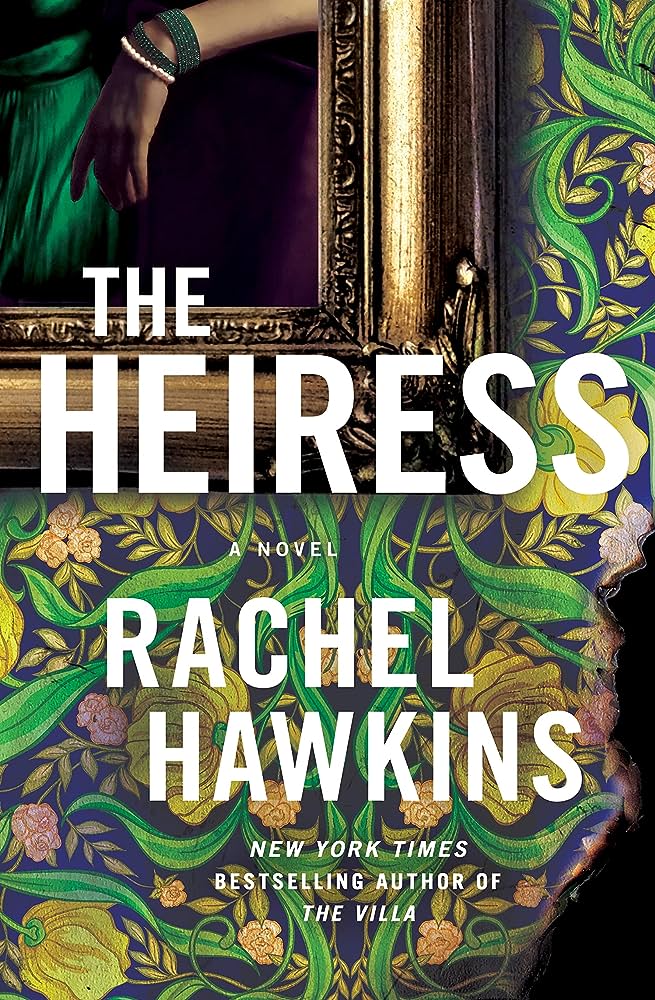
The Heiress

By Rachel Hawkins

This one started a little slowly for me, which isn’t necessarily a bad thing, plus I was worried by the early hints that the two likable protagonists might turn out to be not so likable after all. As it turned out, they do have secrets from each other and the reader that don’t put them in the best light, but even in the face of a few doubts that came and went throughout the novel, even to the very end, I never really stopped rooting for them. Possibly because their antagonists proved to be so vile, but also because Cam seemed like such a good person, and Jules was such a force to be reckoned with in her support of Cam.

It’s hard to review a thriller/mystery the way I usually do because it can’t usually be done without spoilers. I will say that this was very smart and very entertaining. I was really in the palm of the author’s hand once Jules and Cam finally arrived at Ashby House and the action really got going. When I read one of these types of books, part of the enjoyment is trying to guess the reveals and the twists while the author is trying to throw you off and misdirect you. I did guess correctly that two aspects would come back into play as important factors but not in the way I thought they would (but in hindsight, should have guessed.) The reveals were clever and surprising and there weren’t just one, two, or three. There were at least eleven by my count! And they were all “Whoa!” worthy.

I really liked the use of 3 points of view to tell the story. Cam is the adopted son of the late Ruby McTavish, “The Heiress.” He hasn’t been back home in 10 years, since her death. He has turned his back on wealth and privilege (lots of wealth and privilege) to scratch out a living in Colorado as a school teacher. His part of the story is told in the conventional first person. Jules is his wife of 10 years whom he met there. Her perspective is also told in first person, but often breaking the fourth wall and speaking directly to the reader.
“So, I guess I have some explaining to do, huh? I know, I know. It looks bad….Second act plot twist, your heroine is actually a potential villain.
The third perspective is told in the letters Ruby wrote shortly before her death to someone she refers to as “My darling”. They are confessional. She tells the truth about how her 4 husbands met their demise as well as other secrets, filling the reader in on her back story and motivations. I started to like her. She was frank and funny. Then things changed. The author kept me turning the pages by ending each of these “chapters” on a cliffhanger before going to another narrator or the objective point of view of a clip from an old newspaper or magazine article on the milestones in the lives of the famous and powerful family.

The book barrels to an exciting climax before we get two remaining letters and an epilogue that reveal more secrets and answer more questions. It ends as well as I could expect such a book to end. It was satisfying. This was a clever and entertaining novel that I recommend without reservation to readers who like mysteries or thrillers with strong gothic overtones along the lines of Rebecca by Daphne Du Maurier.

Many thanks to NetGalley and St. Martin’s Press for providing me with a free copy of this novel in exchange for an unbiased review. This book will be published January 9, 2024.

Rating: 5 out of 5.

Seaview Manor

by Elissa Grandower

This started out pretty well. I was in the mood for a good gothic and this one came to my attention as a likely prospect. I liked the heroine who seemed to have a lot of gumption and an interesting background. I loved the 1970s New York City vibe the book started off with. It reminded me of T.E. Huff’s contemporary Gothics. Unfortunately, the male writer of this one (under a female pseudonym) didn’t measure up to my expectations. This was disappointing and surprising because Hillary Waugh was a very respected and pioneering writer of the police procedural subcategory of mysteries and was named a Grand Master by the Mystery Writers of America. Surprisingly, the mystery part was one of the disappointments in this. In the end, it seemed pretty slapdash and not well thought out or constructed.

Andrea, our heroine, is in a dead-end boring job with a scientific journal and answers an employment ad looking for a young, personable, single female who is adventurous and able to travel. After a somewhat unusual interview, she is selected to be the pretend girlfriend of Charles Carteret, the attractive young head of a very wealthy and prominent family. Her mission is to become friends with Regina, his mentally disturbed sister who is suffering from a devastating disappointment in love which has caused her to become a recluse, depressed, and completely closed down. Hopefully, Andrea, spending the summer with Charles, Regina, and their family on their private island, can penetrate the wall she has put up and start the healing process. This seemed a pretty questionable plan to both me and Andrea. But she is talked into it.

The writing was engaging with a good setup for intrigue, danger, and mystery. It was cooking along pretty well until about the halfway point when smarmy Daniel, Regina and Charles’s stepbrother and the supposed object of Regina’s unrequited love, arrives on the scene. A handsome and charming ladies’ man, he and Andrea start flirting with each other although she is careful not to be inappropriate. Daniel whines about how unfairly he has been treated inheritance-wise and has a “slightly soft body.” Gothic good guys don’t whine and their bodies are not soft unless they are elderly, so I discounted Daniel immediately and soon viewed him with suspicion and distaste. But not so Andrea. Despite the attractions of Charles, she likes him, trusts him, and is even attracted to him. Which, in turn, makes her look stupid and a person of no judgment or sense. After some admittedly suspicious behavior on Charles’ part when a stable worker is killed, she jumps to the conclusion that Charles is a murderer without a thought as to why he would murder that person. It’s not that he had no motive, but that the thought of “what is his motive?” and puzzling over what it might be never enters her mind. This was the point I lost interest in the novel. After a few more chapters, I started skipping through to the end. The death is ruled an accident even though proof that it is not is in plain sight. And on and on. Questionable motivations, unnecessary lies, “proof” that is not proof of anything, and ludicrous actions abound. Not to mention a jarring change of literary point of view near the end. The main thing though was having to see everything through the eyes of a heroine that was just so clueless. I got very antsy and impatient which was not helped by the fact that I was forced to read this book in hardback (interlibrary loan) as it was not available on Kindle. And I had another book with lots of potential waiting in the wings. Even the romance was a bust.

Rating: 1.5 out of 5.

The Dancing Floor

by Barbara Michaels

I listened to this on audio read by the great Barbara Rosenblat. I had read the story many years ago and may have read it more than once. It was Barbara Michaels’s last novel under this pseudonym. I would give the story a 3, but Barbara R.’s reading a 5. I loved the heroine, but in the end, the plot was kind of all over the place. Although Heather, our funny, caustic, and indomitable heroine ends up with the guy I wanted her to, I’m not sure how it happened exactly. She seemed to be going in another surprising direction, and it wasn’t until the end that that attraction was explained, and it kind of made sense. I was happy and even relieved at the pivot.

American school teacher Heather Tradescant is touring the gardens of England in honor of her gentle scholarly father. They had planned the pilgrimage together, but he has since died in an automobile accident. She arrives at what was to be the highlight of their tour, the estate of Troyton House, the site of a famous 17th-century garden long since grown over and all but vanished. When she is locked out of the grounds, Heather being Heather forges through a thick overgrown hedge which mysteriously seems almost alive and malevolent. She bursts through, scratched and bloody, and lands at the feet of the famous and fabulously wealthy Mr. Karim, the current owner. To her surprise and incredulity, he enlists her amateur aid in restoring the important garden. He learned her last name, Tradescant, is coincidentally (?) the same as the original designer. Also, he likes her because, unlike everyone else in the world, she refuses to be bossed or bullied and gives as good as she gets. She is a breath of fresh air.

Unfortunately not much restoration is accomplished because Heather is too busy dealing with local witches, mysterious fogs, trying to rediscover how she got through the impenetrable hedge in the first place, the jealous wife of the former owner of the estate, and her spoiled little boy who has all of the makings of a future serial killer with a history of pyromania to boot. Not to mention being the romantic target of two attractive men despite the fact that she is just average looking with an overweight though athletic build. The third man in the picture is Mr. Karim’s sarcastic grouchy son who is a university professor working on a book and doesn’t seem to like her at all.

There is really not much of a plot and not even a mystery to solve unless you count why Mr. Karim is so hateful to his son. Bobby, the future serial killer, disappears and is feared dead but that is a matter for the police and his unhappy parents and is not any of Heather’s business. Not that anyone misses the horrid child anyway. Heather is poisoned and has two other exciting escapes at the end. The story ends with a shocking development but the reasons behind it all didn’t really make a lot of sense.

This is the last of a long line of Barbara Michaels novels, and she might have been a little tired. She was also keeping up with her yearly and very popular Amelia Peabody adventures under “Elizabeth Peters,” and an occasional Jacqueline Kirby or Vicky Bliss thrown in. Most of her earlier “Barbara Michaels” books were true Gothics which featured haunted houses, witchcraft, and other paranormal activities: Werewolves, fairies, timeslips, and possession included. The latter novels are immersed in fascinating and arcane aspects of various professional and hobbyist pursuits. This one is steeped in the lore of formal gardens and mazes with a healthy dose of witchcraft and ancient curses. Previous books have also tackled vintage fashion, quilting folklore, antique jewelry, old rose cultivation, deciphering damaged manuscripts, and archeology. Barbara Michaels’s scholarly and feminist approach shines throughout all of them. To qualify as “Romantic suspense” each has a sometimes perfunctory sometimes charming romance thrown into the mix. I always loved her Barbara Michaels novels having grown a little weary of Amelia Peabody over the years. I have learned a lot from her books and this one was no exception.

Rating: 4 out of 5.

When Emmalynn Remembers

by T. E. Huff (Jennifer Wilde)

Amnesia or no, Lock, you’ve got to admit she’s got spunk!

This one had a lot in common with Wherever Lynn Goes. A girl in swinging ‘70s London with a wacky roommate gets drawn into mystery and danger at an isolated old mansion. In both of the books, the loyal gal-pals almost steal the show from the heroines. They insist on schlepping along with them (Lynn and Emmalynn) out of loyalty or love of adventure and take an equal role with the heroine in investigating the mystery. In several instances, they take the lead. Mandy and Billie are both gorgeous party-lovers who are used to having men worshiping at their feet as opposed to our beautiful but sensible heroines. But while they come across as flighty, they are both keenly intelligent. And they both are can-opener challenged:

As I set the table, Mandy tried to open a tin—for her a highly dangerous process which might well result in a surprise appendectomy.

I wondered how long it would take Billie to cook dinner. I privately doubted if she could even open a can without performing a surprise appendectomy…”

But enough about the sidekicks. Our likable heroine witnessed the murder of her former employer in the lonely old mansion, but she has amnesia. The eccentric old woman has left Emmalynn the house, and of course, she must go there. Part of the fun in a T.E. Huff is trying to guess who the romantic interest of our leading lady might be vs. The Killer. In this one, we have three men and a possible long shot. Two of them ruled themselves out pretty quickly as the love interest. One because…

He’s smooth and polished and—I suppose you’d think him handsome. He never did a day’s work in his life, although he piddles with stocks and investments and always managed to run through all the money Henrietta let him get hold of.

Romantic heroes never “piddle” are always responsible with money. The other because…

The pants were a bit too tight, the shirt showed a little too much bronzed muscle, his hair was just a bit too shaggy and sun-streaked. He was a stunningly handsome man, but his good looks were too calculated for my taste.

Plus, they are never conventionally handsome. Once you know who the hero is, you then know who the killer is, because it always is the other one. In this case, we know that neither of these dudes is the hero, so one of them must be the ax murderer. According to the playbook. And yes, Henrietta was decapitated with an ax.

The third guy seemed promising from what we hear about him. He’s a socially conscious doctor who is trying to prove his Dad is not guilty of the crime. And he’s a dog owner. But Emmalynn has almost no interaction with him. We meet him briefly about a third of the way through, and they have a hostile public interaction about halfway through, but then he all but disappears. I admit I was stumped. There has to be a romantic interest in a gothic…doesn’t there? Admittedly T.E. Huff keeps the romance in his novels pretty uneventful, but this was ridiculous.

At a little over halfway through the book an alert reader becomes aware that Emmalynn is keeping something from us. COULD IT BE SHE DOESN’T REALLY HAVE AMNESIA??!!!

This was a solid “3 out of 5”: Not the best Thomas Elmer Huff but very enjoyable with an engaging writing style as always. But the last chapter was so delightful that I am bumping this up to 4 stars (for what it is-a quick, light and entertaining read).

Rating: 4 out of 5.

May 11, 2022

The Thirteenth Tale

By Diane Setterfield

I read old novels. The reason is simple: I prefer proper endings. Marriages and deaths, noble sacrifices and miraculous restorations, tragic separations and unhoped-for reunions, great falls and dreams fulfilled; these, in my view, constitute an ending worth the wait. They should come after adventures, perils, dangers and dilemmas, and wind everything up nice and neatly. Endings like this are to be found more commonly in old novels than new ones, so I read old novels.

I had very high hopes for The Thirteenth Tale. I was very intrigued at the beginning and thought the ending was excellent, with the fates of the secondary and bit players nicely revealed and loose ends tied up (see quote above.) It was very well written and had some beautifully written and thought-provoking passages. I should have loved it. I dealt in out-of-print and collectible books for years and there was so much that I definitely enjoyed and related to. However, sad to say, I found the middle a bit of a slog. The stories told by Vida Winter telling of her past were deeply unpleasant and disturbing. They were not enjoyable to read and seemed just setups to establish mysteries to be solved later.

I was never invested in Margaret Ley’s anguish over her lost twin and the dampening effect it had on her life. I guess maybe you have to be a twin to fully appreciate what she was going through and to also understand the key relationship between Adeline and Emmeline. But I just wanted to tell her to get over herself, you were just a baby and didn’t even know about her until you were 10. It was interesting, but I was not emotionally invested in her angst. The refreshing Dr. Clifton says it best, 

“You are suffering from an ailment that afflicts ladies of romantic imagination. Symptoms include fainting, weariness, loss of appetite, low spirits…. However, unlike the heroines of your favorite novels, your constitution has not been weakened by the privations of life in earlier, harsher centuries. No tuberculosis, no childhood polio, no unhygienic living conditions. You’ll survive.”

The final reveals were sort of compelling and surprising, but the reader knew something of the sort was going to be coming since twins were involved.

I had some major questions about some of the key developments in character. Many were answered in the course of the book, but many were not. The characters were deftly drawn but didn’t always hold up to scrutiny. 

**spoiler**

Hester arrived on the scene like a breath of fresh air and brought hope and renewal. But then she turned cold, heartless, and abusive. She and the doctor treated the children like laboratory rats. However good their intentions started out being, they ended up just using them as an excuse to be together without guilt. Then back into a positive character in the postscript. The fact that she had a happy and successful marriage and career at the end seemed to come out of nowhere. Could she really be happy with the patronizing Dr. Maudsley, her intellectual inferior?
Why was young Vida so passionately taken with the placid and dull Emmeline?
Could the violent and uncontrollable Adeline really be kept hidden all those teenage years?
Why was John the Dig so hostile to Hester? Yes, if she found out about Vida, she probably would have brought her out into the open and sent her to school. But would that have been such a bad thing? And why was the present-day elderly Vida so devoted to Adeline who was responsible for so much evil and tragedy? (Assuming it was Emmaline who died in the fire.) 

**end spoiler**

 I would have enjoyed some more closure between Margaret and her mother. I would have enjoyed reading more about the very likable Dr. Clifton, a beacon of sense and sanity. I feel like we should have seen much more of him and learned more about him.

The Thirteenth Tale is definitely a book that would benefit from a “knowing what I know now” reread, but once was enough for me.

Rating: 3 out of 5.

February 21, 2021

Northanger Abbey: An Audible Original Drama

By Jane Austen

What could be better than Emma Thompson reading to you? I enjoyed this dramatization of Northanger Abbey with music, sound effects, and each character portrayed by a different actor. Emma Thompson as the narrator, Jane Austen, was perfect and very amusing. She conveyed so many subtleties of the story by her inflections. It is an abridged version, unfortunately, but it seems that the abridgment was very well done. I have seen all of the movie versions that I know of, but I still look forward to reading the unabridged version sometime soon.

I see that a couple of weeks ago Audible released The Jane Austen Collection, similarly narrated and played by top British actors, such as Claire Foy, Gugu Mbatha-Raw, Billie Piper, and Florence Pugh. How Will I find the Time?

Rating: 3 out of 5.

November 16, 2020

Betrayal at Blackcrest

By T. E. Huff (Jennifer Wilde)

I felt like bursting into tears. Instead, I let loose a series of highly descriptive words that were not ordinarily a part of my vocabulary. That relieved me somewhat, but the rain still poured on the roof of the car and I was nowhere nearer a solution to my dilemma. I had a spare tire in the trunk and all the tools necessary to put it on. However, I was wearing my best white heels and a dress of white muslin printed with tiny pink and green flowers, my best, and I would starve to death before getting out in the rain thus attired.

T.E. Huff’s tongue-in-cheek amusing voice shines through despite the over-the-top plot and his most blitheringly idiotic heroine. Deborah Lane, an actress, is concerned about her cousin and roommate Delia, also an actress. The last she heard from her, she was getting married to Derek Hawke the master of an ancient manor/castle/ estate. That was a month ago, and Deborah has not heard from her further. She travels to the village of Hawkestown to find her, make sure she is alright, and have a little vacation. As soon as she meets Derek, who denies, very very plausibly, even knowing Delia, she is convinced that he has murdered her or is holding her prisoner somewhere. It does give her pause for about a second that there is absolutely no credible motive and that there is considerable evidence from the very beginning that Delia was not telling the truth about her romance with Derek. But Deborah mulishly refuses to see sense. Throughout the whole darn book.

She gets a job being a secretary to Derek’s delightfully scatty aunt, meets her ward, a fey “angelic” teenager in love with an unsuitable village boy, and Derek’s black sheep lookalike cousin, an author of violently disturbing mysteries. All proceeds as all Gothics do, but this one has two quite surprising twists near the end. We are also treated to some funny encounters with the eccentric denizens of the village while Deborah is “investigating.” Despite way too much time exploring the hallways, staircases, cellars, and dungeons of Blackcrest with determined Deborah, this one mostly held my attention.

Fans of “Jennifer Wilde’s” early historical romances might recognize the name “Derek Hawke”. Our modern Derek is apparently a descendent of the Derek Hawke who was either a hero or a villain, I’m not sure which, in the popular “Marietta trilogy”. So that’s kind of fun.

Rating: 3 out of 5.

August 18, 2021

Wherever Lynn Goes

by T. E. Huff (Jennifer Wilde)

I was on my own now, and in my purse was a perfectly lovely contract and an even lovelier check signed by Philip Ashton-Croft himself. The Sunday Supplement would have to do without me. Someone else could cover the next axe murder from “the woman’s point of view.”

I am now on a mission to read every Tom E. Huff gothic novel. The mysteries are nothing too special, the heroines sometimes are not too bright and make silly decisions. If you haven’t figured everything all out at least halfway through, you’ve never read a romantic suspense novel written in their heyday of the ’60s and ’70s. But the humor is top-notch and unusual in a gothic and the pace just merrily rolls along. It’s light on the romance and the secondary characters are well-drawn. I particularly enjoyed Lynn’s best friend Mandy who is a hoot and definitely the brains of the operation.

Men found her fascinating, and with her powerful magnetism and individuality she could have been quite successful had she really tried. Mandy was singularly unambitious—rather lazy, in fact, far more interested in being amused than in having a career. Her chief claim to fame thus far was her appearances on the telly as Maisie the Milkmaid in a series of commercials for Delicious Dairy Milk…Flippant, lighthearted, invariably cheerful, she was also shrewdly intelligent—something few of her merry companions ever suspected.

Mandy is in the thick of things every step of the way and even gets her own unlikely love interest. Huff sometimes plays around with the stereotypical characteristics of the romantic hero and the villain so it actually might take the gothic romance devotee an extra page or two to figure out who the true love interest is. Cliches abound but I love the way he obviously does not take the genre too seriously and I like to think he is giving the knowing reader a little wink and a smile. I love the setting of the London scene of the ’70s and the, now in 2020, retro details and attitudes.

If you’re looking for a baffling mystery and heart-melting romance pass this one by. But if you’re looking for a fun nostalgic trip down memory lane this old-timey contemporary gothic will keep you turning the pages and give you some laughs and smiles along the way.

Rating: 4 out of 5.

January 15, 2020

Come to Castlemoor

By T. E. Huff (Jennifer Wilde)

“If you carry on this way, no man will have you!” she exclaimed. “I’ll take that risk,” I replied calmly. “Impudent! Always were! You go running off to those moors like this, and you’ll regret it, mark my word! It isn’t decent. Reading about those filthy pagans with their stone circles! I couldn’t hold my head up in public when my own nephew published a book about them—” “I see you read it,” I said.

Even though this was very well written as are all of T. E. Huff’s Gothics, I had to skip through the last half of the book. I just could not stand the character meant to be Kathy’s “surprise” love interest. What a pig! He was over the top controlling and chauvinistic, but worse, Kathy, who was intelligent, strong, and ahead of her time in other ways, was a limp dishrag around him. Totally under his power. This is another book that I strongly suspect was written tongue-in-cheek. No gothic cliché is left by the wayside. Choosing to read it that way, and also due to a happy twist at the end, I am rounding up to 3 stars. Not sure I’d really recommend it though. I much prefer his contemporary Romantic suspense.

Rating: 3 out of 5.

April 7, 2020