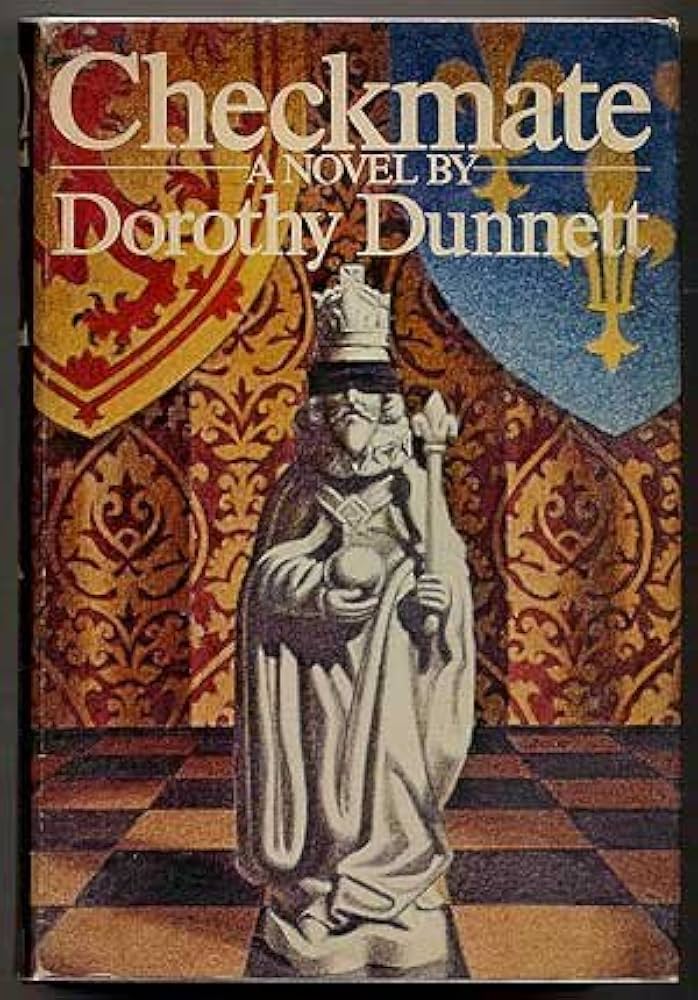
Checkmate (#6 in the Lymond Chronicles)

By Dorothy Dunnett

The current image has no alternative text. The file name is: checkmate.jpg

At the moment, I am tired of journeys. It is time I arrived somewhere.

He wondered why his lordship had claimed to be unable to identify the boy on the bridge. Then he recalled something he had heard rumoured. Once, Lymond had questioned a child and lived to regret it.

“You may give me a brooch. A sapphire one.”
“Ah,” he said. “But will you take care of it?”

It’s been about 3 weeks since I finished this last book in The Lymond Chronicles. And this review has been hanging over my head. Between finishing the book and seriously tackling this review I have had a ball reading other peoples thoughts and insights into the series which I was unable to do while I was reading it because of fear of running into spoilers. More on that later. In short, I have been, off and on, just immersing myself even further in the series.. I have a lot more exploring yet to do down the Lymond/Dorothy Dunnett rabbit hole.

As I look back on this book, Checkmate, I am amazed at how much happened action-wise, the character arcs, and the seamless involvement of our fictional characters with the military actions, politics, and religion of the time. In the course of the series, Dorothy Dunnett has shown herself to be ready, willing, and able to kill off important characters as well as animals. So while I was happy at the return of those whom we kind of left by the wayside during Pawn in Frankincense and/or The Ringed Castle, I feared for them. These included Kate, Philippa’s mother, Jerrott “I don’t understand” Blythe, Marthe, his difficult and troubled wife, and Archie Abernathy, the rock. Of course Lymond’s mother, Sybilla, so beloved and admired by me in previous books was certainly under threat of ye old chopping block given her advanced age (at least for those times) alone. And what of his estranged brother Richard? It would be just like DD to kill him off before he and Lymond could be reconciled. Though frankly, Richard was such a dumbass throughout most of this one, I can’t say I cared much about his ultimate fate.

What we went through in this book, along with Lymond and Philippa, our daring duo! We begin the book, right where The Ringed Castle left off, picking up with Lymond shortly after he has landed back in France after being kidnapped by Philippa and his friends, for his own good. They successfully conspired to prevent him from returning to what he saw as his mission in Russia where he would face certain death. Which was OK with him, but not with anyone else. I know I sure didn’t want him to go back there. Although at the end of TRC, he loves Philippa “in every way known to man” he is determined to divorce her for her own protection and because of his own self-loathing. Philippa is as yet unaware of the nature of her attachment to “Mr. Crawford.” He enters into an agreement to serve embattled France in his capacity as a military leader without peer. In return, the powers that be will see that the divorce is granted. Along with placing Lymond in the middle of real historical military battles and political machinations, we experience all manner of…stuff. High spirited swashbuckling adventure, a love story for the ages (which for me, had its earliest beginnings in The Disorderly Knights), deep dark mystery, family drama, mental and physical anguish of all sorts, sacrifice, evil, goodness, triumph and…well, just name it. And that’s just Philippa. Kidding. But Philippa and Lymond are equal or almost equal partners in all that transpires in this book.

Before I bought the books many moons ago, I vetted the series enough to know it ended in a rewarding and satisfying way. But as the books went on, I didn’t see how the ending could possibly be completely happy due to Lymond’s physical and mental health challenges. But Dorothy accomplished it. At least I chose to buy it. As much as I loved the book, it wasn’t perfect. I struggled with getting my head around the motivations, mindsets, and decisions of Philippa, Lymond, and Sybilla. So much harm and suffering for, what I felt, were weak and not very well supported reasons. I asked the DD in my head, at too many points, “Because why now?” “Huh? But.…” Also, I feel like the title of the book is a little misleading and I felt a bit cheated by part of the conclusion. Because the book is called “Checkmate” I expected a battle of the titans between Lymond and his nemesis throughout most of the series, Margaret Lennox. With, of course, Lymond outmaneuvering, tricking, and finally conquering the wily Margaret in an exciting showdown for the ages. Of course it would exceed in guile and excitement the climaxes we were treated to in 4 of the 5 preceding volumes. The word “Checkmate” comes with certain expectations. The confrontation between the two had its rewards, but in the end that part was anticlimactic. But, thanks to the gorgeous and fulfilling conclusion to Francis’ and Philippa’s love story, It is a fairly minor quibble. In the end there is peace and joy at long last, and that is enough. But still so many questions! I learned from reading this series that sometimes that’s not a bad thing.

So many lovers of this series have read it many times. They comment how much they missed the first time. I had a different experience, thanks to helpful websites and Youtube chapter by chapter discussions posted years ago which leant valuable insights, and conscientiously avoided spoilers. They added historical political and religious context, explained obscure literary allusions, translated foreign language passages, and a whole lot more. Many personal opinions and speculations over countless plot and character points were offered and explored. Not to mention, “What did Dorothy Dunnett really mean by that?” Some hearty souls read this massive work while it was still being written and had to wait years between books. I can’t pretend to imagine what that experience was like. Many forged ahead while up in the air as to whether all would end tragically with Lymond’s death (or worse!). Given his death wish, it seemed more than likely. I had the advantage of knowing the end would be a happy one, though I took great care to avoid any other spoilers. But a funny thing happened. I went through Checkmate and part of The Ringed Castle, under a misapprehension. In looking up an innocuous factoid, I ran across what I thought was a huge spoiler. I caught a glimpse of the answer to one of the big running mysteries we had been teased with throughout the series: Lymond’s true parentage. But since I shut down what I was reading immediately, I got it wrong. It would have been quite juicy, had it been true, so I was a little disappointed when I finally realized that all of the clues that pointed in another direction were not, as I thought, red herrings. Also I read that one very important character died, and he/she didn’t. Where that came from I’ll probably never know. But I was sure happy about it.

So there you have it: A small part of my experience with this scholarly, flamboyant, and, yes, sometimes preposterous series which is influencing writers to this day. But I am certainly not done with Dunnett. I now have the audio books in my library and another series to look forward to: Niccolo Rising. Which from what I gather should be almost as profound a reading experience as was The Lymond Chronicles. We’ll see.
Rating: 5 out of 5.

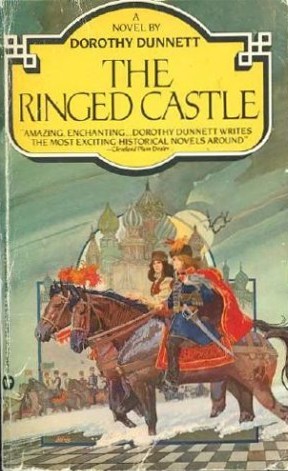
The Ringed Castle (#5 in The Lymond Chronicles)

By Dorothy Dunnett

The current image has no alternative text. The file name is: ringed.jpg

‘I lost three ships,’ Chancellor said. ‘And eighty- five souls.’ ‘I stopped counting,’ Lymond said, ‘after I had seen the first hundred or so of my soldiers dispatched to their earthly rest through me. You lead, therefore you kill.’

‘Your son will be John Dee’s next pupil. You cannot face marriage again?’ Richard Chancellor drew in a short breath, and let it carefully out, without stirring the candle. He said, ‘I have only met one girl to match Eleanor. And you are married to her.’
Lymond slid his hands off the table. On his shadowless face rested, openly, an astonishment so unexpected, so vivid that Chancellor himself was taken aback and said quickly, almost in anger, ‘I’m sorry. But she is a remarkable girl.’ ‘She is a remarkable girl,’ Lymond repeated. He looked startled still. ‘She must be Christopher’s age.’

I was trying to explain to a non-fiction reading loved one the other day why reading fiction was an enriching and important part of my life. Particularly when you find something so involved and complex and written so brilliantly and beautifully as the Lymond Chronicles. I tried to explain how it was like entering another world which doesn’t really fully go away even when you are not reading the words but going about your day to day business. Even when you are not actively contemplating the book, you go through your day knowing there is an alternate reality waiting for you when you choose to go back to it. You live safely through fear, tragedy, and grief. But also through triumph, wonder, joy, and love. People who don’t read stories don’t know about this, I guess. Not every reading experience does this for me. I’ve enjoyed and even loved other books without having this feeling of it being part of my life. For me, It’s mostly been series or at least connected books where there is world building involved. Like Harry Potter. And a sadly somewhat forgotten writer of historical and swashbuckling adventure and romance named Patricia Veryan.

The Ringed Castle, I was thrilled to discover, begins not with Lymond on the way to Russia from The Levant, as the previous book ended, but with Philippa coming home to her mother, Kate.

Not to every young girl is it given to enter the harem of the Sultan of Turkey and return to her homeland a virgin….The most prosaic schoolgirl in England, Philippa Somerville arrived home from Stamboul in the summer….

Kate, nor Lady Culter, cannot reconcile the “The Queen of Sheba”-like stylish young woman with the formerly bedraggled Philippa,

“the undersized fifteen- year- old who had left her uncle’s home in London two winters ago, to plant herself willy nilly in the unsuitable company of Lady Culter’s younger son Francis… Francis Crawford of Lymond, the hard- living leader of mercenaries whose by- blow Kuzúm had been snatched and used in a game by his enemies.”

But it’s her all right. Not being sure what her reception would be, her face is “green with fright.” But after an exchange of quips with her Mom, she slides giggling into Kate’s waiting arms.

From there, Lady Dunnett alternates between Lymond’s adventures accumulating power while navigating the insanities of Russia and the terrifying court of Ivan the Terrible, and Philippa’s continuing maturation in the home of real historical figure Henry Sidney and his family and friends. Lymond is the hated and feared Voevoda Borshoia, The Supreme Commander of the Tsar’s army, and Philippa is a very popular lady-in-waiting in the court of another troubled ruler, Mary I.

As a highly qualified Turkish-trained concubine from the harem of Suleiman the Magnificent, Philippa Somerville settled into English court life as a kite among chickens, and as a kite among kites into the Spanish court of the new King-consort Philip.

She has lots of suitors, except she’s married and her divorce from the Voevoda of all Russia is being held up. As much as I hated sporadically leaving Philippa and the English Court (which includes Mary’s dearest confidant and Lymond’s worst enemy, now that Gabriel is dead, Margaret Lennox. Also an important historical figure), I was always quickly immersed in Lymond’s exploits in Russia. Dorothy Dunnett knows how to keep things interesting no matter what. The husband and wife (in name only) are re-united around a year later when Lymond is forced, through political machinations of his enemies, to leave Russia to accompany the English Muscovy Company back to England to promote trade between the two countries.

Now I, your Tsar, beg it of you. Sail to London, the home of this strange, married Queen, and speak to her in her own tongue, but with the heart of a Russian. Bring me what I want.’ There was no escape. No loophole; no answer, no argument; no excuse. ‘Then of course, Lord, I shall go,’ Lymond said.

With him goes Richard Chancellor another real historical figure much admired by DD. who has become Lymond’s true friend and match in intellect and spirit.

“The Ringed Castle” refers to Moscow and the Kremlin, but it is also a metaphor for Lymond. Since the horrific occurrences in Istanbul he has coped by shutting down all emotion and putting up a virtually impenetrable wall between himself, his comrades and his family. “He can make you want to knock him down, if he feels like it, by simply saying “good morning”. Those who still care for him fear for his humanity: He has become a machine. The alert reader sees that is not entirely true. Further isolating Francis is the knowledge that his parentage is not what he thought it was, and a prophecy that he thinks will doom his brother if he returns home. He wants nothing to do with his formerly beloved and formidable, now heartbroken and fragile, mother. And, as usual, someone is trying to kill him. It is in England, thanks largely to Philippa, that chinks start to appear in his armor. But he is determined to return to Russia where certain death surely awaits.

As always some of the plot elements border on the preposterous, despite the erudition of the writing. And Lymond is surely one of the most maddening heroes in popular fiction. If you don’t like flawed (really flawed), you might want to give this series a pass. But if you gird your loins and proceed, there is always Philippa, who starts to become a major player after the second book. And Archie. And Sybilla. And Richard. And Kate. And Adam. And Danny. Not to mention a growing number of late lamenteds, and not so lamented.
And despite the often grim happenings (don’t get attached to any domesticated animals), there is humor. One of my favorite “running jokes” is Philippa’s and Lymond’s perception of each others ages. Lymond still thinks of her as a schoolgirl, and Philippa believes (and she is not alone) that Lymond is her mother’s age. They are only 10 years apart, and usually only the reader seems to realize it. Also banter, sophisticated wit, and comedy.

On to the last book in the series, Checkmate. I expect to be awestruck, amused, frustrated and saddened, but from what I gather, not disappointed.

Rating: 5 out of 5.

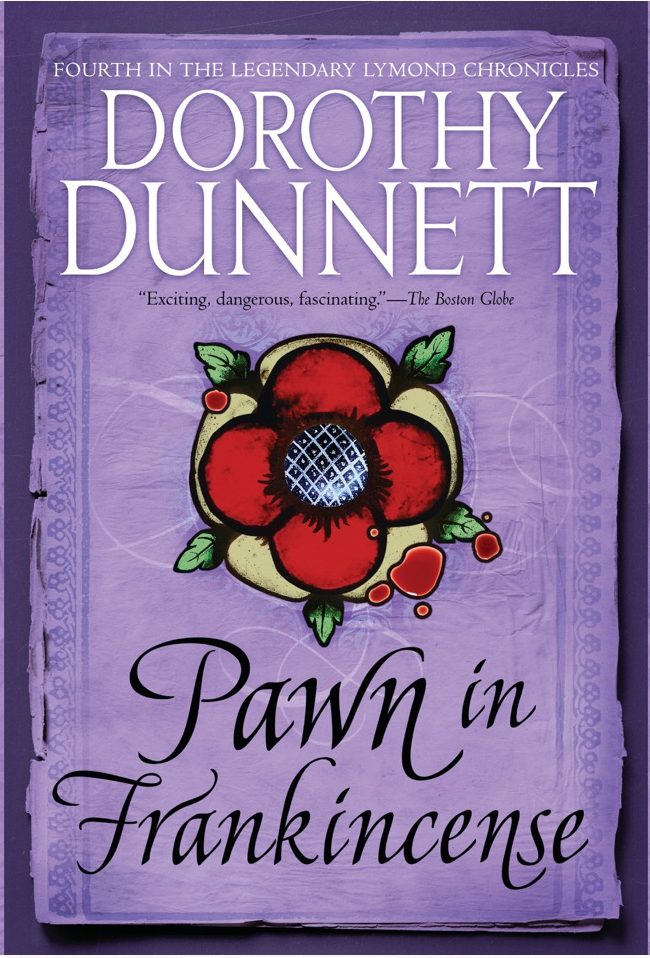
Pawn in Frankincense (#4 in the Lymond Chronicles)

The current image has no alternative text. The file name is: pawn-e1758880080116.jpg

By Dorothy Dunnett

Evil matters. So does love. So does pity. My pilgrim,’ said the Dame de Doubtance gently, ‘you have still three bitter lessons to learn.’

The penultimate scene of The Disorderly Knights foreshadows the age-old ethical dilemma that one is devastatingly confronted with in this, Pawn in Frankincense: When does the greater good outweigh the good of the individual? When it is a matter of life or death, how does one choose the sacrifice, and how will one live with the consequences of the decision?
Francis Crawford of Lymond’s hand is stayed by the redoubtable Philippa Somerville just as he is about to execute the malevolent and malignant Graham Reid Malett a.k.a. Gabriel. In the devastating scene Malett has shockingly revealed that Francis has a baby son who is under his power and if he dies, his son dies. Nevertheless, Francis, knowing the depth of threat Malett represents to the world is determined to carry through killing him after besting him in mortal combat. He is willing to sacrifice one child (Is GRM even telling the truth?) to save thousands.

And a child’s voice, echoing his in turn said, “No!”… No, Mr. Crawford!” cried Philippa forbiddingly, and ducking under the snatching arms that tried to prevent her, she ran forward…..sinking on her knees she shook, in her vehemence, Lymond’s bloodstained arm…There is a baby. You can’t abandon your son!” …Philippa Somerville, who believed in action when words were not enough, had leaned over and snatched the knife from Lymond’s left hand.

It is enough. Gabriel escapes back to the Ottoman Empire as, thanks to Lymond, he is persona non grata anywhere in Europe. There, in this book, he will betray his brothers, the Knights of St. John, and abandon all pretense of Christianity. He will successfully consolidate the power he craves under Suleiman the Magnificent while planning the entrapment and downfall of Lymond using his son as a pawn in the game.

The final scene in the preceding book has Lymond in front of a church altar vowing to find and save his lost son while somehow destroying Gabriel. Pawn in Frankincense is his quest.

We start out in Baden, in the Swiss Confederation, where Philippa, accompanied by Lymond’s sidekick, the usually very confused Jerott Blythe, has snuck away from her mother Kate and tracked Lymond down. She has come, she says, to look after the baby once he is found. One may ask, how could Lymond agree to take a 15 year old schoolgirl, the daughter his one of his closest friends, on such a treacherous journey?

As I have said before, and am now saying for the last time, I cannot tell you with what awe my family and friends, not to mention yours, would receive the idea that I should ship a twelve- year- old girl along the Barbary coast——’

Not surprisingly (if one has gotten to know her) Philippa prevails. And thank God for it. She provides the only safe haven and flashes of light in a book full of tension, fear and horror. Somehow, we know that she will always be all right. She is a master of “the feat of keeping her head, her reason and her sense of the ridiculous amid conditions of civilized lunacy.” Not that she doesn’t have a difficult journey. At one point, Lymond decides he must place killing Gabriel over finding his son and sends Philippa back home. He thinks. Philippa decides to continue the hunt virtually on her own and ends up entering the Sultan’s harem to protect the young toddler (because of course she finds him) from the cruel tentacles of Gabriel. As she writes to her mother, Lymond’s good friend,

Dear Kate. As you will see from the address, I am staying as a concubine in the harem of Sultan Suleiman the Magnificent, son of Sultan Setim Khan, son of Sultan Bayezid Khan, King of Kings, Sovereign of Sovereigns; Commander of All that can be Commanded, Sultan of Babylon, Lord of the White Sea and the Black Sea, most high Emperor of Byzantium and Trebizond, most mighty King of Persia and Arabia, Syria and Egypt, Supreme Lord of Europe and Asia, Prince of Mecca and Aleppo, Possessor of Jerusalem and Lord of the Universal Sea….There are two hundred and ninety- nine other girls here: but no one else from Northumberland. Tell Betty I have the dearest little black page.

We meet and continue our acquaintance with many intriguing characters, some fictional, some not. Some lovable, some not. They include Marthe, a young woman who could be Lymond’s twin. Sybilla’s child? But that’s impossible. Isn’t it? We learn there are two supposedly indistinguishable babies in peril, the other one being Gabriel’s own son from an unspeakable union. At times it seems we are in a retelling of the Odyssey, at others, Raiders of the Lost Ark, Ladyhawke, or an Errol Flynn pirate movie situation. Even once, a very strange romantic comedy fake marriage, one bed trope. At one point, horribly, Sophie’s Choice came to mind.

Dunnett’s books are very cinematic thanks to the lush realism of her descriptions. She is merciless with what she puts Lymond and those he cares for through and they will not emerge triumphant unscathed. In one of the last chapters, I was physically trembling as I read. I love Dorothy Dunnett, but thanks to this at times painful book, I kind of hate her too.

Rating: 5 out of 5.

The Disorderly Knights (#3 of The Lymond Chronicles)

By Dorothy Dunnett

The current image has no alternative text. The file name is: disorderly.jpg

A hunter went killing sparrows one cold day, and his eyes gave forth tears as he went. Said one bird to another, “Behold, this man weeps.” Said the other, “Turn thine eyes from his tears. Watch his hands.”

–Dragut Rais–

I am currently not quite a third of the way through the 4th book in the series as I write this review of its predecessor, The Disorderly Knights. Instead of continuing to struggle to do justice to it, I am just going to keep it short. There is a lot of this review left on the cutting room floor. First of all, what they say is true. For a first time reader, Dunnett’s writing does get easier and easier to understand though no less complex in plot and character. There were less sentences that I had to try to decode and wring the meaning out of. Everything flows so much better: Less like she’s looking to punish readers with her scholarship and more like she herself is caught up in the story and having a wonderful time just telling it. Even though divided into 3 parts, it is really a tale of two countries: first Malta and then Scotland. It’s also a study of two extraordinary men engaged in a high stakes struggle of wills and cunning. And I guess to a lesser extent, for me, it was a comparison of the disparate nature of two teenage girls. And it is also a tale of two armies. And two religions.
There is tragedy and yes, there is comedy. Spanning two continents, Lymond goes through many tribulations in trying to expose and take down a powerful villain as evil as evil can be. A villain whom the world, even the good and the wise, believe to be a saint. Meanwhile, not even a handful, his family included, have total faith and trust in Francis Crawford. Not that he always deserves it. There are shocks in this book. And Terror and Horror. And then there is Philippa Somerville, who is quickly becoming my favorite fictional female character of all time. And Nicolas de Nicolay one of my favorite real historical figures that figure in this book.

Some things that happen still don’t bear a lot of scrutiny as to what one man can accomplish or bear. She really puts Lymond through the wringer. Some scenarios beggar belief and draw one up short, and some you just have to go with, revel in, and just keep reading. One such of the latter is a flashback to an event that takes place after The Game of Kings, and before the second book, Queen’s Play, begins. It could have just been a fun, cheer worthy example of Lymond’s military acumen, however implausible, meant to show Lymond’s trickiness and out of the box thinking. But I feel like it’s fair game to scrutinize because Dunnett makes it so important. Briefly, it relates how Lymond routs a small army of attacking English soldiers by fooling them into thinking, in the fog and distance, that Lymond’s small number of 20 Clansmen actually number a force approaching 1000 troops. He does this by slapping shining metal helmets on 800 sheep and driving them forward into the valley where the soldiers are set to advance. It is brought up in the series time and again (even in the 4th book I am currently reading) as an example of why Lymond’s services as a military leader are so much in demand. Unfortunately for my peace of mind, I got all caught up in where he got the 800 helmets. Were they friendly helmets or enemy helmets? Where were the helmetless soldiers? Did he store them up one by one in preparation for a scenario just like this, or did he steal them in one fell swoop and where did he store them? I’m sure Dunnett knows the answers, but didn’t choose to share. It wouldn’t have bothered me so much but it is a favorite set piece in the series. People have gotten tattoos of sheep and helmets and coffee mugs are available on line for £16.50.

Anyway, it’s all part of the experience, I guess. Dunnett is so brilliant one fears to question, but it’s part of the fun. These books are absolutely spellbinding. This one ends on a cliffhanger. I fear for the fates of many characters. I was so glad I could get right to the next one and didn’t have to wait. How did her readers bear it back in the day?

Rating: 4.5 out of 5.

The King’s Messenger

by Susanna Kearsley

The current image has no alternative text. The file name is: kings.jpg

“Happy endings are of little comfort,” Logan told me, very sure, “to characters who die afore the tale is done.”

I wasn’t crazy about this one. It was very romance-forward for a Susanna Kearsley novel which I was happy about at first. But it seemed much lighter than the other books by her I’ve read. To be fair, that perception might be influenced by the book I read right before this one. She picked a good bit of history to provide the foundation for her novel, but ultimately the history part, which was confined and personal as opposed to overarching and epic, was depressing to think about. Since many of the characters were based on real historical figures, it limited her on what she could do with them. The fiction part was a bit plodding and I was not emotionally engaged in the predictable romance. That’s true of most of her books, but usually there’s enough “other stuff” to make up for it. Kearsley almost always includes a supernatural element which has always been well integrated into the story. In fact, it has been the key factor and those books as written would not exist without it. There was a supernatural element in this one but it could have been left out and would have changed nothing to plot or character. In this one, one of our main characters has second sight and gets random brief visions of the future, which are mostly always deceiving. Also he sees dead people. Neither of these “gifts” have any major influence on anything that happens. They’re just kind of tacked on seemingly to make Andrew more interesting, or just because it’s Susanna Kearsley’s “thing” to have a paranormal element to her novels.

It is set in 1613 shortly after the sudden and suspicious death of Henry, King James I of England’s promising teenage son and heir to the throne. Rumors are starting to spread that he was poisoned and suspicion is starting to fall on King James, his own father. King James was a nasty piece of work and was jealous of his talented, intelligent, and principled son. In order to quell the rumors, he sends for David Moray a.k.a. Murray (real person), Henry’s trusted courtier and companion with the intention of pinning Henry’s murder on him. Andrew Logan, our hero, is the King’s Messenger sent to Scotland to arrest and bring David Moray to London for the inquiry and trial. Because there will be a trial: David Moray is being framed by the King himself. With him on the journey goes a Scrivener who is assigned to write down everything that David says and does with hopes of gathering actual evidence against him, and his daughter Phoebe who insists on coming with to watch over her father who is in poor health. Phoebe and Andrew’s families have been neighbors for a long time, but due to a misunderstanding and some lies told to her, Phoebe has always disliked Andrew. On the journey to London, there are some not very thrilling adventures, and we get to know the characters in depth. As Andrew proves his worth time and again, Phoebe’s dislike turns to love. David Moray is a wise and good man, and still suffering the lingering pain of Henry’s death whom he loved like a son. Of course we care what happens to him but the fact that Wikipedia (and other sources-Ha ha-not really) tells us that David Moray was never brought to trial and lived a long and productive life for years after the events in this book kinda put a kibosh on any suspense regarding his fate. However, “the how” was neatly and cleverly done. Can Andrew remain loyal and dutiful to King James but not be a party to turning over an innocent man to certain death?

There are some interesting little nuggets in this book. For one, We meet and learn about real person Esther Inglis, who, despite her gender, was a well respected calligrapher of the day. Susanna Kearsley does her research, so I found all of the real historical details regarding the royal personages, King’s Messengers, scriveners, etc. pretty fascinating. Speaking of research, Kearsley is a firm believer in the theory that Prince Henry was poisoned, and poisoned at the instigation of his father the King. This flies in the face of most historians’ long held view that he died of Typhus. She makes a strong case, and I believe her. But it is so depressing to think what a great English King Henry would have made as opposed to his brother Charles I whose beliefs sparked the English Civil War and led to his execution. It was very neat how Kearsley used an incident that really happened to fashion Queen Anna’s revenge on her husband for her son’s death. Spoiler Alert! My second book in a row that a dog dies. I hope this is not a trend.

Rating: 3 out of 5.

Queen’s Play (# 2 ofThe Lymond Chronicles)

By Dorothy Dunnett

The current image has no alternative text. The file name is: queensplay.webp

Lymond’s behaviour, as always, went to the limits of polite usage and then hurtled off into space.

**Spoilers**

It is 2 years after the events of the Game of Kings, the 1st of the Lymond Chronicles. Francis Crawford of Lymond has returned to the bosom of his family. His reputation throughout Europe has not only been restored but his talents are held in such high esteem that he is called upon by Mary of Guise, the Dowager Queen of Scotland to come to France with her to protect her daughter, the 7 year old “High and Mighty” Mary, Queen of Scots from rumored danger of assassination.

Notoriously, at some time, every faction in the kingdom had tried to buy Lymond’s services. Nor was the bidding restricted to Scotland, or to statesmen, or to men. Europe, whenever he wished, could provide him— and probably did— with either a workshop or a playground.

He agrees to do so, but on his own terms, making clear that his loyalty is not to the powerful and ambitious Queen Mother, but to Scotland. He will not be her beholden acolyte and in turn, she will not, can not, intercede if he gets into trouble. And thus we are off to the decadent and dissolute French Court of Henry II of France, which Lymond will infiltrate in order to stay close to the threatened little Queen and to discover who is behind the assassination attempts. For indeed, we learn the child’s life is in grave danger. As his disguise he creates a character so eccentric and unlikely that no one will suspect his true identity but will allow him to use the talents and skills that Francis Crawford of Lymond is well known to have mastered. As the fat, perpetually drunk, and slovenly attendant to an unimportant-by-choice Irish Chieftain, he seduces the court:

Each in its nest of gauze and gilt thread, of tissue and taffeta, swathed in silver and satin, in velvet and white fur sugared with diamonds, each face painted, each brow plucked, hair hidden by sparkling hair of raw silk, the well- born of France sat in waxlight and flowers like half a hundred candied sweets in a basket. Last at the last table, soggy gristle next the sugar plums, sat Thady Boy Ballagh.

At levée and reception, at ball and after sport, during meals and after supper parties, Thady was expected as a matter of course. His playing had become as fashionable as a drug. He made music in public and in private for them all: …and already they thought nothing and less than nothing of how he looked. Then, that goal reached, he hardened his long fingers in their entrails of icing and sugar and started to twist.

The plot is complex as are the many characters who people this book. As in G of K, Dunnett expertly fills in the blanks of history with her fictional story ostensibly going on behind the scenes. For example, The main villain was a real person with significant connections to powerful people, but little is known about his actual life or what he may or may not have been up to. Those about whom much is known stay authentic to what history knows about their characters and actions. How Dunnett weaves her fiction around what is factual is nothing less than amazing. Rather than go through the plot and try to touch on all the fascinating characters, both real and imagined, I’ll just mention two characters that stood out for me.

The first is the “wholly spoiled, wholly self-centred, ruthless, neurotic, worldly- wise” character of the French Court itself. It was fascinating and unpredictable. In one of the attempts on Queen Mary’s life, her beloved pet rabbit, Susannah, is stolen and let loose amongst the other prey to be sport to the hunting Cheetahs. As predicted, the little girl escapes her minders and rushes to rescue her pet. In the resulting maelstrom of confusion, panic, and violence, A brave and noble Irish wolfhound, (as well as poor little Susannah) meet heartbreaking ends. The French court, once the little queen is off stage and safe, cheers the Cheetah. They care for nothing but the thrills and excitement provided by bloodlust.
Yet, taken individually, many are funny and insightful. Thankfully, because no group of people can perpetually be that dissolute and depraved (can they?), they prove to be capable of change, much to my surprise. Later in the story, a race down from a tower results in the death of many horses and men. Thady boy is framed and blamed for the tragedy and he escapes from the court he once dominated with his talents, wit, and pursuit of pleasure.

“What had been vulgarly clever, in the light of bare exhumation looked bleakly coarse; what had been vivid looked vulgar; what had been witty looked common; what had been forthright looked outrageous.
A sense of acute spiritual discomfort hung over the flower of France, the aftermath of its brilliant flare of indulgence. If Thady Boy had come back— a Thady Boy even absolved from the treachery imputed to him— they would have had him beaten from the room by their valets.”

The other character that I became fascinated with was Phelim O’LiamRoe, who, as Thady Boy’s supposed master, provides him with his cover. At first he was kind of a silly non-entity. Intelligent, humorous, cheerful, but having no ambition or purpose to his life at all. He was kind of a bore.

In terms of followers, O’LiamRoe was one of the mightiest chieftains in English-occupied Ireland, except that it had never yet occurred to him to lead them anywhere.

But he starts to change at the death of his noble Luadhus, his dog who threw himself between the deadly cheetah and the little queen. He starts to think and question his life. Meanwhile, he falls deeper in love with a beautiful and fiery Irish revolutionary who holds him in contempt until he proves his mettle with an act of bravery. He convinces her to give him the name of the man who can prove the guilt of the powerful mastermind of the assassination attempts. He will save Mary and also save Lymond from execution.
But first they must part.

Her hands lay cold in his. Searching her empty face he said, ‘We shall meet?’ ‘At the fall of night, on the far side of the north wind,’ she said.’ ‘Love me.’ ‘All my days,’ said Phelim O’LiamRoe, Prince of Barrow, dropping into the tongue of his land. ‘Dear stranger, dear mate of my soul: all my days.’ And walking quiet and blind, he let slip her two hands and left.

To the rescue!:

Dark in the misty June morning, Châteaubriant was still. Dim through the painted shutters, the hoof beats of a single horse burst, applauding the cobbles, and were gone.

Before the book ends O’LiamRoe will not only be instrumental in saving Francis from death, but in setting his life on a different more mature and thoughtful path. Thanks partially to him, Francis will become the great leader of men he was destined to be.

Dorothy Dunnett is a wonderful writer. Her prose is beautiful, evocative, and clever. But still, I had my problems with some of the details of the book as much as I admired and enjoyed it.

It seemed pretty impossible that Lymond’s disguise as Thady Boy held up so long and with so many. Keeping his blond roots covered under black dye, his pale skin constantly having to be stained, his slender nimble body disguised under thick padding, all the while bedding God knows how many men and women in the French Court? With a fake stomach? And what about Lymond’s slender delicate fingers which are referred to regularly? That doesn’t track with Thady’s fat pudgy body.

The recuperative powers of two of the characters who were on death’s door one minute and engaging in physical heroics the next reminded me of a Roadrunner cartoon.

Too much knowledge is withheld from the reader and too much important action happens off stage. I found this to be true of Game of Kings as well. When did Lymond figure out who the master villain was and how? Once it is finally revealed to the reader, he claims he already knew who it was. Then why was it so important to send O’LiamRoe to the Tower of London to get his name from his hitman, Robin Stewart? Lymond was released from prison just in time to save the queen. It seemed very easily done without much justification. Some obscure sculptor knew a guy who knew a guy who said so? The bad guy might be guilty, so Lymond must be freed-and immediately? How did they get let in to see the Constable again with Robin Stewart’s undelivered letter? One minute we leave him locked up, and the next he’s free and racing to save the little Queen from being blown to kingdom come with her retinue.

Some things do not bear too much looking into and no doubt a careful reread would set me straight. . But sometimes, even in great books, you just have to roll with it, and revel in the brilliance, not the WTFuckery. Everyone says Dunnett historical research and authenticity is unimpeachable. Sometimes I found some of the fiction parts a little far-fetched. But maybe that’s OK. As Lymond says in Game of Kings,

“Versatility is one of the few human traits which are universally intolerable. You may be good at Greek and good at painting and be popular. You may be good at Greek and good at sport, and be wildly popular. But try all three and you’re a mountebank. Nothing arouses suspicion quicker than genuine, all-round proficiency.”

Rating: 4.5 out of 5.

The Game of Kings (#1 of The Lymond Chronicles)

By Dorothy Dunnett

The current image has no alternative text. The file name is: dunnett1.jpg

To the men exposed to his rule Lymond never appeared ill: he was never tired; he was never worried, or pained, or disappointed, or passionately angry. If he rested, he did so alone; if he slept, he took good care to sleep apart. “—I sometimes doubt if he’s human,” said Will, speaking his thought aloud. “It’s probably all done with wheels.

This series first came to my attention probably over 30 years ago. I bought the beautiful Vintage Paperback editions around 25 years ago when a local book seller was having a sale. And there they sat. Looking very pretty and impressive, giving my library a certain intellectual credibility. The series would tap me on the shoulder every so often, but I never seriously considered starting them until recently. I read a recent review from one of my Goodreads friends https://www.goodreads.com/review/show… and I thought “people are still reading these?” Then I read some more reviews, and then I read a few scholarly type blog posts and essays. I started to get excited, but very very intimidated at the prospect of reading the first one, The Game of Kings. But then I thought, “Becky if you’re going to read these before you lose your faculties, you better get a move on. You can do hard things!” So I did.

And it was daunting. It is a deep dive into 16th century history, arts, culture, warfare, and politics that our formidable author assumes you are already familiar with. She also assumes you are fluent in multiple languages. There are no translations or footnotes-those are in a whole separate 400 page book. And a lot of the actual English isn’t that comprehensible either. Here’s an example:

“Johnnie Bullo! Man, I wish you’d take to wearing clappers on your breeches; you’re desperate sore on the arteries. And that last damned powder you gave me would have done Jimmie of Fynnart a twelve- month and pointed up the whole of Linlithgow if you laid it on with a trowel. Will ye bring to mind it’s my inner workings you’re repairing, not the Toll Brig o’ Dumfries.”

The book is peopled with real historical figures both obscure and famous. And Lymond of Crawford, our main character, mostly talks in poetry, double entendres, quotations from sources no modern reader has any business even hearing of, let alone being passing familiar with.
“ I wish to God,” said Gideon with mild exasperation, “that you’d talk–just once– in prose like other people.”
If Gideon Somerville was not a favorite character before, he certainly was one after that comment to our hero. I almost gave up several times. But I did some more research, trying to take good care to avoid spoilers (though didn’t always succeed), and found out that virtually everyone felt the same way I did at the beginning. But to a man and woman, I was assured that it would get easier and I would be rewarded.
I quote from a blog entry called “The Game of Kings in 15 minutes”. https://archiveofourown.org/chapters/… Highly recommend if you’ve already read the novel

RANDOM SCOTTISH PEOPLE: Lymond is back.
READERS: And we’ll have to wait hundreds of pages to find out why.
LYMOND: *is incomprehensible*
PIG: *is drunk*
READERS WHO ARE NEW TO THE SERIES: wtf?
READERS WHO HAVE READ THE WHOLE SERIES: You’ll learn.

Two things in particular helped me. One, someone wrote that The Game of Kings could be read as a stand alone (I have commitment issues with series books and tv shows) and I discovered a wonderful website improbably named “Now You Have Dunnett” https://nowyouhavedunnett.blogspot.co… for which I am eternally grateful. It took me through each chapter and scene almost paragraph by paragraph, translating the more important foreign language quotes, explaining the context when it was important, giving historical background, and pointing out little things that I might have missed that would become important later on. I would read a chapter, sometimes two and then go back to the website on those chapters to check for understanding. Eventually, I could go for longer and longer periods with confidence before having to check back to make sure I understood what was going on. At about the 25% mark, I not only started to comprehend without help (forgetting the foreign language quotes and esoterica which I just skipped over) but started to see the appeal and actually enjoy what I was reading. I started to get The Scarlet Pimpernel, The Count of Monte Cristo, and unabridged Les Miserables vibes. The first two being youthful favorites re-read many times, and the last reminding me of the feeling of pride and accomplishment as I waded through it without skipping.

So what about the actual book, you may ask? Enough already about your personal relationship with it! Well, as I said, the first sentence of the book is “Lymond is Back”. Back Where? From Where? The setting is Scotland in 1547, a time of war with England and great unrest politically, religiously, and every other way. King Henry the VIII has just died and the English powers that be want his young son Edward, (A.K.A. The Prince of The Prince and The Pauper) to be betrothed to Mary, the 5-year-old Scottish Queen. Loyal Scots do not want that.

We first meet our hero robbing and pillaging a friend of the family’s castle, to insure ultimate chaos, introducing the victim’s pet pig to the joys of adult beverages. Then he moves to his own family’s castle where, drunk, he breaks in with his gang of mercenaries, flirts with his new sister-in-law, robs his mother’s guests, threatens their lives, exchanges barbs with the mother he hasn’t seen for over 5 years, and stabs her best friend. He finishes off his busy day by locking them inside the castle and setting it on fire. Lymond is indeed living down to his reputation as obnoxious, amoral, ruthless, and other synonyms too numerous to list including brilliant and funny. He is a notorious proven traitor to Scotland and an outlaw also wanted for a crime so horrible and shocking that I won’t say what it is. And if possible, the English hate him almost as much as the Scots. But all is not what it seems. No, indeed. Because Lymond is back to *spoiler alert* prove his innocence, restore his reputation as a loyal Scotsman, serve his country, and protect his family. Not an auspicious start, Lymond.

And that is the most detailed I am going to get about the plot. Because if I went on, it would take me a long long time and I wouldn’t know where to stop. There are whole books written about this novel alone, only the first book in the series, as well as on the whole series. But we have many adventures and meet many people both very very good, very very bad, and very in between. Also very clever, wise, and cunning, and very and very obnoxiously thick-headed (I’m looking at you, Richard.) There is espionage, betrayal, revenge, romance, secrets, alchemy, reconciliation, tragedy, comedy, a duel considered one of the best ever written for the page, and a courtroom trial/very welcome info dump to rule them all.

This was Dorothy Dunnett’s first novel. As she says in the forward, she grew in wisdom as she wrote. And I think she meant that she saw the need to make the subsequent books a little more accessible to the other  99% of the population of potential readers. Either that, or a wise editor firmly took her in hand. From all accounts the best are yet to come, so now that I have conquered, that is, managed to survive, this first in the series…Onward

Rating: 5 out of 5.

Harry Potter and the Chamber of Secrets

By J. K. Rowling

The current image has no alternative text. The file name is: chamber.jpg

“Not kill you, sir, never kill you!” said Dobby, shocked. “Dobby wants to save Harry Potter’s life! Better sent home, grievously injured, than remain here, sir! Dobby only wanted Harry Potter hurt enough to be sent home!”

**Original thoughts, 2018, on the American Audible version**

Going through all of the HPs, listening on Audible. I have listened to the Stephen Fry Philosopher’s Stone, but all the rest I have are the Jim Dale versions. I much prefer the Stephen Fry, as Jim Dale has some odd intonations and I don’t like his pronunciation of Voldemort and other words. Sometimes Dale sounds really whiny and wheedling, especially with the children’s voices.

**re-read on kindle 06/2025**

Even though this remains a Harry Potter that is not a favorite of mine, it cannot be skipped. It is the introduction of Dobby, Lucious Malfoy, Tom Riddle, Ginny Weasley, Arthur Weasley, the first Horcrux, The Burrow, Polyjuice Potion, the Sword of Gryffindor, Borgin and Burkes, Aragog, Moaning Myrtle, and Fawkes. And probably some others I don’t remember. It gives so much context to many momentous events to come. So many aspects which have far reaching influence on our key players’ final outcomes and fates start here. Nevertheless, it still comes across as a children’s’ book (which it is, of course) but, for me, minus much of the wonder, and, though there were some funny lines, humor, of its predecessor. I almost think the movie surpassed the book in many areas particularly in its portrayal of Dobby. It brilliantly captured the amazing, almost impossible, mix of annoying and adorable, funny and tragic, victim and victor.

And a few things took me out of the book. I couldn’t get over why Harry was shunned and suspected of being the Heir of Slytherin when Draco Malfoy should have been the obvious suspect of everyone from the start.

Then someone shouted through the quiet. “Enemies of the Heir, beware! You’ll be next, Mudbloods!” It was Draco Malfoy. He had pushed to the front of the crowd, his cold eyes alive, his usually bloodless face flushed, as he grinned at the sight of the hanging, immobile cat.

But there is no reaction to this outburst! Where is the outrage? It is a harbinger of Harry being celebrated one minute and vilified the next that repeats itself throughout the series.

Also the whole Polyjuice Potion scheme was a very high risk, low reward plan. It could only succeed in possibly satisfying the trio’s suspicion of Draco’s guilt or innocence, but would prove nothing to anyone else and could never accomplish anything.

Hermione’s infatuation with the nincompoop Lockhart seemed very out of character.

Of course Chamber of Secrets is part of Harry Potter so I liked it a lot. I am enjoying noticing things I didn’t notice before. Listening to books on Audible holds many joys, but you miss some detail and subtleties. This is my second time reading Harry Potter in “print” on Kindle and it’s been quite a few years. I am enjoying all of the re-discoveries. One of these worth noting is the part where Harry first hears the name “Riddle”. He thought it sounded vaguely familiar. He knew he had never heard it before but it “still seemed to mean something to him almost as though Riddle was a friend he’d had when he was very small and had half forgotten.” Chilling. It’s a clue and dark foreshadowing as to what is going on with the connection between Harry and Voldemort that will gradually be revealed in the coming books.

Rating: 3 out of 5.

Harry Potter and The Sorcerer’s Stone

By J.K. Rowling

The current image has no alternative text. The file name is: harrypotterss.jpg

Re-read for 4th time (I think). 02/2025

“Doris Crockford, Mr. Potter, can’t believe I’m meeting you at last.” “So proud, Mr. Potter, I’m just so proud.” “Always wanted to shake your hand — I’m all of a flutter.” “Delighted, Mr. Potter, just can’t tell you, Diggle’s the name, Dedalus Diggle.” “I’ve seen you before!” said Harry, as Dedalus Diggle’s top hat fell off in his excitement. “You bowed to me once in a shop.” “He remembers!” cried Dedalus Diggle, looking around at everyone. “Did you hear that? He remembers me!” Harry shook hands again and again — Doris Crockford kept coming back for more.

What can I say that hasn’t already been said about this book? And by far smarter and more insightful people than me.
All I can say is I enjoyed it very much and was very entertained by Rowling’s playful sense of humor. I am amazed at the funny names she gave her characters. The humor is geared for children in this book, but there is much for adults to enjoy as well. She seems like she was having a heck of a good time writing it and sometimes I imagined that she was just cracking herself up. And I appreciated that reading the book instead of listening to it or watching the movies gave me the opportunity to pause and reflect. Knowing the series backwards and forwards, I enjoyed the foreshadowing of things yet to be and happen. Or was it foreshadowing? How far down the road did she plan out the story and details? It is said she spent 5 years planning out the series before she started writing Sorcerer’s Stone. I wonder what she would have changed if she knew then what she knew by the time she wrote the words “All was Well”? She mapped out everything before she even knew this first in the series would be written, or if written, if it would ever find a publisher. Amazing. A truly amazing woman and writer.

The only quibble I have ever had with this book was the way Gryffindor won the House Cup at the end. As a fair-minded Hufflepuff, it really bothers me. If I was a Slytherin, I can’t even imagine my reaction.

Rating: 4 out of 5.

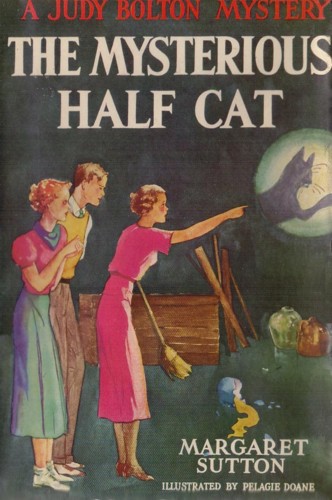
The Mysterious Half Cat (Judy Bolton #9)

By Margaret Sutton

“Holy Christmas!” Horace exclaimed way down in his throat. “What do you call that?” “The Half Cat!” gasped Scottie, one had to her heart. Even Judy found herself clutching Arthur’s coat sleeve in that moment of frozen terror… Let’s get out of here,” Horace whispered hoarsely and began helping Scottie through the window…..“Wait a minute!” Judy detained him “I have an idea.”

I had decidedly mixed feelings about this one. At the beginning of the book, Judy is awakened from a horrible nightmare in which Blackberry, her beloved cat, is hit by a car and cut in half! Peter and Arthur appear and Blackberry, still cut in two, gets up and follows them. The top half follows Arthur and the bottom half follows Peter as they head in opposite directions. Although obviously symbolic of Judy’s feelings being torn between the two young men, this image was very disturbing to me and it is one of the recurring themes in the book. An old beggar approaches the front porch where Judy is telling Honey about her dream and Honey buys the old man’s dream book to interpret it. The old man warns her against dreaming of cats, a coincidence which startles Judy. Peter comes by and shows the girls a mysterious coded note which he found in front of Wing Lee’s Chinese laundry. Judy is intrigued.

When the mail comes, Judy is surprised and pleased to receive a letter from an old playmate, Dora ”Scottie” Scott, who had moved to Alaska before the Roulsville flood. Scottie is coming back home with her little sister Carol. She is all alone in the world now and hopes to stay with the Boltons while she searches for lost relatives. Judy is very excited and of course the Bolton family starts making preparations to welcome Scottie and Carol into their home. Remembering that Scottie was always one for adventure and excitement, Judy thinks that maybe the mysterious note might be a good mystery for them to solve together. Judy goes to talk with Wing Lee about the note and he tells her that “spooks” come to his laundry every Wednesday. This is right up Judy’s alley and she hides out in his basement overnight (on a school night no less!) to investigate. She gets locked in and hears strange sounds and someone talking about splitting a cat in half! What?! How can Judy’s dream be connected to an old beggar, and nefarious doings in Wing Lee’s cellar? I, for one, was baffled. Surely Judy does not have psychic dreams?!

In addition to the mystery of the coded note and the “Half Cat”, Scottie and Carol’s troubles take center stage. When Scottie arrives, she is nothing like the girl Judy remembers. She is unpleasant, ungrateful and unappreciative of Judy’s efforts to make her welcome and involve her in adventure. She is also exhausted because she can not let Carol out of her sight. There is something wrong with Carol’s brain which causes her to go into trances or fly into destructive rages. She also seems to be hearing impaired. Poor Scottie has a lot on her plate, but sometimes the interested, curious, and fun-loving Scottie peeks through. Judy powers through Scottie’s sometimes nasty behaviour and sets to work to help her and Carol and solve the mystery of the “half-cat” into the bargain.

One has to appreciate the unusual step of incorporating a child who, these days, would be considered “on the spectrum” or having serious brain damage into a children’s mystery series. But it was disturbing and painful. Margaret never shied away, even in her early books, from addressing controversial topics to her young readers. In fact, Carol’s problems reflect a tragic circumstance in Margaret Sutton’s own life. How Carol’s behavior affects Scottie emotionally is very layered and authentic. The portrayal of the old beggar is also complex with paranoia, guilt, hoarding, the corruption of wealth, and repentance coming into the mix.

How Judy’s dream seemed to be repeated in real life is neatly explained at the end, to my satisfaction and relief. And Judy’s efforts, with the help of the whole gang, result in tying a kind of “half-cat”, the old beggar, and Scottie and Carol together into a hopeful happy ending. The end of the book sees Judy graduating from high school and and anxiously looking towards an uncertain future.

Rating: 3.5 out of 5.