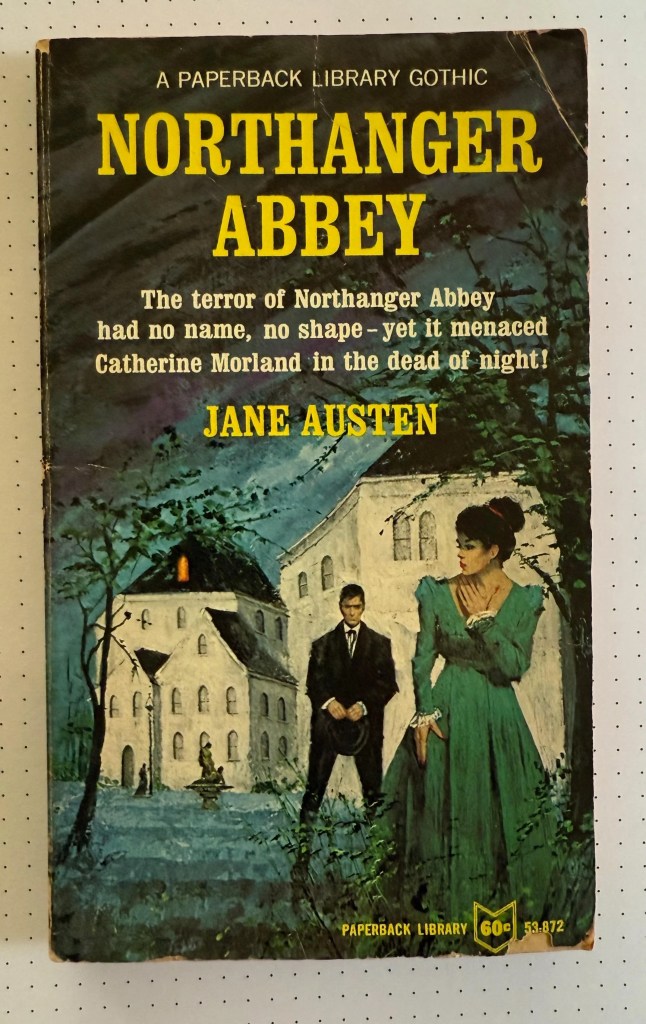
Northanger Abbey

by Jane Austen

The current image has no alternative text. The file name is: northangera.webp

Although I had never read this novel before, I knew the plot backwards and forwards thanks to the two BBC productions I have watched numerous times. Also I listened to an abridged version several years ago. I had started Val McDermid’s modern re-working of Northanger Abbey and it was not going well. It started me to thinking, “why am I reading this, when I still haven’t actually read the real one”? I decided to listen to it again since I have had the unabridged version in my Audible library for years. It was very funny right from the the start. It did go well. Of course I knew all the ins and outs of the plot. But I probably would have enjoyed it more if it were the first go round of any kind. Also, I suspect I would have picked up even more of the humor if I had read it on the page.

The book begins with Jane Austen informing the reader of all reasons why Catherine Morland, our heroine, is not suited to the role. In fact, The Narrator (Austen) pulls no punches in eviscerating Catherine and detailing her lack of heroic qualities. Brains? Nope.

She never could learn or understand anything before she was taught; and sometimes not even then, for she was often inattentive, and occasionally stupid.

Beauty? Nope

…and Catherine, for many years of her life [was] as plain as any. She had a thin awkward figure, a sallow skin without colour, dark lank hair, and strong features…” No mention of “speaking, twinkling, intelligent, or laughing gray eyes, you will notice. But… At fifteen, appearances were mending…she had now the pleasure of sometimes hearing her father and mother remark on her personal improvement. “Catherine grows quite a good-looking girl-she is almost pretty today.”

Talents and accomplishments? Nope.

Her taste for drawing was not superior. though whenever she could obtain…any…odd piece of paper, she did what she could in that way, by drawing houses and trees, hens and chickens, all very much like one another. Writing and accounts she was taught by her father; French by her mother: her proficiency in either was not remarkable, and she shirked her lessons in both whenever she could. What a strange, unaccountable character!—

I laughed aloud at the idea of a house, a tree and a chicken looking very much alike. After being assured that Catherine’s father “is not the least addicted to locking up his daughters” we read that her mother was a woman of useful plain sense, with a good temper, and, what is more remarkable, with a good constitution.”

So having assured us that Catherine does not fit the mold of a Gothic heroine she eventually plops her in the middle of a plot worthy of any respectable gothic romance. In her own mind. For Catherine is a little obsessed with gothic novels. Taken to Bath by well off family friends, Catherine is drawn in and befriended by the manipulative Isabella Thorpe and her crass brother who tries to worm his way into her affections. She also meets the upstanding and witty Henry Tilney and his nice sister Eleanor. Catherine develops a tendre for him and he seems to reciprocate her feelings. Eleanor invites her to their ancestral home, Northanger Abbey, for several weeks, and Catherine is in a state of shivery delight that the Tilney’s ancestral home is an actual Abbey.


Her passion for ancient edifices was next in degree to her passion for Henry Tilney…With all the chances against her of house, hall, place, park, court, and cottage, Northanger turned up an abbey…long damp passages…narrow cells and ruined chapel…the hope of some traditional legends, some awful memorials of an injured and ill-fated nun.”

Although unlike the films, the Abbey does not live up to her imagination, (not an “antique chimney”, dirt, or cobwebs in sight-Neither “awful forebodings of future miseries” nor “sighs of the murdered” either) she finds plenty of fuel for her fantasies. She convinces herself that Henry and Eleanor’s intimidating, strange-acting, and hot-tempered father murdered their mother (or possibly has her imprisoned somewhere in a secret cell.) When she is caught snooping in a place she should not be by Henry, he sets her straight and makes no bones about what he thinks of her deluded fantasies. In the face of his disdainful take-down she comes to her senses with a decided ker-plunk. (But he still likes her.) Ironically, it is after her wake-up call when General Tilney genuinely does her a shocking cruelty and even puts her life in danger by his rude and heartless actions. So maybe not so detached from reality after all.

Although Catherine Morland is not the crispiest chip in the bag, I grew to like her very much. She is kind and good-hearted, and if she is sometimes silly it stems from naivety and innocence rather than brainlessness. I was completely won over by this passage:

[Henry Tilney] looked as handsome and as lively as ever, and was talking with interest to a fashionable and pleasing-looking young woman, who leant on his arm, and whom Catherine immediately guessed to be his sister; thus unthinkingly throwing away a fair opportunity of considering him lost to her forever, by being married already… he had never mentioned a wife, and he had acknowledged a sister. From these circumstances sprang the instant conclusion of his sister’s now being by his side; and therefore, instead of turning of a deathlike paleness and falling in a fit on Mrs. Allen’s bosom, Catherine sat erect, in the perfect use of her senses, and with cheeks only a little redder than usual.

And she shines in comparison to two other women in the story: Isabelle Thorpe and Mrs. Allen. Mrs. Allen makes Catherine seem sensible and resolute and Isabelle highlights Catherine’s virtues by being her opposite. That Catherine has been able to attract the friendship and liking of such a role model as Eleanor Tilney also speaks very well of her. And how can one be too hard on someone who is such a voracious reader of novels? Unfortunately, although witty and tolerant, I found Henry a bit prosy and self satisfied. Not as likable as the Henry Tilney of the films.


“Henry,” said Miss Tilney, “you are very impertinent. Miss Morland,…He is forever finding fault with me, for some incorrectness of language, and now he is taking the same liberty with you. The word “nicest,” as you used it, did not suit him…”Very true, said Henry, “and this is a very nice day, and we are taking a very nice walk and you are two very nice young ladies. Oh! It is a very nice word indeed! It does for everything. Originally perhaps it was applied only to express…”

And blah blah blah.

But that aside, I found myself chuckling at the wry humor, admiring Austen’s characterizations, and the skewering of the gothic novels of her day. Even though I am an old Gothic reader myself, I am not at all tempted to read one of the many of Catherine’s reading list based on the little snatches we are favored with in Northanger Abbey. I now have read all of Jane Austen’s books except Sense and Sensibility and Pride and Prejudice several times. I guess you could say I’m saving it.
Rating: 3 out of 5.

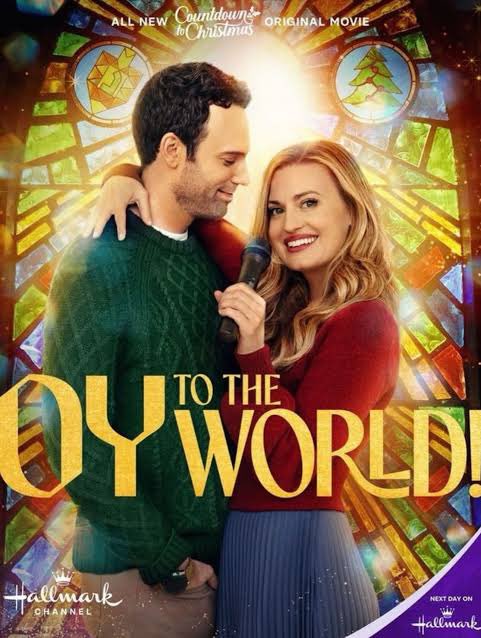
Oy to the World

The current image has no alternative text. The file name is: oy.jpg

Oy to Joy

Hallmark’s Hanukkah based holiday movies of recent years have been some of their better ones, so I was cautiously looking forward to this one. The title seemed a little iffy but I do like Jake Epstein in most everything, and I thought he had really good chemistry with Brooke D’Orsay, his co-lead. Overall this was a pretty standard enemies to lovers plot, although both were so nice and family and faith oriented that I use the term “enemies” with a huge grain of salt. It was very sweet, if a little too good to be true. But you know what? It’s Christmas.

Nikki and Jake were childhood friends who at some point became rivals during their high school years. It all probably had it’s beginnings in their opposing personality traits. Nikki being structured, organized, and serious, and Jake being free-wheeling, unfocused, and fun. In a flashback scene we see Nikki getting up to sing “Joy to the World” in front of the whole school. She hits a bad note, her voice breaks, and she runs off the stage in embarrassment only to see Jake backstage smirking at her. The whole experience was so devastating to her that she quit singing in public despite her love of music. She is now the “choir director” of her father’s Episcopalian Church. I put that in quotes because the choir consists of 4 kids one of whom quits mid-movie. This is apparently her only job because she is in her mid-thirties and seems like she is still living at home, although I may be wrong about that. This struck me as pretty sad though it does not seem to be an issue and no mention is made of it. Jake, on the other hand is a singer/songwriter in New York City and has enjoyed moderate success though he has yet to get his big break with an actual record deal. His dad is the rabbi at the temple across the street from Nikki’s church and their families are close. When the pipes burst at the temple, and Jake’s grandmother injures herself in a resulting fall, it brings Jake home to take her place as the temple’s choir director. Not using quotes because his choir has 5 teens in it.

Needless to say (a phrase often used when talking about Hallmark movies), The two single thirty-somethings continue their rivalry while simultaneously falling in love. The tipping point is kind of sweet. Nikki and Jake make a wager that if Nikki’s family loses a bowling match to Jake’s family, Nikki will have to get up and sing in front of the whole bowling alley. On the verge of winning the bet, Jake purposely throws a gutter ball to lose the match when he sees how horrified and sick Nikki becomes at the prospect of singing publicly. When one of Nikki’s 4 choir members quits the choir because under her direction, the choir is no fun (poor Nikki! Again, so lame) the two choirs are merged under their dual direction for a big concert on Christmas Eve (which also happens to be the last day of Hanukkah) at Father Paul’s church. The joint effort will be raising money for Rabbi Levi’s broken pipes. To kick off the extravaganza, Nikki and Jake will sing the fateful “Joy to the World”. And Nikki is fine with that because Jake will be there by her side and supporting her. Won’t he? I mean surely he will not be called away back to New York for a big career break on that very day! Will he?!

Needless to say, we have a flirty baking scene complete with flour throwing, in which Nikki’s gentile gingerbread cookies recipe gets mixed up with Jake’s Jewish rugelach cookies recipe and they are delicious. The symbolism reflects the whole movie’s message which is peace, love and acceptance between the two religions and amongst people everywhere, despite their underlying differences. Yes, it was very cheesy, but it is tough times these days and I welcomed the message wholeheartedly. I won’t comment how accurate and faithful certain things in this movie were to Jewish customs and culture because I am not qualified to do so. But I did detect a few Jewish stereotypes, and I had to cringe when the Jewish part of the congregation had to listen and smile to a song which celebrates baby Jesus as the king of the world. To be fair, the Hanukkah song written by Jake was really beautiful. It was a very sweet comfort movie. And thanks to these Hallmark movies I can now spell Hanukkah without looking it up.

Rating: 7 out of 10.

A Suite Holiday Romance

The current image has no alternative text. The file name is: asuite.jpg

“Oh My Lord!”

~~Eloise (on the tippy top floor of The Plaza)

This is one of those Hallmarks that feels like it has to retcon what we have seen and heard with our own eyes and ears in order to create a last minute drama that tears the couple apart so they can get them back together at the very very end. In this one it is the “You’ve Been Lying to Me the Whole Time!” scenario. I understand that this is the formula. And I really don’t mind it when there is a reason for the conflict and drama. Like if the guy or girl had really actually been actually lying to the other one the whole time. But in this case, there was no lying to be had. At All. Well Ok, maybe just a little bit very near the end, when he realizes for the first time that she thinks he is someone he is not. He doesn’t immediately correct her misapprehension. It would have been difficult. He is in a state of shock probably because he is thinking she was only pretending to love him because she thought he was a higher status person than he actually was. Depressed as well, probably. And it’s too bad, because otherwise this was a pretty good Hallmark.

By virtue of a great article she wrote about Hazel Holley,  a famous children’s book author, Sabrina, our heroine, has been tapped to ghost write the memoirs of a great world famous art-broker.  He, Grayson Westcott, was once Hazel Holley’s butler while she lived at the famous Grand Fairbanks Hotel in Manhattan while writing her books. This book series is about a little girl named Cordelia who lives at this same world renowned and very fancy hotel. If you are familiar with Kay Thompson’s children’s series about Eloise and The Plaza, you will recognize a lot of parallels with this movie. Right down to Sabrina staying in the “Cordelia Suite” and a huge oil painting portrait of “Cordelia” in a place of honor. So that was fun! Also staying at the same luxurious hotel, is Lord Braxton, who is vaguely part of the royal family of England, and his secretary, Ian, who also works for the family’s charity, “Read for the Stars”. They are there to exhibit the Braxton family’s jewelry collection to raise money for this charity which fosters reading skills for learning disabled children. After they have their meet-cute (she starts to eat his delicious-looking sandwich by mistake at the hotel bar), Ian and Sabrina form an instant connection, start doing stuff together (remarkably not ice skating at Rockefeller Center, however), and fall in love.  Meanwhile Ian is trying to keep the immature and fun-loving Lord Spencer Braxton out of trouble, specifically keeping him from proposing marriage to the hotel jewelry clerk (who is doing post graduate work on the Victorian author, Elizabeth Gaskell. Kudos there, script writer!). Also meanwhile, Sabrina is interviewing Grayson Westcott for her book. He tells her the story of his love affair with an 18-year-old debutante while he was taking care of Hazel Holley. It ended sadly because she had to go to London to fulfill her dream and the dream of choice of seemingly all young Hallmark heroines: being a fashion designer. They keep in touch but when he finds out down the road that her family lost their money and her fashion designer dream is dead, he doesn’t go to her rescue. This was badly done on Grayson’s part and quite a plot hole. Especially since when she was rich he didn’t think he was good enough for her. 

Now the crux of the matter, which everyone sees coming. Thanks to Sabrina’s daffy and obnoxious friend, Sabrina thinks that Ian is really Spencer the royal Lord, but he is just calling himself Ian to protect his privacy. The fact that Ian, she thinks, is royalty and very rich doesn’t seem to bother her too much at first *wink*, but she finally realizes that the romance cannot be because they live in two different worlds and two different countries. So inspired by Grayson’s frustrated romance, she writes him a letter breaking up with him. Please note that he never lies to her except when he finally realizes, near the end, that she has the wrong end of the stick and thinks he is a rich royal and not a lowly secretary. At that point he is shocked, discombobulated, and he doesn’t know how to tell her the truth. And then she breaks up with him before he can set her straight. All this while, Sabrina knows he has no idea that she thinks he is a Royal. Very early on, she comments to him that he didn’t tell her he was “with” the Braxtons. Not that he was Lord Braxton, but “with” the Braxtons. And later than that, when their romance is in full swing, she tells her flakey friend that Ian has no idea that she knows he is really royalty. In other words Ian thinks she thinks he is just a normal guy. Which he is. After a pow-wow with Grayson, she has a change of heart and decides to try to make their relationship work despite the challenge of him being a Royal and all. But when the truth is finally publicly revealed she stalks off accusing him of lying to her “the whole time.” and “Was any of this even real?!” The only unreal part was what was going on in her own head. You’d think she’d be happy. How could he be lying to her? He never claimed to be a Royal, and thought she knew that. Which she knew. My head is still spinning.

Other than that, I liked the movie. It was good to see Jessy Schram again after 2 Hallmark-free years. The male lead was good as was Adam Hurtig as the volatile Spencer Braxton. The production was very well mounted with the hotel and New York City background. And, small spoiler, I’ll never have a quarrel with three happy endings. But it lost a star due to the rewrite of established facts.

Rating: 6 out of 10.

Single on the 25th

The current image has no alternative text. The file name is: singleon.jpg

Thirty, Flirty, and Thriving

This was but a simple love story set in Chicago with no gimmicks or even much of a secondary plot line to distract us from the romance. Everything was focused on the character development and the growing connection between the two leads. And it was lovely. Lyndsy Fonseca, Hallmark Christmas movie veteran, usually seen only during the Holidays (once in January), was charming and charismatic as always. I am not sure this would have worked without her talented presence. She was paired with Daniel Lissing and he was good. I would say the time we spend with them in the movie was pretty much equally divided between the two.

Christmas-loving Nell Duke is looking forward to her family visiting her in the city during Christmas and she has taken the whole week off from her successful career to show them a good time with a host of curated activities. So refreshing not to have our heroine dealing with career woes or trying to convince an awful boss that she deserves the big promotion! Unfortunately her family has to all drop out due to unexpected family emergencies and Nell decides to go home with her good friend and cancel all of the reservations. Unfortunately some are non-refundable. She is discussing the situation with her friend when she runs into her apartment building neighbor with whom she has a cordial but rather awkward relationship. He helps her carry in her Christmas tree, and later, she locks herself out of her apartment, knocks on his door for help, and they get to talking. He convinces her to stay in Chicago during the holidays and embrace her singleness, taking part in all of her planned activities all by herself. He is kind of a loner at work, not seeming to have a lot in common with his obnoxious office buddy. When he is roped into planning the important office Christmas party, he has to cancel his own planned skiing trip and stay in Chicago himself. Nell and Cooper get to know each other and they start doing some of the activities together. Cooper, who prides himself on his independence, coaches Nell on how to be successfully single while living in a world seemingly made up of happy couples and babies.  Nell, who is experienced at planning parties, helps Cooper make his office party for clients extra special to impress his bosses. They slowly become good friends and start to fall for each other while Cooper’s family welcomes her into some of their traditional events. Cooper learns that going it alone is sometimes not as fun as being part of a couple and he can show his true self, a goodhearted guy and a bit of a nerd, and still not be an outcast in the corporate world full of yuppies.

The romance is developed slowly and steadily and is well founded. They open up to each other, learn about each other, and when they resolve that dreaded last minute misunderstanding and get together at the end, it is because of choice, not need. 

One of the highlights was seeing Cooper’s obnoxious office buddy learn from Cooper’s example and quit being such a phony. Bro Hug! The movie was well paced with lots going on despite the slow steadiness of the romance development. I loved the messages this movie conveyed, the Christmas in the city atmosphere, and seeing both leads have real character arcs and backstories. There was nothing “wrong” with either of them, but they brought out the best in each other and learned to be happier people together. I loved that it seemed to be aimed at a younger than usual demographic. Of course there were a few of the usual tropes, but they were not crutches for a weak plot. And it was nice to see Lyndsy Fonseca star in a movie that didn’t rely on paranormal activity.

Rating: 8 out of 10.

She’s Making a List

The current image has no alternative text. The file name is: shesmaking-1.jpg

Coal-Worthy

It’s not that I didn’t understand this movie, it’s that so many little things did not make sense. And it was boring. I really had high hopes for it. The premise was cute and different, and it starred two of Hallmark’s biggest and most popular stars: Lacey Chabert and Andrew Walker. I would have thought they would have given them a better script. And I don’t know much about direction, I just know when it’s good, but things were said or implied that I didn’t see on screen. Then at the end, the plot just went off into La-La Land, and by that I don’t mean Los Angeles.

In a nut shell, here is the plot. The naughty or nice list is real. But Santa’s elves have long since been relieved of the huge responsibility of deciding whether the children of the world get presents or coal in their stockings. That  job has been sourced to Naughty or Nice, Inc. who uses modern technology and algorithms to separate the good, the bad, and the in-between. They have a huge fancy office building in a big city so the whole company and its mission is right out there on Front Street. The algorithm is adequate for most kids, but some kids are on the line between naughty and nice. And that is where the human inspectors come in. Isabel (Chabert) is one of the best and up for a big promotion. The inspectors are dispersed throughout the Santa Claus believing world assigned to take a closer in-person look at the actions and behavior of these fence-straddling kids. They are armed with a huge guide book detailing, among other things, the rules of engagement in order to make the final determination of coal or presents for Christmas. And no one knows the rule book better or follows it more closely than Isabel. Sounds cute, right? And I am the last person to turn my nose up at a little whimsey. The production values were good, there were some clever and cute lines and concepts, and Lacey Chabert and Andrew Walker are always competent at the very least. But it ended up in a muddle that could have been done much better. And easily fixed.

The first case has Isabel scrutinizing two little boys playing with a ball. One dares the other to throw the ball as high as he can and when he does it breaks a car tail light when it lands (somehow?). It was just an accident, but the one kid runs away and the other struggles with his conscience and then runs away. Lacey writes down “Mischief, Destruction, and Evasion”. Both the boys are judged “Naughty.” Case Closed. No presents. One of the messages this movie seems to be trying to convey is about digging deeper past the surface actions before putting a label on a child. Wouldn’t it have been more effective if the kid would have changed his mind and taken responsibility for his actions but after Lacey had left the scene of the crime? Or some other extenuating circumstances?

The next case is a boy named Teddy who is apparently planting seedlings (In December?) with his classmates. He sprays bleach on everyone’s plants except his own! Why? Were they in some kind of plant competition? Why would a kid be so malicious? It’s never made clear. Isabel’s assistant thinks that he meant to spray fertilizer, not bleach. But if that’s true, why would he not fertilize his own plant? Isobel later claims it was the only bottle of bleach in a row of fertilizer bottles so it must have been a mistake. Which is clearly what the viewer is supposed to believe. But the frame showing the bottles clearly shows that is not true.  And why would bottles of bleach be right next to fertilizer in a children’s garden in the first place? And he was definitely acting guilty and sneaky. Making mountains out of mole hills? Maybe. But it was disengaging and distracting for no reason. Nothing about it made sense. If he was spraying bleach on innocent little baby plants that is more than just mischievous, it is very concerning behavior. The lesson of not jumping to conclusions about kids’ motivations was confused and murky.

Those two cases are just prologue to Isabel’s main case of Charlie, played by Cadence Compton, who was fantastic. 11-year-old Charlie is an amateur magician we first see making a little kid’s $20 bill “disappear.” Basically she steals it from him. And the other older kids are so impressed that they start waving their money at her so she can make all their money “disappear” too. What the Hell. As far as we see, she never gives them their money back, and the kids never report her to the authorities either. Again what would have served the moral of the story was her giving their money back when judgmental Isabelle wasn’t looking. Or maybe using the money to buy a warm coat for a homeless kid, or do some other good deed. No, what she did was more than just “naughty.” She does other bad stuff too. But since Isabel is now dating her handsome father Jason (very much against the rules but she couldn’t care less all of a sudden), she starts looking to make an exception for Charlie and protect her from getting coal instead of presents. Because you see, Charlie’s mother died last year, so all is forgiven and excused. Plus she picks up litter. We find out later that when she did get coal for Christmas last year, her Dad secretly replaced it with real presents anyway. I’m like, “Maybe a little coal in her stocking would have done her a lot of good!” Isabel is breaking all the rules when it comes to this one girl because of her crush on Charlie’s father. It just wasn’t right or fair to all the other gray-area kids. Not that Charlie was actually that “gray area” in my opinion. But let’s just overlook Isabel’s shady behavior. I mean it’s Lacey Chabert after all.

I won’t go on with other examples of badly presented and mixed messages, but trust me. Isabel gets closer to Jason, finds out she has been doing more harm than good in putting kids on the “Naughty List,” and Charlie is miraculously transformed from bad girl to good girl at the drop of a hat. As it turns out, next year Isabelle’s boss (Steve Bacic) is going to take the whole human element out of labeling the children of the world and rely strictly on the algorithm. There will no longer be any excuses or human input. A now wiser Isabelle is so upset by this, that she quits and then decides to visit the top man, Santa Claus, along with Charlie and Jason to plead her case: No child is ever really naughty, they are just trying to find their way in the complicated adult world. No comment. But it all ends in a happy ending with a world free of coal, naughty lists, and children not being held accountable for their actions. I’m sorry, but this is a 5 in my book.

Rating: 5 out of 10.

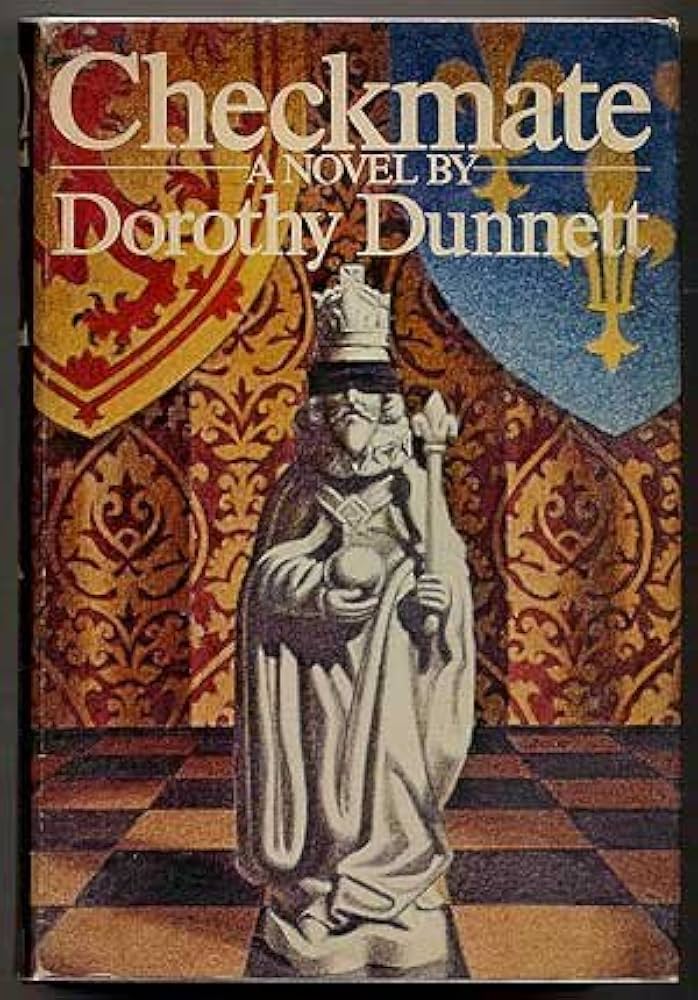
Checkmate (#6 in the Lymond Chronicles)

By Dorothy Dunnett

The current image has no alternative text. The file name is: checkmate.jpg

At the moment, I am tired of journeys. It is time I arrived somewhere.

He wondered why his lordship had claimed to be unable to identify the boy on the bridge. Then he recalled something he had heard rumoured. Once, Lymond had questioned a child and lived to regret it.

“You may give me a brooch. A sapphire one.”
“Ah,” he said. “But will you take care of it?”

It’s been about 3 weeks since I finished this last book in The Lymond Chronicles. And this review has been hanging over my head. Between finishing the book and seriously tackling this review I have had a ball reading other peoples thoughts and insights into the series which I was unable to do while I was reading it because of fear of running into spoilers. More on that later. In short, I have been, off and on, just immersing myself even further in the series.. I have a lot more exploring yet to do down the Lymond/Dorothy Dunnett rabbit hole.

As I look back on this book, Checkmate, I am amazed at how much happened action-wise, the character arcs, and the seamless involvement of our fictional characters with the military actions, politics, and religion of the time. In the course of the series, Dorothy Dunnett has shown herself to be ready, willing, and able to kill off important characters as well as animals. So while I was happy at the return of those whom we kind of left by the wayside during Pawn in Frankincense and/or The Ringed Castle, I feared for them. These included Kate, Philippa’s mother, Jerrott “I don’t understand” Blythe, Marthe, his difficult and troubled wife, and Archie Abernathy, the rock. Of course Lymond’s mother, Sybilla, so beloved and admired by me in previous books was certainly under threat of ye old chopping block given her advanced age (at least for those times) alone. And what of his estranged brother Richard? It would be just like DD to kill him off before he and Lymond could be reconciled. Though frankly, Richard was such a dumbass throughout most of this one, I can’t say I cared much about his ultimate fate.

What we went through in this book, along with Lymond and Philippa, our daring duo! We begin the book, right where The Ringed Castle left off, picking up with Lymond shortly after he has landed back in France after being kidnapped by Philippa and his friends, for his own good. They successfully conspired to prevent him from returning to what he saw as his mission in Russia where he would face certain death. Which was OK with him, but not with anyone else. I know I sure didn’t want him to go back there. Although at the end of TRC, he loves Philippa “in every way known to man” he is determined to divorce her for her own protection and because of his own self-loathing. Philippa is as yet unaware of the nature of her attachment to “Mr. Crawford.” He enters into an agreement to serve embattled France in his capacity as a military leader without peer. In return, the powers that be will see that the divorce is granted. Along with placing Lymond in the middle of real historical military battles and political machinations, we experience all manner of…stuff. High spirited swashbuckling adventure, a love story for the ages (which for me, had its earliest beginnings in The Disorderly Knights), deep dark mystery, family drama, mental and physical anguish of all sorts, sacrifice, evil, goodness, triumph and…well, just name it. And that’s just Philippa. Kidding. But Philippa and Lymond are equal or almost equal partners in all that transpires in this book.

Before I bought the books many moons ago, I vetted the series enough to know it ended in a rewarding and satisfying way. But as the books went on, I didn’t see how the ending could possibly be completely happy due to Lymond’s physical and mental health challenges. But Dorothy accomplished it. At least I chose to buy it. As much as I loved the book, it wasn’t perfect. I struggled with getting my head around the motivations, mindsets, and decisions of Philippa, Lymond, and Sybilla. So much harm and suffering for, what I felt, were weak and not very well supported reasons. I asked the DD in my head, at too many points, “Because why now?” “Huh? But.…” Also, I feel like the title of the book is a little misleading and I felt a bit cheated by part of the conclusion. Because the book is called “Checkmate” I expected a battle of the titans between Lymond and his nemesis throughout most of the series, Margaret Lennox. With, of course, Lymond outmaneuvering, tricking, and finally conquering the wily Margaret in an exciting showdown for the ages. Of course it would exceed in guile and excitement the climaxes we were treated to in 4 of the 5 preceding volumes. The word “Checkmate” comes with certain expectations. The confrontation between the two had its rewards, but in the end that part was anticlimactic. But, thanks to the gorgeous and fulfilling conclusion to Francis’ and Philippa’s love story, It is a fairly minor quibble. In the end there is peace and joy at long last, and that is enough. But still so many questions! I learned from reading this series that sometimes that’s not a bad thing.

So many lovers of this series have read it many times. They comment how much they missed the first time. I had a different experience, thanks to helpful websites and Youtube chapter by chapter discussions posted years ago which leant valuable insights, and conscientiously avoided spoilers. They added historical political and religious context, explained obscure literary allusions, translated foreign language passages, and a whole lot more. Many personal opinions and speculations over countless plot and character points were offered and explored. Not to mention, “What did Dorothy Dunnett really mean by that?” Some hearty souls read this massive work while it was still being written and had to wait years between books. I can’t pretend to imagine what that experience was like. Many forged ahead while up in the air as to whether all would end tragically with Lymond’s death (or worse!). Given his death wish, it seemed more than likely. I had the advantage of knowing the end would be a happy one, though I took great care to avoid any other spoilers. But a funny thing happened. I went through Checkmate and part of The Ringed Castle, under a misapprehension. In looking up an innocuous factoid, I ran across what I thought was a huge spoiler. I caught a glimpse of the answer to one of the big running mysteries we had been teased with throughout the series: Lymond’s true parentage. But since I shut down what I was reading immediately, I got it wrong. It would have been quite juicy, had it been true, so I was a little disappointed when I finally realized that all of the clues that pointed in another direction were not, as I thought, red herrings. Also I read that one very important character died, and he/she didn’t. Where that came from I’ll probably never know. But I was sure happy about it.

So there you have it: A small part of my experience with this scholarly, flamboyant, and, yes, sometimes preposterous series which is influencing writers to this day. But I am certainly not done with Dunnett. I now have the audio books in my library and another series to look forward to: Niccolo Rising. Which from what I gather should be almost as profound a reading experience as was The Lymond Chronicles. We’ll see.

Rating: 5 out of 5.

The Snow Must Go On

The current image has no alternative text. The file name is: thesnow.jpg

Snow Business

Wow. I didn’t quite know what to make of this one (at first). Now I hate when people use this word I am about to use to describe the first 15 minutes of this movie, but it perfectly describes how this movie started out: Surreal. We open in a very dark and empty bar/theater with a man singing his heart out in true Broadway fashion with a crown of horns on his head. Yes, if you haven’t seen this, you read it right. It turns out that he is supposed to be Rudolph the Red Nosed Reindeer who is apparently very upset about something and who at the same time looks very menacing and demonic. The very talented Corey Cott plays Isaiah, the star of this debacle. He was a once rising star on Broadway who has been struggling in his career. The opening scene is from the one man show he also wrote, produced, and directed, apparently out of desperation. He meets with 2 of the 3 audience members who turn out to be his sister and his niece who have come to New York to get him to come back to his home town for Christmas. He shoots them a tragic look, but after he is fired from his Christmas caroling job and after failing to get even an audition to the new Cindy Santos (big name and top producer) fronted musical, he accepts. CS is played by Stephanie Sy who is always great.

Now in a whiplash inducing turn, we get more Hallmarky with small town vibes, bright lighting and decor, and Isaiah’s wholesome family. But when he gets out of the car and volunteers to pick up his niece Aurora from highschool, he is wearing a very weird “sweat suit” as he calls it, that looks just like Christmas pajamas: Snow white with candy canes and sleighs and other Christmas paraphernalia all over it. And he actually gets out of the car dressed like this and into the high school to find his niece with no hesitation or embarrassment at all. Very few would even wear this getup to Wal-Mart after midnight. I don’t know, I just didn’t understand who Isaiah was supposed to be. Desperate and sad? or Goofy? Things settle down to one of the usual Hallmark plots after he gets the suit off. Curiously not mocked or molested by cruel highschoolers, he is wrangled by his niece (who is a real go-getter) and LilyAnne, a teacher (Heather Hemmens), into directing the school Christmas musical after the former director quits to marry a lumberjack she met online. *shrug emoji* (BTW, Hallmark, Where’s that movie?) The usual struggles with the theatre kids ensue. The young actors were all very talented singers. Especially one who played Miranda, a shy girl who happens to be the daughter of the great Cindy Santos. When he finds out who her mom is, he starts to put his all into getting the musical together (hoping to impress her), including writing the second act of the unfinished play. He simply tacks on his “off-off-off” Broadway musical about the most famous reindeer of all to the school’s play about “Randolph, The Christmas Elk.” After Lilyanne helps him with a re-write (This Stinks! It makes no sense!) including taking out the ungulate’s filibuster to Congress (ala Mr. Smith Goes to Washington?), things start to develop in the romance department. He casts Miranda, Cindy Santos’ daughter, as his understudy taking the starring Randolph role for himself in hopes that when Cindy sees him she will cast him in her big Broadway show. Yes, it came across as pathetic and contemptible as it sounds. So we have another facet to Isaiah’s personality: Jerk. Despite his shameless attempt to exploit his position and power for his own ends, a funny thing happens on the way to putting on a show. He starts to love it and is good at it. As it turns out, Cindy, being very busy and important, cannot be at the school on opening night, to her daughter’s and Isaiah’s disappointment. But she offers him an audition in New York after she sees him in the dress rehearsal, and you won’t believe this, but the audition is the same day as Opening Night of the play. Will Isaiah choose the kids and his responsibilities over his one chance to revive his career? Does Broadway stardom lie again in his future or will he choose small town life as a drama teacher with LilyAnne at his side? Will shy Miranda power through her stage fright and shine as his understudy? Will her mother see the light and become the parent her daughter needs?

Believe it or not, thanks to the set design, the make-up, the costuming, and the performances of the kids, I enjoyed what we were shown of “Randolph, the Christmas Elk.” I wish we had seen more. It was a huge success and it all came to a rousing finish, including the snow machine finally producing snow, Isaiah getting the girl, seeing the error of his ways, and apologizing to all and to all a good night. 7 stars.

Rating: 7 out of 10.

A Grand Ole Opry Christmas

The current image has no alternative text. The file name is: agrandole.jpg

A Good Daddy

I didn’t expect this to be as good as it was. Often highly promoted efforts by Hallmark fall a little short for me. But if it gives me some chuckles, and this one did, I am prone to look benevolently on it no matter how much it otherwise annoys me. But if it makes me cry in a good way as well, it might qualify for an 8 thru 10 stars out of 10. And this one certainly did. The story was moving, but that can go for naught if the acting is not there. Thank goodness Nikki Deloach played the lead. She is easily one of the best actresses that works at Hallmark and I have praised her skills before. More than once. Honestly, she has never given a bad performance, even if the movie wasn’t so great. And Kristoffer Polaha, who plays her leading man, has his own acting style which can get a teeny bit old sometimes, but he is one of my favorites anyway. Just because I can see what he’s doing there, doesn’t mean I don’t like what I see. And they were great together. Add in some time travel, and I’m all in.

Gentry Wade (Deloach) is the daughter of a country music star who died when Gentry was just a teenager. She was once an aspiring songwriter, like her Dad, but things got in the way, and she now runs a popular bar and music venue which is a gathering place for Nashville country stars. The 100th anniversary of the Grand Ole Opry is coming up and the legendary duo of Jett Wade (Gentry’s late father) and Von Winters are going to be honored on stage during the annual Christmas show. Gentry has been invited to appear and is encouraged by her “Uncle Von” and her late father’s cousin Rita (the always welcome Sharon Lawrence), who was a talent coordinator for the Grand Ole Opry back in the day. Before his tragic and unexpected death Winters and Wade mysteriously broke up and Von Winters went on to great solo fame. But Gentry is hesitating because she feels she has not earned her right to appear on the hallowed stage as she gave up on her dream to be a songwriter (for what appears to be several reasons). Also in the mix is Mac, (Polaha) a lifelong friend who has returned from L.A. to pursue his successful talent manager career in Nashville.

While all of the talent is preparing for the big Christmas show, Gentry sits down on one of the onstage pews which are reserved for family and friends of performing artists, and she is sent 30 years back in time! It’s the day before the 1995 Christmas concert which was also Winters and Wade’s final appearance together. I’m skipping some steps but Mac follows soon after. Together they spend time with the young Rita. Gentry (who calls herself Jen, because if she had the same name as Jett’s teenage daughter, who is not around, thank heavens, that might be confusing) also gets to reconnect, as an adult, with her beloved father. Also his pal, Winters. At one point she finishes, with the help of her Dad, an old song she started to write as a young girl but never finished. Winters hears it and he is so encouraging, she knows that if she stays in 1995, she will be able to finally pursue her career as a songwriter. So will she stay in the past? Will it be with or without the love of her life, Mac? Why did the legendary duo break up that fateful Christmas in the first place? Will Gentry be re-inspired to try to write again in 2025 (If she goes back, that is)? What would happen if she stayed and met herself as a teenager? The answer to at least one of these questions brought me to tears. And 3 subsequent scenes kept them flowing.

A few things added even more to the overall appeal of this movie. One was the mystery of whether two of the main characters remembered the 2025 Gentry as the 1995 Jen that was a brief part of their lives for one day. From a few things that were said or happened, I’m pretty sure one of them did, but am not so sure about the other. There is even a little hint (not in anything in the script, but in the actor’s subtle performance) that her father might have suspected something. It was a welcome wrinkle to the usual Hallmark where everything is spelled out. I like a little thought provoking mystery, sometimes. Of course, the appearances of real life Nashville stars were entertaining (even if the only one I recognized was Brad Paisley). You could really tell that everyone involved was committed to this production, and was glad to be a part of it. Finally, and I’m not sure I should mention this because I may be the only one, but I saw a great resemblance between the two actors who played the younger Winters and Wade to a Wyatt Earp-era Val Kilmer and present day Leonardo di Caprio. For me, it added a certain Je ne sais quoi. One thing I would have liked was to touch base with the poor Opry Guard who saw Gentry and Mac disappear into thin air. That might have long term consequences. 9 stars thanks to a little “Opry magic.”

Rating: 9 out of 10.

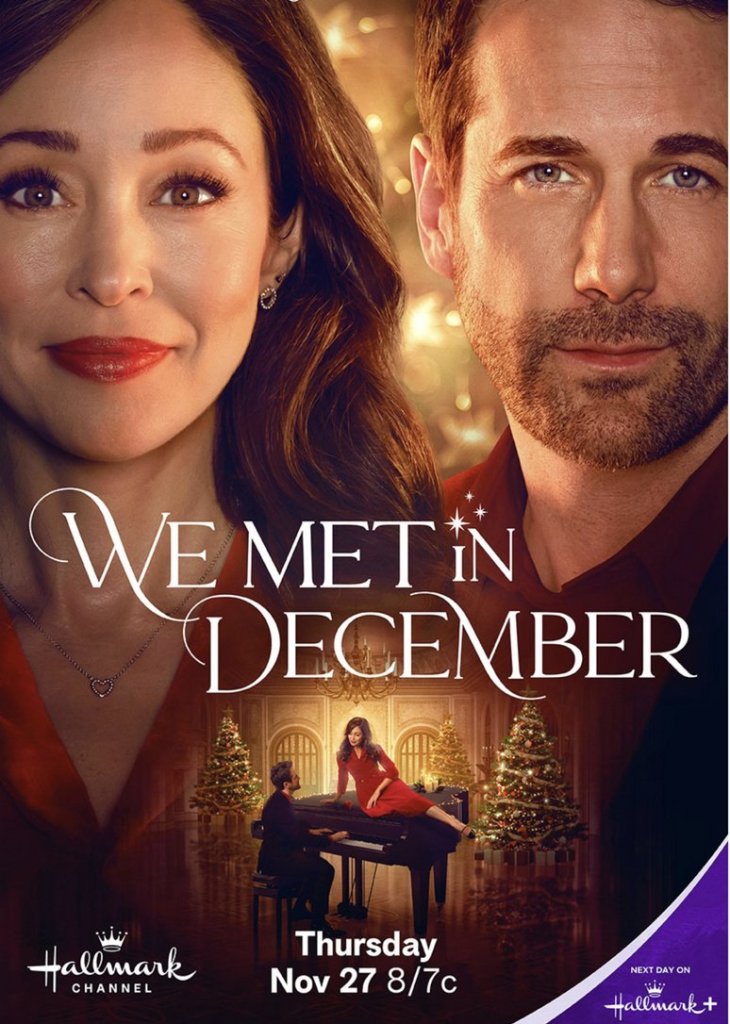
We Met in December

Google is Your Friend

The current image has no alternative text. The file name is: wemet-1.jpg

Autumn Reeser and Niall Matter, both with very lengthy Hallmark resumes individually, are finally in a movie together. And it was a pairing I didn’t know we needed. They were a good match and in a movie where age and singleness was not an issue. Usually Hallmark ties itself up in knots trying to justify why the female and/or male leads are not already “with someone”. Most of the regular and popular Hallmark actors are either pushing 40 if not 50 years old. So if the plot doesn’t call for the death of a spouse they have to engineer a traumatic break up with a long term partner causing a paralyzing inability to trust again and move forward in the romance department. Or, they push these mature actors into stories obviously written for characters in their 20s or early 30s, just getting started in their personal and professional lives. In this one Autumn and Niall play two mature, successful, and well-adjusted professionals not hobbled emotionally by unhappy love stories. Why they are still single is not explained or even  addressed. So refreshing. If it was mentioned, I sure missed it.

The movie’s structure is also kind of unusual. We are thrust right into the action with Annie and Dave having a love at first sight moment while both in a city not their own due to a airline layover. No laborious info dump in the first 2 minutes. They learn that they both are on the way home to Chicago, and spend the day and half the night together cementing their relationship. They are secure in the fact that they have seats together on the flight home in the morning to get to know each other even more. But Dave misses the plane. And since during their time together they only talked about their individual Christmas traditions and warm and fuzzy things like that, rather than more pedestrian topics like phone numbers, last names, and employer’s names, they both are challenged with finding each other for the rest of the movie. The romance part is handled with flashbacks to their time together in this unnamed (to my knowledge) city. The Christmas part is seamlessly tied in during these flashbacks and as the couple, in the present, treks around Chicago visiting places they remember are a part of each other’s Christmas traditions hoping to run into them or someone who knows them. There are false leads, coincidences, and near misses for our viewing pleasure. But it is not until the end, needless to say, after they have each pretty much given up, at least temporarily,  that they are brought together in a church during midnight mass on Christmas Eve. I am always kind of a little moved when church scenes appear in Christmas movies. Home Alone being my favorite.

In addition to the romance, both Dave and Annie, thanks to their time together, get a handle on some personal challenges that have been holding them back. It is the first Christmas that Dave and his family are spending without his late father. He is so wrapped up in recreating all of his family’s Christmas traditions that he forgets that the important thing is to spend time with his family and to be in the moment, rather than controlling, organizing, and otherwise not dealing with his father’s death. Thanks to Dave, Annie is inspired to pursue her first love, fashion design, rather than just being on the outside looking in as the lawyer for a fashion design company. Did you know that Fashion Law is a real legal specialty? I didn’t. And according to Dave’s “Swifty Seek” search for “Annie, attorney, fashion, Chicago”, there are over 67,000 of them in Chicago alone! Of course that is absurd. As is Annie’s “Peep-Look” result of 48,302 financial advisors named Dave in Chicago. Try Google next time, guys. At least Dave’s lack of success with The World Wide Web is explained by Annie’s real name being “Mary Anne”, not Ann-something. But if they found each other right away, there wouldn’t be a movie. And that would be a shame, because this was a worthy, if low-key, addition to Hallmark’s Countdown to Christmas slate.

Rating: 7 out of 10.

Melt my Heart this Christmas

The current image has no alternative text. The file name is: meltmy.jpg

Unpopular Opinion Alert!

Once again, in my view, Hallmark’s Sunday Christmas movie unexpectedly outshone its big Saturday premiere movie. Yes, yes,  I know. The football one got a lot of notice and publicity, high ratings and mostly good reviews, and this one seemed like it was meant to be kind of a throwaway. It was not a Hallmark production but an often second-rate “in association with” one. The plot and the tropes had an old school throwback feel, with our struggling heroine being bullied and abused by an evil female boss, and our hero having a few run-ins with a stick-in-the-mud controlling grandfather. Why they didn’t make him his father, which would have been more age appropriate, I do not know.

 Holly (Laura Vandervoort) is an aspiring glass blower who runs into Jack (Stephen Huszar) when she is trying to sneak into his  prestigious family Christmas craftsman festival. They seem to have some kind of unspecified history because there is definitely some snarky animosity between them. The festival has been struggling a bit and if this one is not a huge success, “Pops” is going to sell the land and close it down. Sound familiar? Honestly this plot summary almost writes itself.  Luckily they have secured the participation of Bianca Bonhomme who is a great and famous glassblowing artiste. She is the headliner and will presumably be a big draw and guarantee the festival’s success and the continuation of their legacy. While Jack is throwing Holly out of the festival, they meet Bianca stomping past them saying she is leaving because her assistant quit and she cannot participate without an assistant. Holly, who idolizes Bianca, volunteers herself as a substitute in return for Jack letting her enter the show as an “emerging artist” and agreeing to give her a recommendation to an Artist’s Residency. The character of Bianca was a real hoot. She was AWFUL:  A real diva who is so demanding, capricious, and snotty that it was downright delicious. I love a good villain you love to hate.  But wait. Was that a little vulnerability we see beneath that Miranda Priestlyesque surface? We soon learn that she has turned away from her signature colorful style because a critic gave her a bad review calling her pieces “loud” and accusing her of using color to mask a subpar technique. She was devastated and as a result the pieces she is exhibiting at the fair are clear glass, boring, and not selling. And of course the critic who trashed her work is at the festival and is as anxious to interview her as Bianca is anxious to avoid him. Meanwhile Holly’s beautiful and colorful ornaments are selling like hotcakes under a phony name. Don’t look now but the unknown is the star of the show. So that’s the basic set up. 

I enjoyed Holly’s unexpected success and anticipated the big reveal of her true identity as well as Bianca’s inevitable crash and burn. At the same time, I was kind of feeling sorry for her, and hoping Holly could help her. The (eventual) Redemption of Ms. Meanyhead was signaled loud and clear and I was looking forward to that as well. And sure enough, the reveal and the crash and burn was epic indeed but was quickly followed by the two glassblowers having a heart to heart and making up. Holly helps Bianca see the light and return to her  bold signature style that was her true strength. The romance with Jack took second place to the dynamic between the two women and the glass blowing. That is not usually a good thing in a Hallmark, but I was fine with it because Jack was kind of a dim bulb and not only did not come to Holly’s defense when it was called for but piled on and started yelling at her himself. Not good. Especially since Holly almost singlehandedly saved the whole fair. I don’t think it’s too much to ask for heroes to act heroic and have more brains than a rutabaga.

In addition to the perfectly predictable yet comfortingly familiar plot, the whole experience was elevated by Laura Vandervort who played Holly and the Glassblowing storyline. Ms Vandervoort has always been a favorite. Jennifer Wigmore conveyed the insecurity and fear beneath Bianca’s hard exterior and added some humor and a lot of drama too. She gave depth to what could have been a cardboard character. The glass blowing was very interesting, seemed authentic to me, and the pieces were beautiful. **7 1/2 stars**

Rating: 7.5 out of 10.